Pier Francesco Foschi
1502 – 1567
In short
Pier Francesco Foschi (1502–1567) was a Florentine painter who worked in a Mannerist style, trained under Andrea del Sarto and later assisted Pontormo. He is noted for portraiture, religious altarpieces, and for influencing later Florentine artists such as Alessandro Fei.
Notable works



Early life Pier Francesco Foschi was born in Florence in 1502, a city that was then the heart of the Italian Renaissance. Details of his family background are scarce, and his exact nationality is recorded simply as Italian. He grew up in an environment saturated with artistic activity, which shaped his early exposure to painting and the emerging stylistic currents of the period.
Career and style Foschi entered the workshop of Andrea del Sarto, one of the leading Florentine masters of the early sixteenth century. Under del Sarto’s tutelage he learned the fundamentals of composition, colour harmony and the balanced human figure that characterised High Renaissance art. By the 1530s Foschi had begun to develop his own stylistic voice, moving towards the heightened elegance and artificiality that typify Mannerism. His work shows a clear affinity with the later Florentine painter Bronzino, particularly in the refined modelling of flesh and the cool, polished surface treatment of his portraits. In 1536 he assisted Pontormo with the frescoes at the Villa di Careggi, an experience that deepened his familiarity with the dramatic spatial experiments and elongated forms that Pontormo employed.
Signature techniques Foschi’s paintings are distinguished by a few recurring technical choices. He favoured a smooth, almost enamel‑like finish, achieved through careful layering of glazes that gave his subjects a luminous quality. His palette often combined cool, silvery blues with warm, golden tones, creating a subtle contrast that highlighted the sitter’s status without resorting to overt ornamentation. In portraiture, Foschi employed a precise, almost photographic attention to facial features, while still allowing a slight idealisation that suited the tastes of his aristocratic patrons. In his religious works, he used compositional diagonals and a restrained use of chiaroscuro to guide the viewer’s eye toward the central devotional figures.
Major works Among Foschi’s surviving oeuvre, several works stand out for their artistic and historical significance.
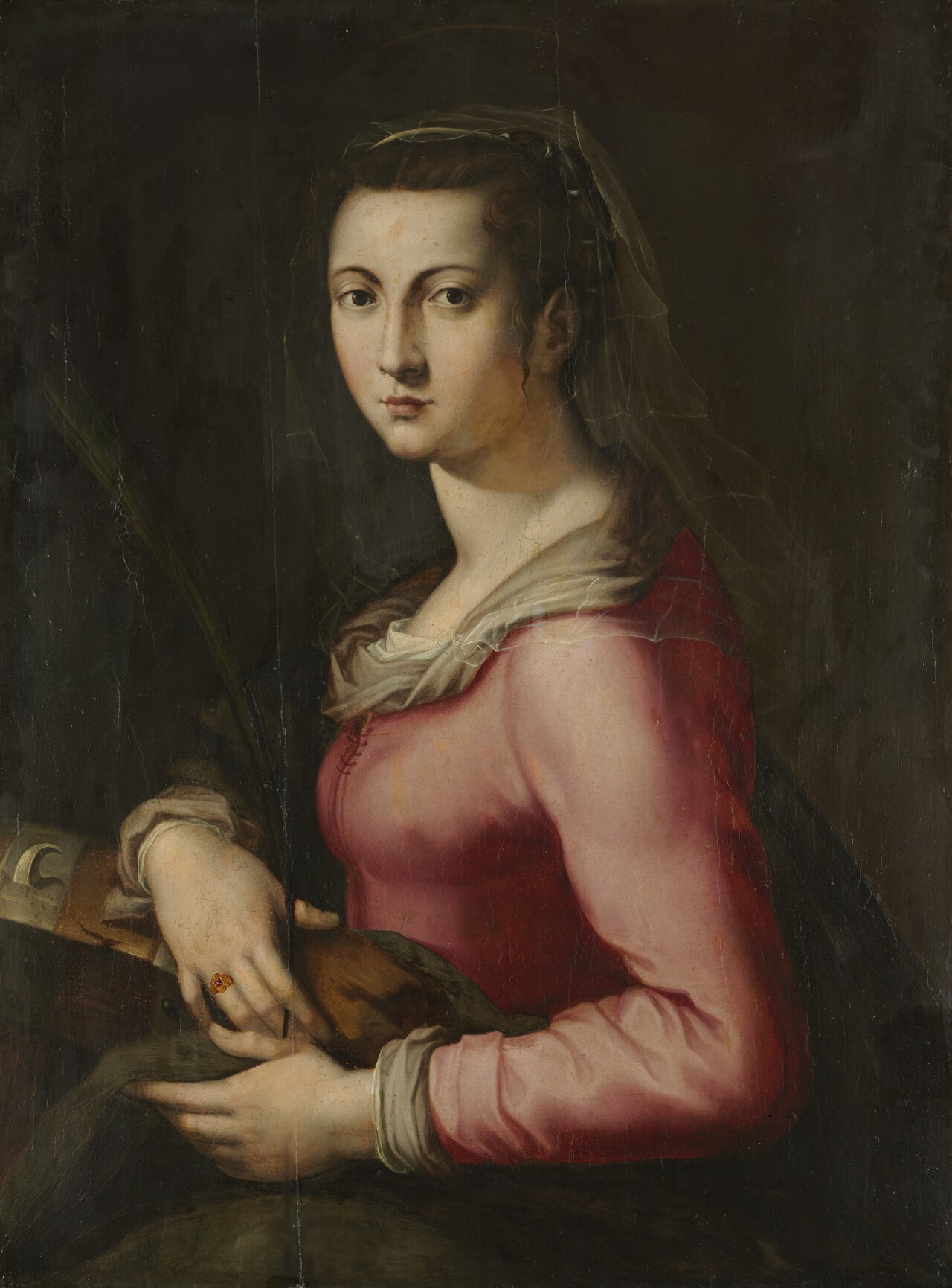
* Portrait of Andrea del Sarto (1525) – This early portrait, executed while Foschi was still a young apprentice, offers a respectful rendering of his master. The composition places del Sarto in a modest interior, his gaze directed toward the viewer, signalling both admiration and the apprentice’s ambition. * Portrait of a Lady (1530) – Dated to the early phase of Foschi’s independent career, this portrait presents a seated noblewoman in a richly embroidered mantle. The work exemplifies his transition from the balanced realism of his training to the more stylised elegance of Mannerist portraiture. * Portrait of a Woman (1550) – This later portrait shows a mature Foschi, now comfortable with the conventions of courtly representation. The sitter’s delicate features are rendered with a soft modelling, while the background recedes into a muted, atmospheric haze. * Madonna with Child and Saint John the Baptist (1560) – One of his major religious commissions, this altarpiece demonstrates Foschi’s ability to blend devotional narrative with his refined portrait style. The figures are arranged in a harmonious triangle, the Madonna’s serene expression echoing the calm dignity of his secular portraits. * Portrait of a Woman as Saint Catherine (1560) – Combining portraiture with saintly iconography, this work illustrates Foscher’s skill in integrating symbolic attributes—here, the wheel of Saint Catherine—into a realistic likeness. The painting’s cool palette and luminous skin tones are characteristic of his late period.
In addition to these individual pieces, Foschi executed three altarpieces for the church of Santo Spirito in Florence between 1540 and 1545: an Immaculate Conception, a Resurrection, and a Transfiguration. Although the individual panels have been dispersed, documentation confirms his involvement in these major commissions, further cementing his reputation as a versatile painter capable of handling both private portraiture and large‑scale religious narratives.
Influence and legacy Foschi’s contribution to Florentine art lies in his synthesis of High Renaissance naturalism with the emerging Mannerist aesthetic. By maintaining a high level of technical finish while embracing the elegant elongation of form, he provided a bridge between the balanced classicism of del Sarto and the more experimental approaches of later Mannerists. His workshop trained a number of younger painters, the most notable being Alessandro Fei (known as ‘Il Barbiere’), who would go on to become a prominent court painter in Florence. Foschi’s portraits continued to be admired for their psychological depth and refined execution, influencing the visual language of Florentine aristocratic portraiture well into the late sixteenth century. Today, his works are studied for their role in the transition from Renaissance to Mannerist styles, and they remain a testament to the vibrant artistic environment of mid‑sixteenth‑century Florence.
Frequently asked questions
Who was Pier Francesco Foschi?
Pier Francesco Foschi (1502–1567) was a Florentine painter who worked in a Mannerist style, trained under Andrea del Sarto and later assisted Pontormo.
What style or movement is Foschi associated with?
He is associated with the Florentine Mannerist movement, blending High Renaissance naturalism with the elegant elongation and polished surface typical of Mannerism.
What are his most famous works?
His most recognised pieces include the Portrait of Andrea del Sarto (1525), Portrait of a Lady (1530), Portrait of a Woman (1550), Madonna with Child and Saint John the Baptist (1560) and Portrait of a Woman as Saint Catherine (1560).
Why is Foschi important in art history?
Foschi bridged the transition from Renaissance classicism to Mannerist elegance, influencing later Florentine artists such as Alessandro Fei and shaping the city’s portrait tradition.
How can I recognise a painting by Foschi?
Look for a smooth, enamel‑like finish, cool‑warm colour contrasts, refined modelling of faces, and a graceful, slightly elongated composition that combines realistic detail with an elegant, idealised presentation.