Philippe-Jacques van Bree
1786 – 1871
In short
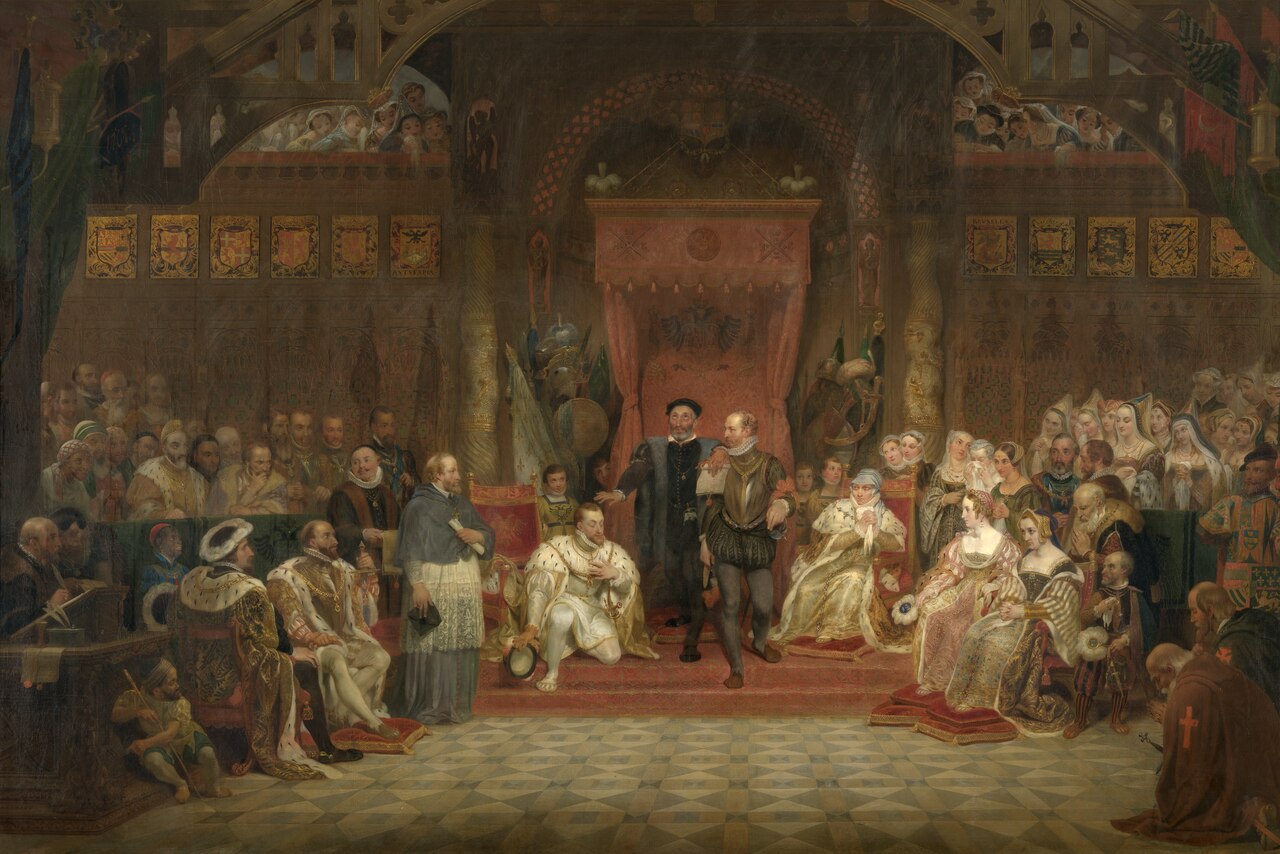
Philippe-Jacques van Bree (1786–1871) was a Belgian painter from Antwerp, known for his historical and genre scenes such as the 1824 'Abdiction of Charles V', and for his scholarly engagement with the work of his brother Mattheus van Bree.
Notable works
.jpg)


Early life Philippe-Jacques van Bree was born in Antwerp in 1786, a period when the Southern Netherlands were undergoing political and cultural change. He grew up in an artistic family; his brother Mattheus van Bree would later become a noted painter, and Philippe-Jacques served as a close scholar and chronicler of his brother's oeuvre. Little is recorded about his formal education, but the artistic climate of Antwerp—home to the Royal Academy of Fine Arts and a thriving guild system—provided ample opportunity for a young artist to acquire foundational training in drawing, composition, and the techniques of oil painting. The city’s rich collections of Flemish masters and its vibrant market for historical and genre painting would shape his early aesthetic sensibilities.
Career and style Van Bree’s professional career unfolded during a transformative era for Belgian art. After the Belgian Revolution of 1830, a new national identity encouraged artists to explore both local history and broader European themes. Van Bree embraced this climate, producing works that combined a scholarly interest in historical narrative with a careful observation of contemporary life. His style can be described as academically grounded, reflecting the influence of the French neoclassical tradition while retaining a subtle Flemish colour palette. He favoured clear outlines, balanced compositions, and a restrained use of chiaroscuro, allowing the narrative content of his paintings to remain front and centre.
Signature techniques Although not associated with a specific avant‑garde movement, van Bree developed a set of technical hallmarks that distinguish his hand. He often employed a layered glazing technique, building thin, translucent oil layers over a well‑prepared underpainting to achieve depth and luminosity. His brushwork is generally tight in the rendering of architectural elements—such as columns, arches, and interior spaces—while allowing a looser, more expressive touch in the depiction of fabrics and skin tones. Van Bree also paid particular attention to the accurate rendering of period costume and insignia, a practice that reinforced the historical credibility of his subjects.
Major works Among van Bree’s extant oeuvre, several paintings stand out for their historical significance and compositional skill.
* Abdication of Charles V (1824). This large‑scale history painting captures the moment Emperor Charles V relinquishes his imperial authority. Van Bree situates the scene within an opulent interior, using a restrained colour scheme of muted reds and earth tones. The composition is anchored by the solemn figure of the emperor, whose dignified posture contrasts with the emotive gestures of surrounding courtiers. The work reflects van Bree’s interest in political themes and his ability to convey narrative tension through subtle facial expression.
* Child’s Head. A more intimate study, this portrait focuses on the delicate rendering of a young child’s visage. Van Bree applies his characteristic glazing technique to achieve a soft, luminous skin quality, while the background remains muted, directing attention to the subject’s expressive eyes. The piece exemplifies his skill in portraiture, balancing realism with a gentle idealisation.
* Interior of the Studio of Van Dael and his students at the Sorbonne (1816). In this composition, van Bree documents the bustling environment of a Parisian studio, capturing both the architectural space and the activity of artists at work. The painting functions as both a genre scene and a visual record of artistic practice, illustrating van Bree’s keen observational eye. A replica of this work, also dated 1816, demonstrates his practice of reproducing significant compositions for broader dissemination.
* The Youth of future Pope Sixtus V (1832). Here van Bree portrays a young Alessandro Farnese, who would later become Pope Sixtus V, in a contemplative pose. The painting combines religious iconography with a secular portraiture approach, highlighting the subject’s intellectual promise. Van Bree’s careful rendering of period dress and the inclusion of symbolic objects—such as a book and a crucifix—underscores his meticulous approach to historical detail.
These works collectively reveal van Bree’s preoccupation with historical narrative, his respect for academic conventions, and his capacity to render both grand public events and private moments with equal care.
Influence and legacy Philippe-Jacques van Bree did not found a distinct artistic movement, but his contributions remain valuable for several reasons. First, his paintings provide visual documentation of early nineteenth‑century Belgian and European historical consciousness, offering scholars insight into how political and religious themes were visualised in the post‑Napoleonic era. Second, his meticulous approach to costume and interior detail serves as a reference point for later Belgian artists who sought historical authenticity. Finally, his role as a scholar of his brother Mattheus ensures that the broader van Bree family legacy is preserved within art historical records. Though his name is less prominent than some of his contemporaries, van Bree’s work continues to be exhibited in regional museums and referenced in studies of Belgian academic painting.
Overall, Philippe-Jacques van Bree exemplifies the diligent, historically‑aware painter‑scholar of the early nineteenth century, bridging the worlds of artistic production and art historical documentation.
Frequently asked questions
Who was Philippe-Jacques van Bree?
Philippe-Jacques van Bree (1786–1871) was a Belgian painter from Antwerp, known for his historical and genre paintings and for his scholarly work on his brother Mattheus van Bree.
What style or movement is he associated with?
He worked in an academically grounded style that combined French neoclassical influences with a restrained Flemish colour palette, rather than belonging to a specific avant‑garde movement.
What are his most famous works?
His most cited paintings include the 'Abdiction of Charles V' (1824), the portrait 'Child's Head', 'Interior of the Studio of Van Dael and his students at the Sorbonne' (1816), and 'The Youth of future Pope Sixtus V' (1832).
Why does he matter in art history?
Van Bree provides valuable visual documentation of early‑19th‑century historical themes and exemplifies the scholarly painter who combined artistic production with careful historical research.
How can I recognise a Philippe-Jacques van Bree painting?
Look for tightly rendered architectural elements, a layered glazing technique that creates luminous skin tones, and meticulous attention to period costume and interior detail.