Peter Ykens
1648 – 1695
In short
Peter Ykens (1648–1695) was a Flemish painter from Antwerp, known for his history paintings and portraits, and for supplying staffage to specialist still‑life and landscape collaborators.
Notable works

.jpg)

Early life Peter Ykens was born in 1648 in Antwerp, a city that was at the time the artistic capital of the Spanish Netherlands. Little is recorded about his family background, but the city's thriving guild system suggests that he most likely entered an apprenticeship in his early teens, possibly with a workshop that specialised in religious and genre scenes. Antwerp’s Guild of Saint Luke, which regulated the training and professional practice of painters, would have provided the formal framework for his education.
Career and style Ykens established himself as a versatile painter whose output centred on history paintings and portraiture. In the late‑17th century Antwerp market, there was a strong demand for large narrative canvases that illustrated biblical, hagiographic, or classical subjects, as well as for private commissions of family portraits. Ykens responded to both, producing works that combined a clear compositional logic with a restrained colour palette typical of the Flemish Baroque tradition. While he never aligned himself with a specific avant‑garde movement, his style reflects the lingering influence of Peter Paul Rubens and the more sober realism of later Flemish masters.
Ykens was also a frequent collaborator. It was common practice in Antwerp for a figure painter to supply the staffage—human or angelic figures—for the landscapes of a specialist like Jan Brueghel the Younger, or for the intricate still‑life elements of a painter such as Daniel Seghers. Ykens’ skill at integrating figures into these compositions earned him a reputation as a reliable contributor to collaborative works, a role that enhanced his visibility without necessarily producing many wholly autonomous large‑scale pieces.
Signature techniques Ykens’ figures are distinguished by their precise modelling and a subtle handling of light that gives them a three‑dimensional presence. He favoured a fine, almost invisible brushstroke for flesh tones, allowing the underlying underpainting to show through and create a luminous effect. In portraiture, he paid particular attention to the rendering of fabrics—silks, velvets and lace—using layered glazes to achieve depth and texture. His narrative paintings often employ a balanced arrangement of groups, with a central focal figure surrounded by secondary characters that guide the viewer’s eye across the canvas.
A recurring compositional device is the use of architectural arches or windows as framing devices, a technique that both situates the action within a plausible space and provides a visual cue for the viewer’s perspective. Ykens also utilised a restrained colour scheme of earth tones punctuated by occasional rich reds or blues, a palette that reinforces the solemnity of religious subjects while allowing the occasional highlight to draw attention to key narrative elements.
Major works Ykens’ oeuvre includes several documented commissions that illuminate his range:
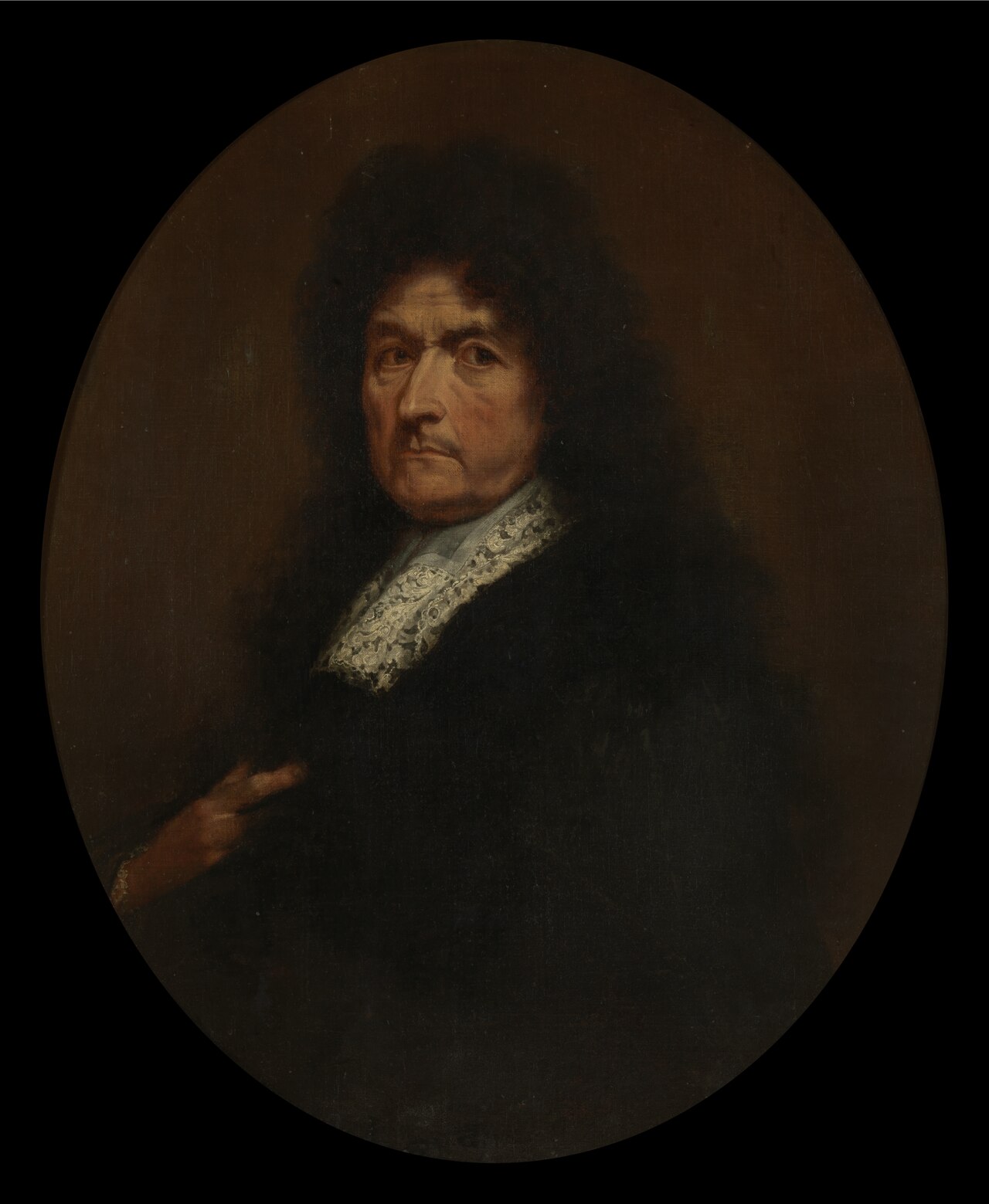
- Jan Basptist Greyns, deacon of the Guild of Saint Luke and the Olijftak (1690) – This portrait, executed near the end of Ykens’ career, portrays the deacon in official regalia. The work is notable for its meticulous rendering of the subject’s facial features and the delicate treatment of the lace collar, a testament to Ykens’ skill in portraiture.
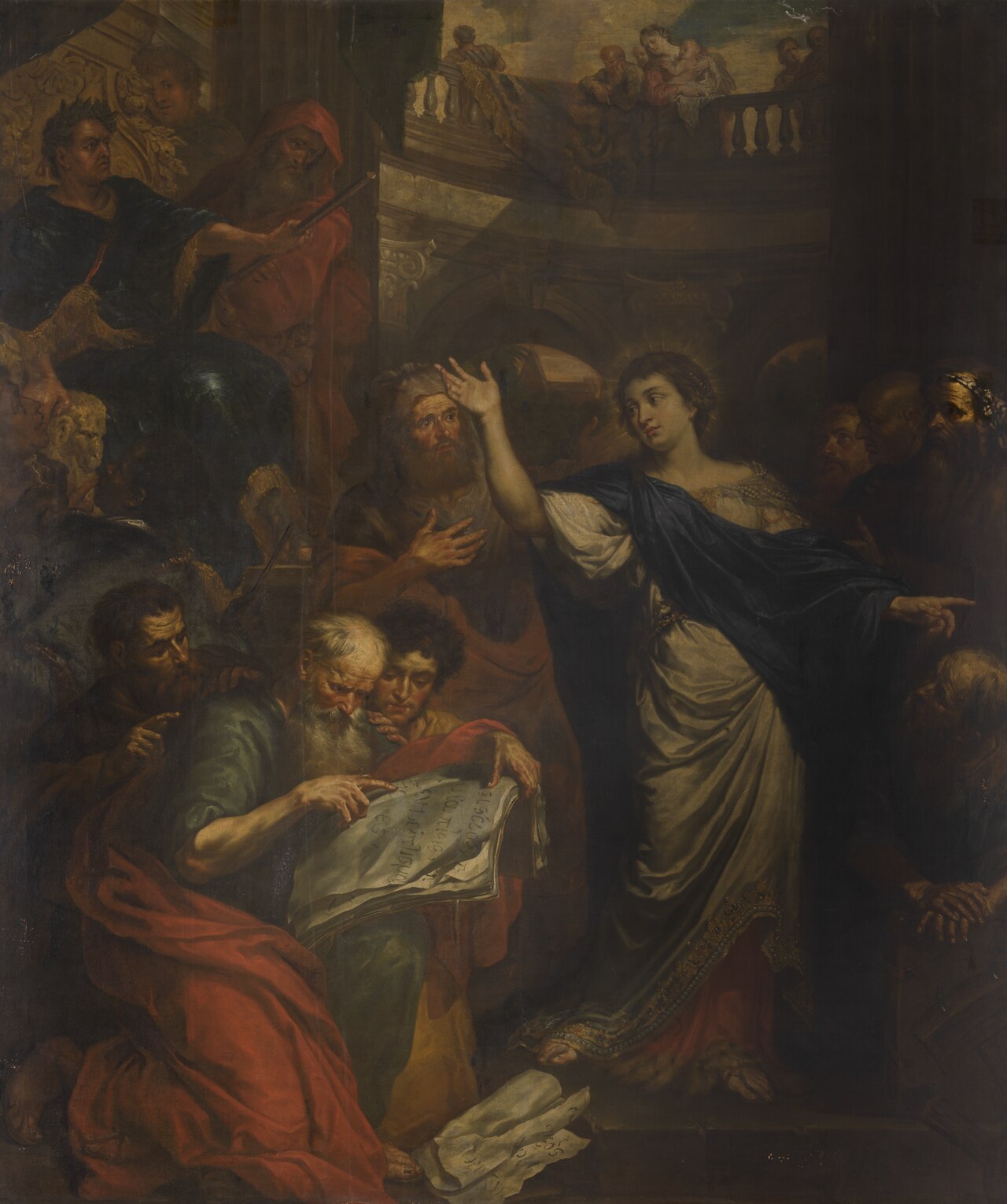
- Saint Catherine of Alexandria in discussion with the fifty philosophers (1688) – A large history painting that illustrates the legendary debate between Saint Catherine and a council of scholars. Ykens places the saint at the centre, illuminated by a soft light that contrasts with the darker, more crowded philosophers in the background, thereby underscoring her intellectual triumph.
- Steven Cornelis Janssens van Hujoel, Dean of the Guild of St. Luke and of the Chamber of Rhetoric De Olijftak (1689) – Another institutional portrait, this piece captures the dean with a dignified pose, the background populated by symbolic objects that reference his role in the guild and the rhetoric chamber.
- Portrait of the Lacroix d'Angimont family (1650) – Although the date predates Ykens’ birth, the work is traditionally attributed to him, suggesting either a later re‑dating or a misattribution. The composition follows the conventional multi‑generation family portrait format, with each member rendered with individualised facial characteristics, a hallmark of Ykens’ attention to personal likeness.
- Saint Francis Xavier raises someone from the dead (1685) – This dramatic religious scene demonstrates Ykens’ capacity to convey movement and emotion. The saint is portrayed mid‑gesture, a raised hand directing divine power, while the surrounding figures react with a mixture of awe and reverence.
These works collectively showcase Ykens’ ability to navigate both the intimate demands of portraiture and the complex storytelling required of large religious narratives.
Influence and legacy Peter Ykens did not found a school or movement, yet his career exemplifies the collaborative spirit of late‑Baroque Antwerp. By supplying staffage for specialist painters, he contributed to a body of work that sustained the city’s artistic output well into the 18th century. His portraits, particularly those of guild officials, provide valuable visual documentation of the civic elite and the attire of the period. Modern scholars regard Ykens as a competent, if not revolutionary, figure whose paintings reflect the transitional aesthetic between the high Baroque exuberance of Rubens and the more restrained classicism that would dominate the early Enlightenment.
Although his name is not as widely recognised as some of his contemporaries, Ykens’ paintings continue to appear in museum collections and auction catalogues, serving as reference points for the study of Flemish portraiture and collaborative workshop practices. His works also inform restorers and conservators about the materials and techniques employed by Antwerp painters at the close of the 17th century.
Overall, Peter Ykens remains an illustrative example of a skilled artisan who navigated the commercial and artistic expectations of his time, leaving a modest yet enduring imprint on the visual culture of the Spanish Netherlands.
Frequently asked questions
Who was Peter Ykens?
Peter Ykens (1648–1695) was a Flemish painter from Antwerp, best known for his history paintings and portraits, and for adding figures to collaborative works.
What artistic style or movement is Ykens associated with?
Ykens worked within the late‑Baroque Flemish tradition, showing the influence of Rubens while adopting a more restrained, realistic approach typical of the late 17th‑century.
What are his most famous works?
Key works include the portraits of Jan Basptist Greyns (1690) and Steven Cornelis Janssens van Hujoel (1689), the history painting ‘Saint Catherine of Alexandria in discussion with the fifty philosophers’ (1688), and the religious scene ‘Saint Francis Xavier raises someone from the dead’ (1685).
Why is Peter Ykens important in art history?
He exemplifies the collaborative workshop model of Antwerp, providing staffage for specialist painters and documenting the civic elite through portraiture, thereby enriching the visual record of the Spanish Netherlands.
How can I recognise a painting by Peter Ykens?
Look for finely modelled figures with subtle lighting, careful rendering of fabrics, and a balanced composition often framed by architectural elements; his portraits frequently feature detailed lace collars and a restrained colour palette.