Abraham Brueghel
1631 – 1690
In short
Abraham Brueghel (1631–1690) was a Flemish Baroque painter from the renowned Brueghel family who settled in Italy, becoming a leading figure in decorative still‑life painting in Naples.
Notable works




Early life Abraham Brueghel was born in 1631 in Antwerp, the artistic hub of the Spanish Netherlands. He was a member of the celebrated Brueghel dynasty, a lineage that included Pieter Bruegel the Elder and Jan Brueghel the Elder. Growing up in a household saturated with artistic practice, Abraham received his initial training within the family workshop, where he absorbed the Flemish traditions of meticulous observation and a keen interest in natural subjects. The Brueghel workshop was known for its collaborative approach, and young Abraham would have assisted senior relatives on commissions, gaining a solid grounding in composition, colour, and the handling of oil paint.
Career and style In his early twenties, Abraham moved to Italy, a common destination for Northern artists seeking new patrons and artistic influences. He settled in Naples, a city flourishing under Spanish rule and a centre for Baroque patronage. There, he joined a network of painters who were adapting the lavish, dramatic aesthetics of the Italian Baroque to the still‑life genre. Brueghel’s work merged the Flemish attention to detail with the Italian taste for theatrical lighting, rich colour palettes, and elaborate ornamentation. His canvases often combine fruit, flowers, and sometimes small figures in compositions that balance naturalistic observation with a decorative, almost theatrical, sensibility. Throughout his career he maintained a consistent focus on the sensual qualities of fruit and flora, employing a luminous palette that accentuated the translucency of skins and petals.
Signature techniques Abraham Brueghel distinguished himself through several technical approaches. He applied a layered glazing technique, building thin, transparent layers of oil to achieve depth and a subtle glow in the rendered surfaces. This method allowed the colours of fruit and blossoms to appear saturated yet nuanced, capturing the play of light on their skins. His compositions frequently employ a diagonal or pyramidal arrangement, guiding the viewer’s eye across the canvas and creating a sense of movement. Brueghel also incorporated finely rendered background elements—often a muted landscape or architectural motif—that provide contextual depth without detracting from the central still‑life subjects. The contrast between the vivid foreground and the softer, atmospheric background is a hallmark of his decorative Baroque style.
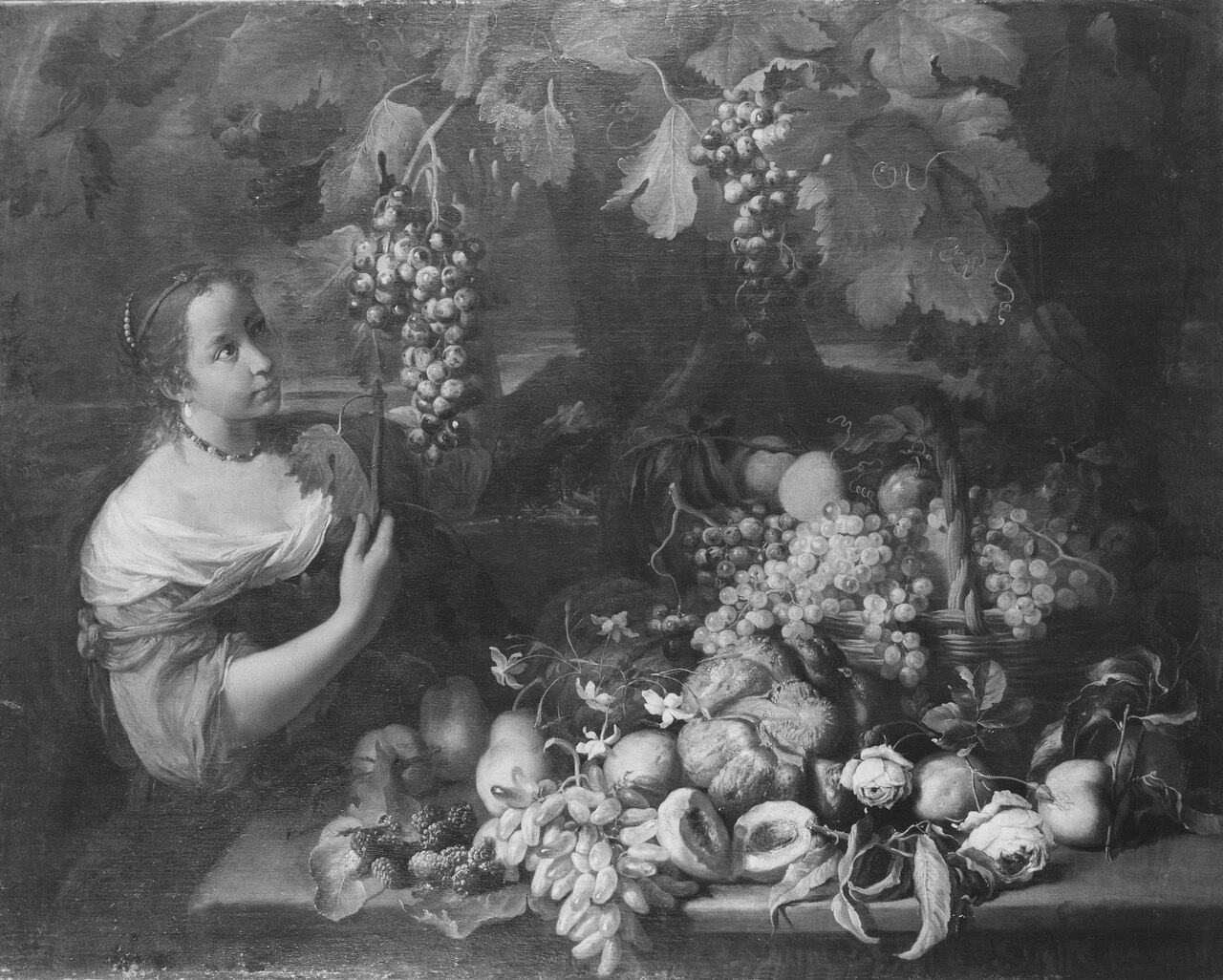
Major works Among Brueghel’s documented oeuvre, several works illustrate his mature style. **"Woman Grasping Fruits" (1669)** presents a partially clothed figure delicately holding a cluster of ripe fruit, juxtaposing the human form with the lush produce to highlight both sensuality and abundance. In **"Still life with fruit" (1670)**, a luxuriant arrangement of peaches, grapes, and citrus rests on a richly draped table, the composition punctuated by a subtle play of light that emphasises the translucency of the skins. **"Girl with Grapes and Still Life with Fruit"** combines a genre scene of a young girl with a secondary still‑life panel, demonstrating Brueghel’s skill in integrating narrative elements with his primary focus on fruit. The earlier **"Pomegranates and Other Fruit in a Landscape" (1650)** showcases his capacity to embed still‑life subjects within a broader landscape, a practice that foreshadows the decorative integration that would become a signature of his Neapolitan period. Finally, **"Fruit and flowers" (1675)** exemplifies his later work, where an exuberant bouquet of blossoms surrounds a meticulously rendered fruit arrangement, the composition balanced by a delicate chiaroscuro that heightens the three‑dimensional effect.
Influence and legacy Abraham Brueghel’s relocation to Italy contributed significantly to the diffusion of Flemish still‑life techniques across the Mediterranean. In Naples he worked alongside local artists, influencing a generation of painters who adopted his lush colour schemes and decorative compositional strategies. His paintings helped to cement the still‑life as a respected genre within the Baroque hierarchy of subjects, demonstrating that inanimate objects could be rendered with the same theatrical drama as historical or religious scenes. Though his name is sometimes eclipsed by his more famous relatives, Brueghel’s works remain valuable exemplars of cross‑cultural artistic exchange in the 17th century. Contemporary scholars regard his oeuvre as a vital link between Northern European naturalism and Southern Italian ornamental exuberance, and his paintings continue to be displayed in major European collections, underscoring his lasting contribution to Baroque art.
Frequently asked questions
Who was Abraham Brueghel?
Abraham Brueghel (1631–1690) was a Flemish Baroque painter from the Brueghel family who spent most of his career in Naples, Italy, where he became known for decorative still‑life paintings.
What artistic movement or style is he associated with?
He worked within the Baroque movement, blending Flemish naturalism with the Italian Baroque’s dramatic lighting and ornamental richness.
What are his most famous works?
Key works include "Woman Grasping Fruits" (1669), "Still life with fruit" (1670), "Girl with Grapes and Still Life with Fruit", "Pomegranates and Other Fruit in a Landscape" (1650) and "Fruit and flowers" (1675).
Why is Abraham Brueghel important in art history?
He played a pivotal role in introducing Flemish still‑life techniques to Southern Italy, influencing Neapolitan painters and helping to elevate the still‑life genre within the Baroque hierarchy.
How can I recognise an Abraham Brueghel painting?
Look for vibrant, glazed colours, a decorative composition that often combines fruit or flowers with a soft landscape background, and a luminous chiaroscuro that gives the objects a three‑dimensional, tactile quality.