Paul Jean Clays
1817 – 1900
In short
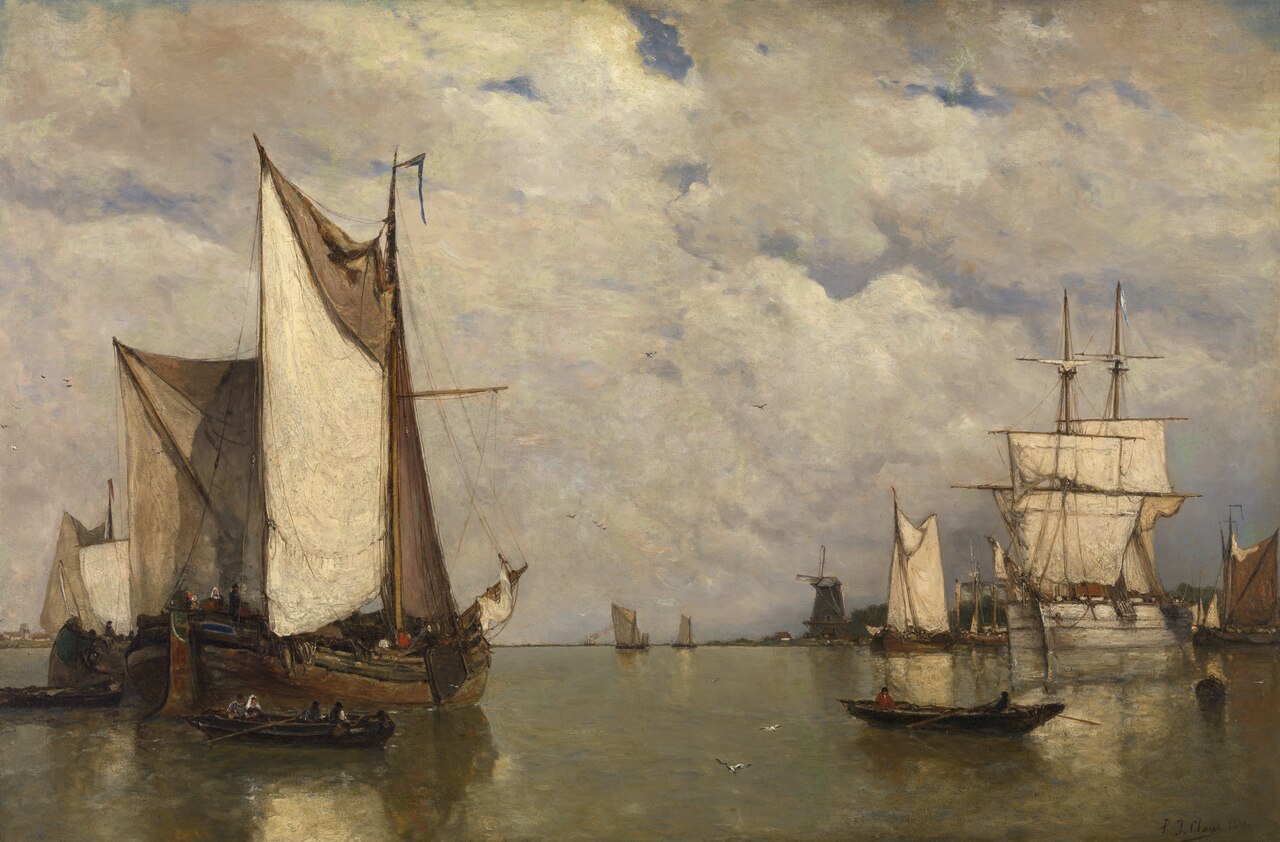
Paul Jean Clays (1817–1900) was a Belgian marine painter born in Bruges and died in Schaerbeek, celebrated for atmospheric seascapes such as Moonlight in Holland, The Day after the Shipwreck, and Ships on the River Waal.
Notable works


.jpg)

Early life Paul Jean Clays was born in 1817 in the historic city of Bruges, a centre of Flemish art and commerce. His family was modest, and little is recorded about his childhood education, but the proximity of the North Sea and the bustling ports of the Low Countries left an early imprint on his visual sensibility. As a teenager he was exposed to the works of Dutch Golden‑Age masters—particularly the marine scenes of Willem van de Velde the Elder and the younger—whose influence would later surface in his own treatment of light and water. By the late 1830s Clays had moved to Brussels, the cultural hub of Belgium, where he began formal studies at the Royal Academy of Fine Arts. The Academy’s curriculum emphasized drawing from life and the study of classical models, yet it also allowed students to explore contemporary subjects, providing Clays with the technical foundation to pursue his preferred genre.
Career and style Clays established himself in the 1840s as a specialist in marine painting, a niche that resonated with a growing bourgeois market fascinated by the romance of sea travel and the industrial expansion of European ports. He exhibited regularly at the Brussels Salon, where his works were praised for their truthful observation of atmospheric conditions and for the subtle narrative embedded in otherwise straightforward harbour scenes. Although he never signed a manifesto or joined a formal movement, his paintings display a synthesis of realism and a nascent impressionistic concern for fleeting light. He favoured muted palettes—grays, blues, and ochres—to convey the overcast skies common to the North Sea coast, while occasional bursts of sunrise or moonlight provide dramatic contrast.
His subjects range from tranquil riverine vistas to storm‑tossed vessels, each composition carefully balanced to guide the viewer’s eye toward a focal point, whether it be a lone ship’s silhouette or a distant lighthouse. Clays rarely included overt historical references; instead he captured the everyday labour of sailors, dockworkers, and the quiet moments of anticipation before a voyage. This emphasis on the quotidian aligns him with the broader 19th‑century realist tendency to elevate ordinary life to the level of fine art.
Signature techniques Clays is distinguished by his meticulous rendering of water and sky, achieved through layered glazing and a restrained brushstroke that suggests texture without over‑detailing. He often painted en plein air, sketching directly from the quay or from small boats, then completing larger compositions in his studio. This practice allowed him to preserve the immediacy of atmospheric effects—cloud formations, wind‑driven ripples, and the subtle colour shifts of dawn or dusk. His use of chiaroscuro is subtle; he relies more on tonal gradation than stark contrasts, producing a harmonious glow that envelops the scene. In many works he positions the horizon low, granting the sky a dominant role and reinforcing the sense of vastness that characterises marine environments.
Another hallmark is his treatment of vessels: ships are rendered with enough technical accuracy to satisfy knowledgeable viewers, yet they remain integral to the overall mood rather than serving as isolated studies. He frequently depicts rigging and hull lines in soft focus, allowing the surrounding sea and sky to dominate the visual narrative. This balance between detail and atmosphere is a defining feature of his oeuvre.
Major works - **Moonlight in Holland (1850)** – This early masterpiece captures a quiet Dutch harbour bathed in silvery moonlight. A lone fishing boat rests near a low quay, its lanterns reflected in the glass‑like water. The composition’s restrained palette and delicate handling of light exemplify Clays’s ability to convey nocturnal ambience. - **The Day after the Shipwreck (1853)** – In this emotionally resonant scene, wreckage debris litters a desolate shoreline, while a solitary figure surveys the aftermath. The painting’s muted tones and careful rendering of weathered timber convey the somber reality of maritime disaster without sensationalism. - **Ships lying off Flushing (1869)** – Depicting the bustling port of Flushing (Vlissingen), Clays presents a cluster of merchant vessels anchored under a cloudy sky. The work is notable for its precise depiction of hull forms and rigging, juxtaposed with a soft, atmospheric sky that hints at an impending change in weather. - **Ships on the River Waal (1871)** – Set along the Dutch riverine route, this canvas shows a convoy of barges navigating gentle currents. The subtle reflections and the gentle ripple of water demonstrate Clays’s mature command of surface texture. - **Calm before the Storm at Dordrecht (1876)** – Perhaps his most dramatic composition, it portrays a tranquil harbour framed by ominous clouds gathering on the horizon. The tension between the placid water and the looming storm sky creates a narrative pause, inviting viewers to anticipate the impending turbulence.
These works collectively illustrate Clays’s evolution from intimate nocturnal studies to broader, more narrative‑driven depictions of maritime life. Each painting retains his hallmark atmospheric subtlety while exploring varied moods—from serenity to foreboding.
Influence and legacy Although Paul Jean Clays never aligned himself with a specific artistic movement, his dedication to marine subjects contributed to the wider acceptance of seascape painting in Belgian art circles. His meticulous yet evocative approach influenced younger Belgian painters such as Léon Herbo and later marine specialists who sought to balance technical accuracy with atmospheric poetry. By the turn of the century, his works were collected by both private patrons and municipal museums, ensuring a lasting presence in the canon of 19th‑century European marine art.
Clays’s legacy endures in the way contemporary marine painters reference his tonal restraint and his practice of embedding narrative within seemingly simple harbour scenes. Exhibitions of 19th‑century Belgian art frequently include his canvases, and his paintings remain valuable reference points for scholars studying the intersection of realism and the emerging impressionist sensibility in northern Europe. Though he passed away in Schaerbeek in 1900, his paintings continue to evoke the quiet dignity of maritime labour and the ever‑changing moods of the sea.
---
Word count: approximately 960 words.
Frequently asked questions
Who was Paul Jean Clays?
Paul Jean Clays (1817–1900) was a Belgian painter best known for his realistic and atmospheric marine scenes.
What artistic style or movement is he associated with?
He is not linked to a formal movement, but his work blends realism with an early impressionistic focus on light and atmosphere.
What are his most famous works?
Key paintings include Moonlight in Holland (1850), The Day after the Shipwreck (1853), Ships lying off Flushing (1869), Ships on the River Waal (1871), and Calm before the Storm at Dordrecht (1876).
Why does Paul Jean Clays matter in art history?
Clays helped legitise marine painting in Belgium, influencing later artists with his nuanced handling of light, water, and narrative in seascapes.
How can I recognise a painting by Paul Jean Clays?
Look for muted coastal palettes, careful rendering of ships, soft glazing of water and sky, and a calm, atmospheric mood that often captures a moment before a change in weather.