Parri Spinelli
1387 – 1453
In short
Parri Spinelli (1387–1453) was a Tuscan painter of the early Renaissance, trained by his father Spinello Aretino and later in Lorenzo Ghiberti’s Florentine workshop. He returned to Arezzo as its leading artist, known for bold colours and elongated figures, and produced works such as the Hercules Leaning on His Club and several Navicella copies.
Notable works

![Hercules Leaning on His Club [recto] by Parri Spinelli](https://commons.wikimedia.org/wiki/File:Parri_Spinelli,_Hercules_Leaning_on_His_Club_(recto),_c._1440,_NGA_60788.jpg)
![Gothic Vault [verso] by Parri Spinelli](https://commons.wikimedia.org/wiki/File:Parri_Spinelli,_Gothic_Vault_(verso),_c._1440,_NGA_60789.jpg)
Early life Parri Spinelli was born in 1387 in the province of Arezzo, a town in the Tuscan region of Italy. He was the son of the noted painter Spinello Aretino, who also served as his first instructor. Growing up in a workshop environment, Spinelli absorbed the traditions of late Gothic painting while being exposed to the emerging naturalism of early Renaissance art. His formative years were spent under his father's guidance, where he learned to handle tempera and to execute narrative scenes with a strong emphasis on colour.
Career and style Around 1411 or 1412, Spinelli moved to Florence, the artistic capital of Italy, where he joined the workshop of the celebrated goldsmith and sculptor Lorenzo Ghiberti. During his seven‑year stay in Florence, he was exposed to the innovative approaches of contemporary painters such as Masaccio and the early works of Fra Angelico. Although primarily a painter, his time in Ghiberti’s workshop gave him insight into the emerging techniques of linear perspective and the use of architectural framing.
After returning to Arezzo circa 1419, Spinelli quickly established himself as the most important painter in the city. He received commissions for both public and private devotional works, and his studio became a focal point for the training of younger artists in the region. Spinelli’s style reflects a synthesis of his Gothic heritage and the new Renaissance language: he employed vivid, saturated pigments, and his figures are often elongated, conveying a sense of elegance that distinguishes his work from the more solid forms of his predecessors.
Signature techniques Spinelli’s paintings are characterised by several recurring technical traits:
* Bold colour palette – He favoured intense reds, deep blues, and bright greens, applying them in thick, opaque layers that give his surfaces a luminous quality. * Elongated anatomy – Human figures in his compositions display a graceful, stretched proportion, especially in the neck and torso, which creates a heightened sense of movement. * Linear clarity – Even before the full development of linear perspective, Spinelli used clear, strong contours to separate forms, a technique likely inherited from his Florentine experience. * Decorative borders – Many of his panels include intricate ornamental frames, often featuring foliage or heraldic motifs, that echo the decorative sensibility of his father’s workshop. * Copying as study – Several of his surviving works are copies of earlier masterpieces, suggesting that he used replication as a method of learning and disseminating celebrated compositions.
Major works Parri Spinelli’s extant oeuvre is modest, but the surviving pieces illustrate his artistic concerns.
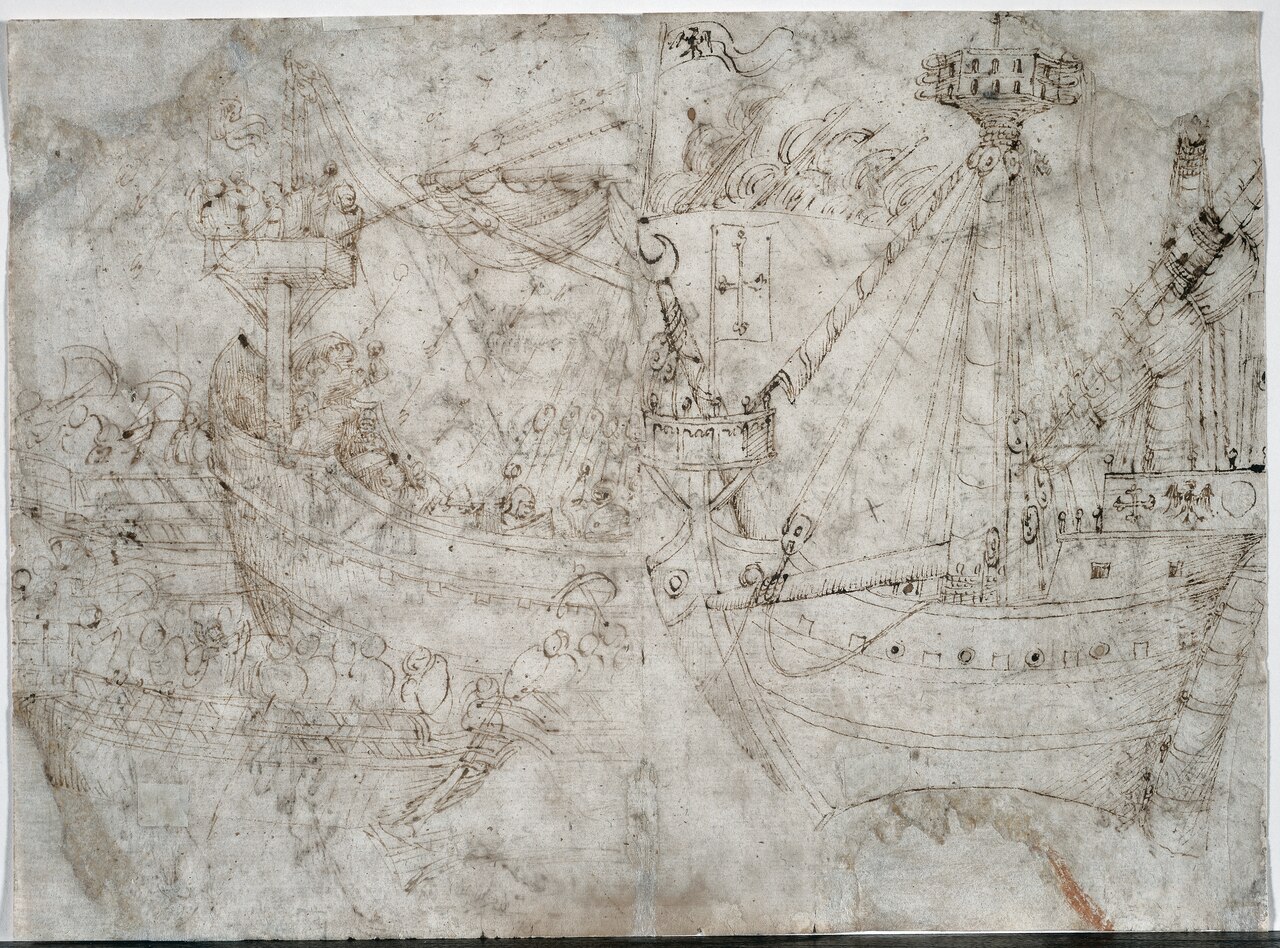
* Free Copy of Giotto’s Navicella (recto) – This panel reproduces Giotto’s famous ship‑scene, allowing Spinelli to engage with the master’s compositional balance. The copy demonstrates his skill in adapting Giotto’s spatial logic while infusing it with his own vivid palette. * Copy of Adam in Masaccio’s Expulsion from the Garden of Eden, and other Figure Studies (verso) (1520) – Although dated 1520, well after Spinelli’s death, scholars believe the panel is a later copy of his study sheets, preserving his approach to modelling the human form. The Adam figure shows the influence of Masaccio’s chiaroscuro, filtered through Spinelli’s elongated style. * Hercules Leaning on His Club (recto) (1440) – This work depicts the mythological hero in a relaxed pose, emphasising muscular tension and a dynamic posture. The bright reds of Hercules’s cloak contrast with a muted background, highlighting Spinelli’s mastery of colour contrast. * Gothic Vault (verso) (1440) – A decorative panel that combines architectural illusion with ornamental detailing. The vault’s arches are rendered with a stylised Gothic vocabulary, yet the use of perspective hints at the transition toward Renaissance spatial concepts. * Navicella (recto) – Another rendition of the ship motif, this piece reinforces Spinelli’s interest in maritime iconography, a subject popular in Arezzo’s civic and religious commissions. The composition is balanced, with a clear horizon line and vibrant sky.
Influence and legacy Parri Spinelli’s impact on the artistic landscape of Arezzo was substantial. By integrating Florentine innovations with local traditions, he set a visual precedent that shaped the city’s painting for the next generation. His workshop trained a number of artists who continued to employ his bold colour schemes and elongated figures, thereby extending his stylistic fingerprint throughout the Tuscan region.
Although he did not achieve the fame of contemporaries such as Masaccio or Fra Angelico, Spinelli’s work offers valuable insight into the transitional period between the Gothic and the early Renaissance in central Italy. Modern scholars regard his panels as important documents of artistic exchange, especially his copies of Giotto and Masaccio, which illustrate how regional painters assimilated and reinterpreted the leading trends of their time.
Spinelli died in 1453 in his native Arezzo, leaving behind a body of work that, while limited in quantity, remains a testament to the vibrant artistic activity of early 15th‑century Tuscany. Contemporary exhibitions and research continue to reassess his contributions, confirming his role as a pivotal figure in the evolution of Italian painting.
---
Frequently asked questions
Who was Parri Spinelli?
Parri Spinelli (1387–1453) was a Tuscan painter of the early Renaissance, trained by his father Spinello Aretino and later by Lorenzo Ghiberti’s Florentine workshop, who became the leading artist in Arezzo.
What style or movement is he associated with?
He worked during the early Renaissance, blending Gothic decorative elements with the new naturalism of the period, noted for bold colours and elongated figures.
What are his most famous works?
Key works include the Hercules Leaning on His Club (1440), the Navicella panels, the Gothic Vault (1440), and his copies of Giotto’s Navicella and Masaccio’s Adam.
Why does Parri Spinelli matter in art history?
Spinelli is important for bridging Gothic and Renaissance styles in Tuscany, influencing local artists and preserving the visual language of early 15th‑century Italian painting.
How can I recognise a Parri Spinelli painting?
Look for vivid, saturated pigments, figures with elongated proportions, strong linear contours, and decorative borders that combine Gothic motifs with early Renaissance compositional balance.