Oscar Begas
1828 – 1883
In short
Oscar Begas (1828–1883) was a Prussian painter best known for his realistic portraits and historical scenes. Working mainly in Berlin, he produced notable works such as a portrait of Crown Prince Frederick William and the allegorical ceiling piece for a Berlin villa.
Notable works
_b_779.jpg)
_-_Frederick_William,_Crown_Prince_of_Prussia_and_later_Emperor_Frederick_III_(1831-1888)_-_RCIN_404016_-_Royal_Collection.jpg)


Early life Oscar Begas was born in 1828 in Berlin, then part of the Kingdom of Prussia. He grew up in a city that was rapidly becoming a centre for artistic training, benefitting from the legacy of the Berlin Academy of Arts. Details of his family background are sparse, but the cultural environment of mid‑19th‑century Berlin provided the foundation for his artistic development. Begas entered the academy as a teenager, where he received formal instruction in drawing, composition and the techniques of oil painting. His early exposure to the works of German masters such as Caspar David Friedrich and the emerging realist tradition shaped his sensibilities and prepared him for a career focused on portraiture and historical subjects.
Career and style By the 1850s Begas began to exhibit regularly at the Berlin Salon, quickly establishing a reputation for meticulous observation and a restrained palette. He aligned himself with the realist movement, which sought to depict contemporary life and notable individuals with fidelity rather than idealisation. In contrast to the Romantic emphasis on dramatic narrative, Begas’s work favoured a sober, almost documentary approach, especially in his portrait commissions. His style combined the academic training of the academy with a keen eye for the psychological presence of his sitters. Throughout his career he balanced official portraiture—often for members of the Prussian royal family—with more personal and historical commissions, allowing him to navigate both the courtly and public art markets.
Signature techniques Begas’s technique was characterised by a precise underdrawing, which he used to control proportion and light before applying layers of thin, translucent glazes. This method produced a subtle modelling of flesh tones and a luminous quality that set his portraits apart from the flatter academic conventions of his contemporaries. He favoured a restrained colour scheme, employing earth tones and muted blues to avoid distraction from the sitter’s features. In larger historical compositions, Begas employed a balanced compositional structure, often arranging figures in a pyramidal or diagonal format to guide the viewer’s eye across the narrative. His brushwork was tight in the rendering of faces and hands, while broader, more fluid strokes were reserved for drapery and background elements, creating a contrast that heightened the realism of the central figures.
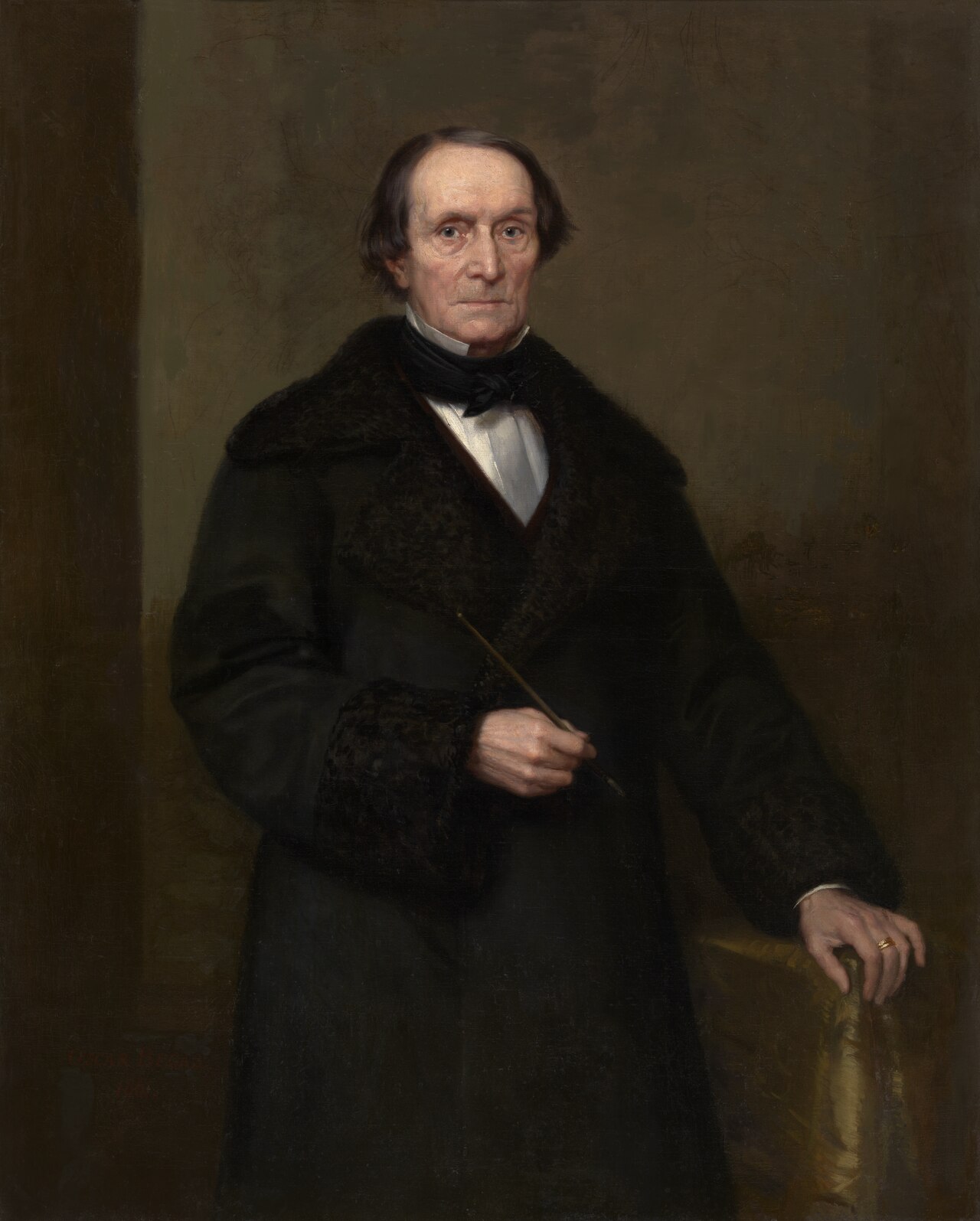
Major works Among Begas’s most celebrated pieces is the 1861 portrait *The Painter Peter von Cornelius*, which captures the celebrated German artist at work. The painting demonstrates Begas’s ability to render both the physical likeness and the intellectual intensity of his subject. In 1867 he received a royal commission to paint *Frederick William, Crown Prince of Prussia and later Emperor Frederick III (1831‑1888)*. This portrait is notable for its dignified representation of the future emperor, with a focus on the crown prince’s thoughtful expression and the subtle play of light on his uniform, underscoring Begas’s skill in court portraiture.
The *Kaisergalerie* (1873) marks a departure from pure portraiture, depicting an interior scene of the imperial gallery with meticulous attention to architectural detail and the surrounding artworks. The work reflects Begas’s capacity to integrate narrative content with a realistic rendering of space. *Young Roman* (1882), one of his later pieces, shows a youthful figure in classical attire, hinting at the artist’s continued interest in historical themes and the idealisation of antiquity within a realist framework.
Perhaps his most public work is the *Allegory of Spring*, a plafond picture that adorned the staircase of a Berlin villa on Tiergartenstraße 27. This ceiling fresco combines allegorical symbolism with Begas’s characteristic realism, rendering mythological figures with a naturalistic texture and a colour palette that harmonises with the architectural setting. The piece demonstrates his versatility, moving beyond portraiture to large‑scale decorative commissions while maintaining his commitment to realistic representation.
Influence and legacy Oscar Begas occupies a respected place in 19th‑century German art history, particularly for his contributions to realistic portraiture in Prussia. His works served as visual documentation of the era’s political elite, offering historians valuable insight into the appearance and self‑presentation of the Prussian royal family. Though he did not found a distinct school, his disciplined approach to drawing and his careful handling of light influenced younger Berlin painters who sought to balance academic training with the emerging realist ethos. Begas’s ceiling work at the Tiergarten villa also prefigured the later integration of realist techniques into decorative arts, bridging the gap between fine painting and interior design. Today, his paintings are held in several German museum collections, and they continue to be referenced in scholarship on Prussian portraiture and the broader European realist movement.
Frequently asked questions
Who was Oscar Begas?
Oscar Begas (1828–1883) was a Prussian painter renowned for his realistic portraits and historical scenes, active primarily in Berlin.
What artistic style or movement is he associated with?
He worked within the realist tradition, favouring accurate, unidealised depictions of his subjects.
What are his most famous works?
Key works include *The Painter Peter von Cornelius* (1861), the royal portrait of Crown Prince Frederick William (1867), *Kaisergalerie* (1873), *Young Roman* (1882) and the ceiling fresco *Allegory of Spring* at a Berlin villa.
Why is Oscar Begas important in art history?
Begas provides a vivid visual record of Prussian society and exemplifies the 19th‑century shift towards realism in portraiture, influencing later German artists.
How can I recognise an Oscar Begas painting?
Look for meticulous underdrawings, a restrained colour palette, precise modelling of faces and hands, and a subtle use of light that gives a lifelike, almost photographic quality to the sitter.