Karl Friedrich Schinkel
1781 – 1841
In short
Karl Friedrich Schinkel (1781–1841) was a Prussian architect, city planner, and painter renowned for his role in shaping Neoclassical and early Gothic Revival architecture in Berlin. His influential designs, including the Bauakademie and Altes Museum, set precedents for modern architecture and left a lasting imprint on European cultural heritage.
Notable works


Early life Karl Friedrich Schinkel was born on 13 March 1781 in the small town of Neuruppin, then part of the Kingdom of Prussia. His father, a merchant, recognised his son's aptitude for drawing and arranged for lessons with local artists. At the age of twelve, Schimmel moved to Berlin to study under the architect Friedrich Gilly, whose early death in 1800 prompted the young Schinkel to continue his training at the Academy of Arts. The rigorous academic environment fostered a deep appreciation for classical antiquity, while exposure to contemporary Romantic ideas sparked an interest in medieval forms. By his late teens, Schinkel was already producing watercolours and architectural sketches that combined precise draftsmanship with an imaginative sense of place.
Career and style In 1805 Schinkel secured a position as a draughtsman in the Prussian Ministry of Public Works, a role that allowed him to travel throughout the kingdom and study historic structures. The experience reinforced his belief that architecture should serve civic purpose while embodying aesthetic ideals. Throughout his career he navigated between the prevailing Neoclassical language—characterised by symmetry, proportion and reference to ancient Greek and Roman models—and an emerging Gothic Revival idiom, which celebrated medieval forms and ornamentation. Schinkel’s style is best described as a disciplined synthesis: his buildings often display the rational geometry of classicism tempered by a restrained use of Gothic motifs, reflecting his conviction that architecture must be both functional and emotionally resonant.
Signature techniques Schinkel’s architectural vocabulary rested on several recurring techniques. First, he employed a clear, modular façade system, using pilasters, columns and entablatures to articulate the structural rhythm of a building. Second, he favoured the use of light and shadow to enhance spatial perception; large windows and skylights were positioned to illuminate interior volumes and accentuate the interplay of forms. Third, his sketches reveal a meticulous approach to proportion, often derived from the golden ratio, which he applied to both monumental public edifices and smaller interior details. In his later works, Schinkel introduced subtle Gothic elements—pointed arches, ribbed vaults and tracery—integrated seamlessly into otherwise classical compositions. This hybridisation became a hallmark of his mature style.
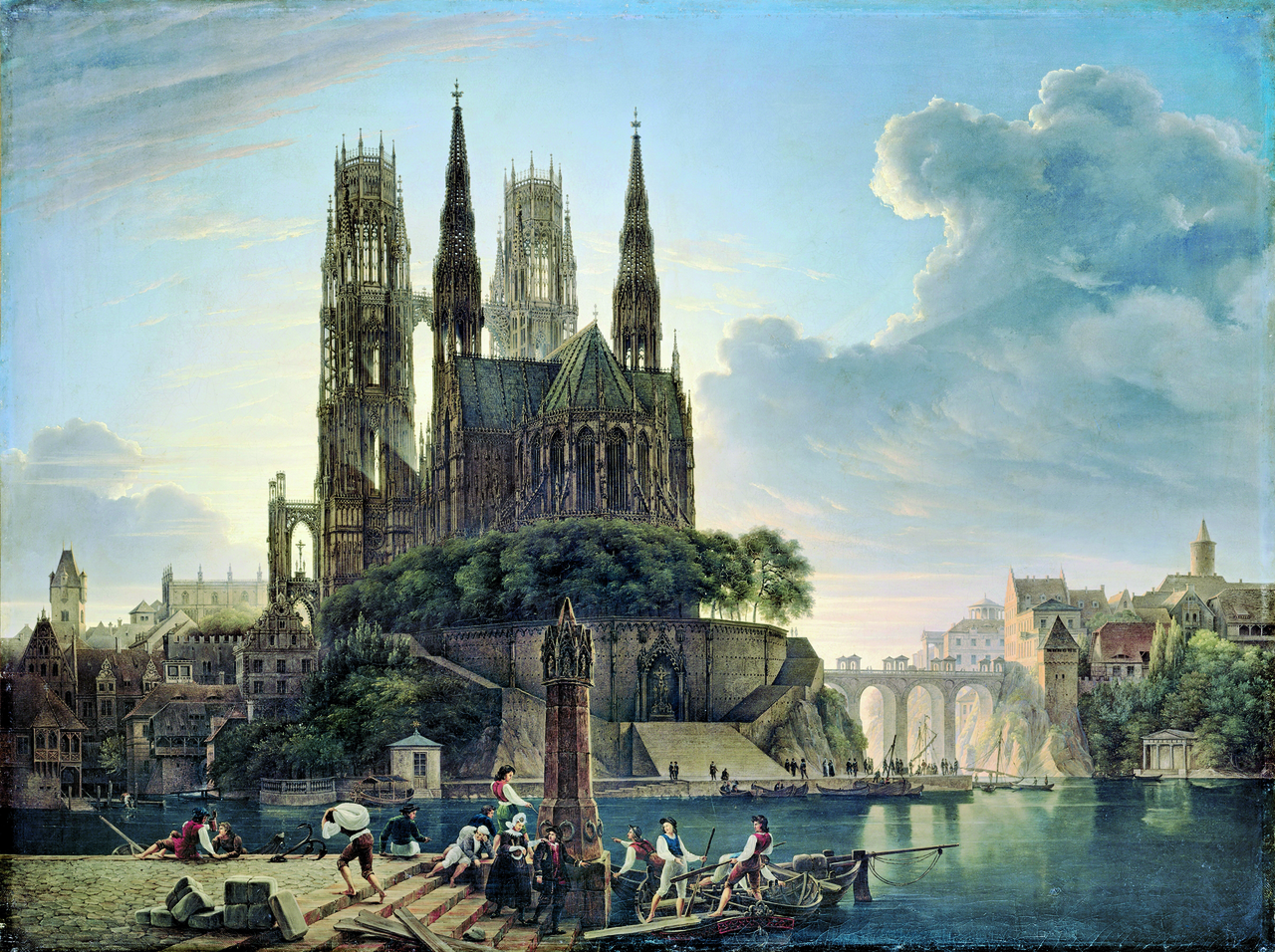
Major works - **Gothic Cathedral by the Water (1813)** – Though never realised as a built structure, this dramatic watercolor depicts a soaring cathedral perched beside a river, its pointed arches and ribbed vaults rendered with a luminous palette. The work exemplifies Schinkel’s fascination with medieval architecture and his skill in translating atmospheric mood onto paper. - **Medieval City on a River (1815)** – Another unbuilt concept, this painting presents a bustling riverside settlement framed by fortified walls and timber‑frame houses. The composition demonstrates Schinkel’s interest in urban planning, illustrating how architecture can shape and reflect civic life. - **View into the Heyday of Greece (1836)** – In this later piece, Schinkel imagines an idealised classical landscape, populated with marble temples and colonnades bathed in golden light. The image underscores his enduring reverence for Greek antiquity and serves as a visual manifesto for the Greek Revival movement. - **Lutherdenkmal** – Completed in 1826, the Luther Monument in Berlin commemorates the reformer Martin Luther. Schinkel designed the surrounding plaza and the monument’s neoclassical base, integrating sculptural elements by his contemporaries. The work reflects his capacity to blend architectural setting with public sculpture. - **Schinkel‑Tabernakel von Großbeeren (1817)** – This small yet significant religious structure showcases Schinkel’s early foray into ecclesiastical design. The tabernacle combines a restrained classical portico with modest Gothic detailing, illustrating his transitional approach during the 1810s. - **Bauakademie (1832‑1836)** – Though not listed among the supplied titles, the Bauakademie remains one of Schinkel’s most influential built projects. The building’s simplified brick façade, flat roof and emphasis on structural clarity anticipate modernist principles, marking a departure from overt historicism. - **Altes Museum (1823‑1830)** – Another cornerstone of his oeuvre, the museum’s grand Ionic colonnade and orderly plan embody the ideals of public enlightenment. Its design set a template for national museums across Europe and reinforced Berlin’s status as a cultural capital.
Influence and legacy Karl Friedrich Schinkel’s impact on architecture extends far beyond his lifetime. His synthesis of classical rigor and Gothic sentiment paved the way for the eclectic historicism that dominated the later nineteenth century. The Bauakademie, in particular, is cited by modernist architects as a precursor to the functionalist aesthetic of the twentieth century, influencing figures such as Walter Gropius and Ludwig Mies van der Rohe. Moreover, Schinkel’s urban planning concepts—emphasising cohesive streetscapes, public squares and the integration of civic monuments—shaped the development of Berlin’s city centre and inspired municipal planners throughout Europe.
In the realm of visual art, Schinkel’s watercolours and architectural renderings contributed to the Romantic fascination with historic landscapes, offering a bridge between technical drawing and expressive painting. His works continue to be exhibited in major German museums, and his drawings are studied for their compositional precision and atmospheric depth.
Schinkel’s legacy is also evident in the preservation of his surviving buildings, many of which are protected as UNESCO World Heritage sites or national monuments. Scholars regard him as a pivotal figure who embodied the Enlightenment’s rational ideals while anticipating the emotional richness of later historicist movements. His commitment to public architecture—designing museums, monuments and educational institutions—underscores the belief that architecture can serve both civic function and cultural aspiration.
Overall, Karl Friedrich Schinkel remains a central figure in the narrative of European architecture, celebrated for his ability to meld the timeless language of antiquity with the evocative power of medieval forms, thereby forging a distinct visual identity that continues to inform contemporary design practice.
Frequently asked questions
Who was Karl Friedrich Schinkel?
Karl Friedrich Schinkel (1781–1841) was a Prussian architect, city planner, and painter renowned for shaping Neoclassical and early Gothic Revival architecture in Berlin.
What artistic style or movement is he associated with?
He is best known for his work in the Greek Revival (Neoclassical) style, while also pioneering elements of the Gothic Revival in his later designs.
What are his most famous works?
His most celebrated built projects include the Bauakademie and the Altes Museum in Berlin; notable drawings include "Gothic Cathedral by the Water" (1813) and "View into the Heyday of Greece" (1836).
Why does Schinkel matter in art and architectural history?
Schinkel set precedents for modern architecture through his rational design approach, influenced European museum design, and blended classical and medieval motifs, leaving a lasting impact on urban planning and architectural theory.
How can I recognise a Schinkel building or drawing?
Look for balanced classical proportions, clear modular façades, restrained use of Gothic details, and an emphasis on light that together create a harmonious, civic‑focused composition.