Nöel-Nicolas Coypel
1690 – 1734
In short
Noël‑Nicolas Coypel (1690–1734) was a French Baroque painter from Paris, known for his mythological and portrait works such as The Rape of Europa (1727) and Birth of Venus (1732). He worked within the Académie Royale and continued the classical‑Baroque tradition of his father, Antoine Coypel.
Notable works




Early life Noël‑Nicolas Coypel was born in Paris in 1690 into a family already distinguished in the French art world. His father, Antoine Coypel, was a celebrated painter and a member of the Académie Royale, and his grandfather, Noël Coypel, had served as director of the French Academy in Rome. Growing up in this environment, young Noël‑Nicolas was exposed to the academic training and the classical ideals that dominated French art at the turn of the 18th century. He received his first lessons from his father, learning the fundamentals of drawing, composition, and the handling of oil paint. By his teenage years, he was admitted to the Académie Royale de Peinture et de Sculpture, where he continued his studies under the guidance of established masters and participated in the rigorous life‑drawing sessions that formed the backbone of French academic practice.
Career and style Coypel emerged as a professional painter in the early 1710s, a period when the Baroque style in France was beginning to soften into a more graceful, Rococo‑tinged classicism. His work reflects this transitional moment: the dynamism and dramatic chiaroscuro typical of Baroque are combined with a refined elegance and a clear, often idealised, rendering of the human figure. Coypel specialised in mythological and allegorical subjects, a genre that allowed him to display his skill in depicting the nude, complex poses, and dramatic narratives. At the same time, he produced portrait commissions for aristocratic patrons, integrating the same polished finish and compositional balance that characterised his larger mythological canvases.
His paintings were regularly exhibited at the Salon of the Académie, where they were praised for their technical proficiency and their ability to convey classical stories with a contemporary French sensibility. While he never achieved the fame of his father, Coypel maintained a steady flow of commissions throughout his career, working for both private collectors and royal institutions.
Signature techniques Coypel’s technique can be identified by several recurring elements:
* Modulated chiaroscuro – He employed a controlled contrast of light and shadow to model forms, particularly in the bodies of his mythological figures, giving them a three‑dimensional presence without resorting to the stark tenebrism of earlier Baroque masters. * Smooth, polished surfaces – His brushwork is largely invisible, producing a glossy finish that enhances the idealised beauty of his subjects. * Elegant line of composition – Coypel arranged his figures along sweeping, curvilinear lines that guide the viewer’s eye across the canvas, a compositional strategy inherited from the French classical tradition. * Rich yet restrained palette – He favoured warm ochres, muted blues, and subtle pinks, allowing the flesh tones to dominate while maintaining harmony across the overall colour scheme. * Attention to drapery – The folds of clothing are rendered with a keen sense of movement, often echoing the gestures of the underlying anatomical forms.
These techniques together create a visual language that is recognisable as Coypel’s, balancing the grandeur of the Baroque with a French classicist restraint.
Major works The following works illustrate the breadth of Coypel’s output and his mastery of mythological narrative:
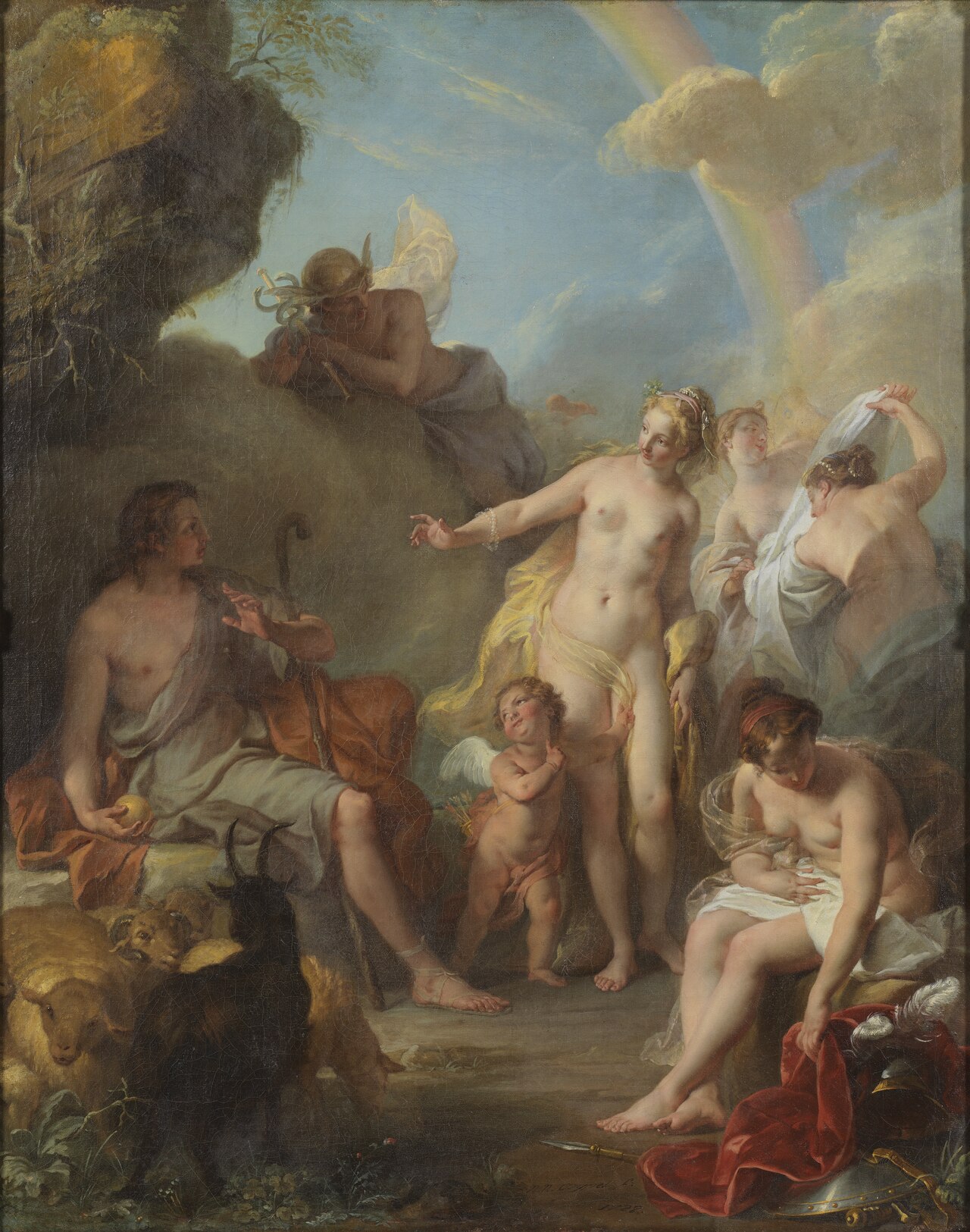
* The Rape of Europa (1727) – This canvas depicts the moment when Zeus, in the guise of a bull, abducts Europa. Coypel captures the drama through a dynamic diagonal composition, with Europa’s flowing garments and the bull’s muscular form rendered in luminous flesh tones. The background suggests a distant seascape, adding depth without distracting from the central action. * The Judgement of Paris (1728) – In this piece, the three goddesses—Hera, Athena, and Aphrodite—are presented before Paris, who must choose the fairest. Coypel’s treatment of the figures emphasizes their individual attributes: Hera’s regal poise, Athena’s martial armor, and Aphrodite’s sensual softness. The work showcases his skill in arranging multiple figures within a coherent pictorial space. * Louise Élisabeth, Madame la Princesse de Conti, as Venus (1731) – A portrait that blends allegory with portraiture, it presents the French noblewoman as the goddess Venus. Coypel renders her with a delicate, idealised beauty, while the surrounding symbols—such as a mirror and a seashell—reinforce the Venusian theme. This work demonstrates his ability to adapt mythological motifs to contemporary portraiture. * Birth of Venus (1732) – Perhaps his most celebrated mythological painting, it shows Venus emerging from the sea on a shell, surrounded by cherubs and swans. Coypel’s composition is harmonious, the figures are arranged in a gentle arc, and the soft lighting imbues the scene with a luminous, almost ethereal quality. * Diana’s Bathing (1732) – This work portrays the goddess Diana in a secluded woodland setting, caught in a moment of private contemplation. The painting is notable for its subtle use of colour, the serene expression of the figure, and the delicate rendering of foliage, highlighting Coypel’s capacity to convey both narrative and mood.
Each of these paintings reflects Coypel’s consistent engagement with classical mythology, his refined handling of the human form, and his ability to blend narrative intensity with courtly elegance.
Influence and legacy Although Noël‑Nicolas Coypel died relatively young at the age of 44, his contribution to French academic painting helped sustain the Baroque‑classic synthesis that characterised the early 18th century. He served as a bridge between the grand, dramatic style of the late 17th century and the lighter, decorative Rococo that would dominate later in the century. His works continued to be exhibited at the Salon after his death, influencing younger painters who admired his polished technique and his ability to integrate allegorical content with portraiture.
Art historians regard Coypel as a competent, though not revolutionary, figure within the French academic tradition. His paintings are held in several public collections, including the Musée du Louvre, where they are used as exemplars of the transitional Baroque style. Modern scholarship often references his oeuvre when discussing the evolution of mythological painting in France and the role of familial artistic dynasties in the transmission of technique and taste.
In sum, Noël‑Nicolas Coypel remains an important, if understated, participant in the narrative of French art, embodying the high technical standards of the Académie and the graceful adaptation of classical themes that would inform later developments in European painting.
Frequently asked questions
Who was Noël‑Nicolas Coypel?
He was a French Baroque painter (1690–1734) from Paris, known for mythological scenes and aristocratic portraits.
What style or movement is he associated with?
Coypel worked within the French Baroque tradition, blending dramatic chiaroscuro with a classical elegance that anticipates the Rococo.
What are his most famous works?
His best‑known paintings include The Rape of Europa (1727), The Judgement of Paris (1728), Birth of Venus (1732) and the portrait Louise Élisabeth, Madame la Princesse de Conti, as Venus (1731).
Why does he matter in art history?
He helped sustain the Baroque‑classic synthesis in early‑18th‑century France and influenced later artists through his polished technique and mythological subject matter.
How can I recognise a Coypel painting?
Look for smooth, highly polished surfaces, a balanced composition with graceful curves, controlled chiaroscuro, and a warm, restrained colour palette, often depicting mythological figures with idealised anatomy.