Nihâl Chand
1710 – 1782
In short
Nihâl Chand (1710–1782) was an Indian painter and poet who served as the chief court artist in Kishangarh, creating a distinctive style of Rajput miniature painting that idealised the ruler Savant Singh and his favourite, Bani Thani, as divine figures. His works, noted for their elongated forms, pastel palette and devotional symbolism, are regarded as some of the finest examples of 18th‑century Rajasthani art.
Notable works
,_Kishangarh,_ca._1750,_National_Museum_New_Delhi.jpg)


_Krishna_Celebrates_Holi_with_Radha_and_the_Gopis_1750-60_Boston_MFA.jpg)
Early life Nihâl Chand was born in 1710, though the precise location of his birth remains undocumented. Little is known about his family background, but he emerged from the rich tradition of Rajput painting that flourished across north‑western India. By the early 1720s he had arrived in the princely state of Kishangarh, a cultural hub that attracted artists, poets and scholars. His arrival, estimated between 1719 and 1726, coincided with a period of artistic renewal under the patronage of the ruling elite, setting the stage for his later prominence.
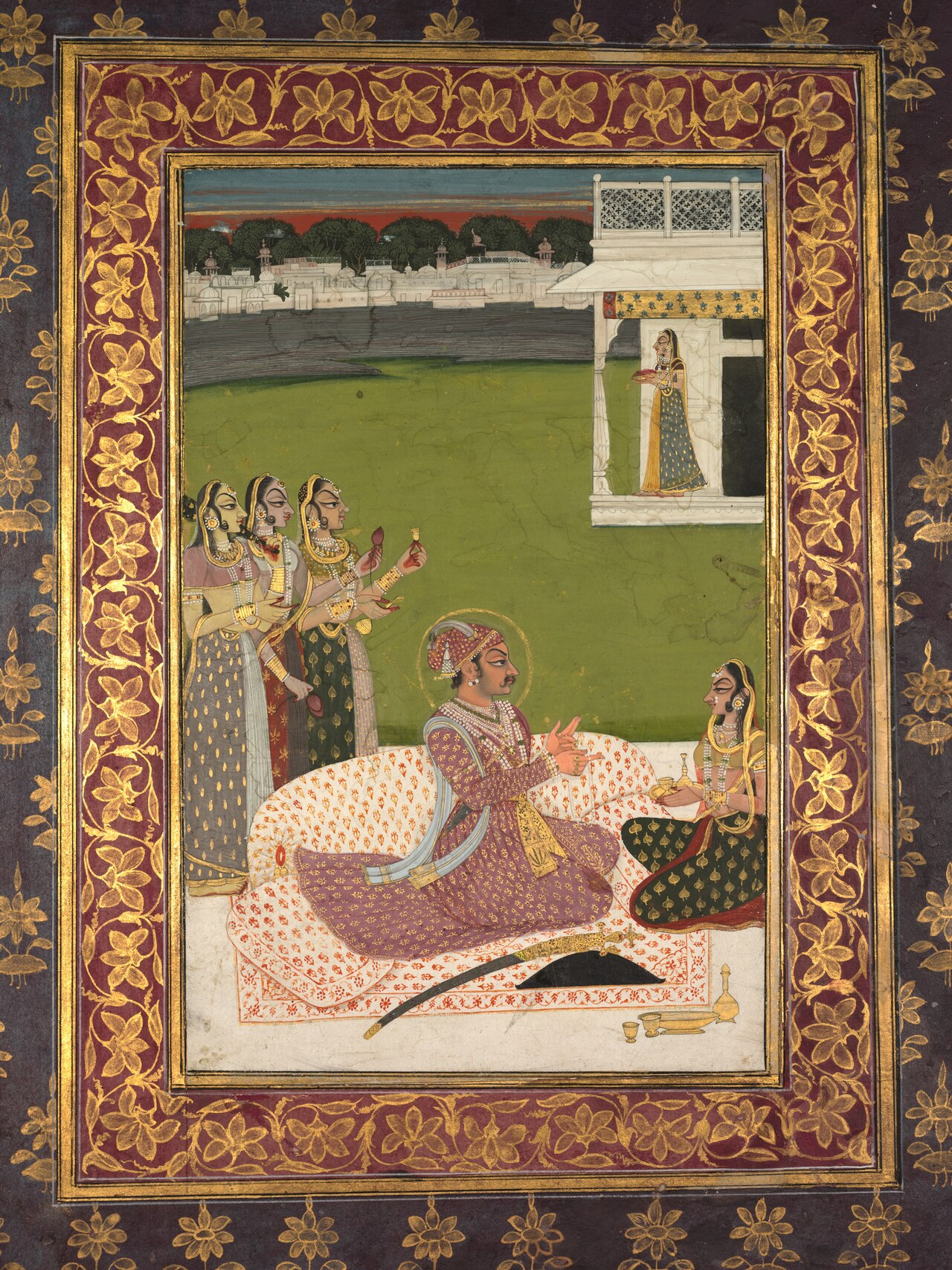
Career and style Soon after his arrival, Chand secured the position of chief painter at the Kishangarh court, serving under Maharaja Savant Singh. The court’s patronage allowed him to experiment with a highly personal visual language that blended classical Rajput conventions with the devotional fervour of Vallabhacharya’s Krishna‑centric philosophy. His paintings are characterised by slender, elongated figures, an ethereal pastel palette, and a serene, almost otherworldly atmosphere. Central to his iconography is the depiction of Krishna with a light‑blue complexion, a direct reference to Vallabh’s teachings that celebrate the deity’s divine play.
Signature techniques Chand’s technique combined meticulous brushwork with a bold use of colour and gold leaf. He employed fine, almost calligraphic strokes to render delicate facial features, while larger brushstrokes suggested flowing drapery and movement. Unlike many contemporaneous miniatures, his works were unusually large—often measuring up to 19 × 14 inches—allowing for greater compositional complexity. The artist also integrated subtle gradations of pink, green and turquoise to create a luminous background, and he frequently used gold foil to highlight divine halos or ornamental details, enhancing the spiritual aura of his subjects.
Major works - **Bani Thani (1750)** – Often called the "Mona Lisa of Indian art," this portrait presents Bani Thani, the Maharaja’s favourite consort, with an elongated nose, almond‑shaped eyes and a graceful tilt of the head. The work epitomises Chand’s idealisation of feminine beauty and serves as a visual allegory for the divine Radha. - **Radha and Krishna in the Boat of Love (1750)** – This composition depicts the lovers navigating a serene river, their bodies rendered in slender lines that convey both intimacy and spiritual union. The light‑blue skin of Krishna reinforces his divine identity, while the delicate foliage and pastel sky create a dream‑like ambience. - **Krishna and Radha (1750)** – A more intimate portrayal, the painting shows the couple in a garden setting, surrounded by blooming lotuses. Chand’s use of soft pinks and muted greens highlights the tenderness of the scene, and the subtle gold accents on Krishna’s crown underscore his celestial status. - **Portrait of Maharaja Savant Singh with Consort, Bani Thani (1752)** – This double portrait pairs the ruler with his beloved, both rendered in the same stylised manner as divine figures. Savant Singh is shown as an idealised Krishna, while Bani Thani embodies Radha, symbolising the ruler’s devotion to both his monarchic duties and spiritual aspirations. - **Krishna Celebrates Holi with Radha and the Gopis (1750)** – In this vibrant depiction of the Hindu festival of colours, Chand captures the joyous atmosphere of Holi while maintaining his characteristic compositional restraint. The figures are arranged in a harmonious arc, their garments rendered in a spectrum of pastel hues that echo the festive spirit without overwhelming the delicate balance of the scene.
Influence and legacy Nihâl Chand’s oeuvre is widely regarded as the pinnacle of Rajasthani miniature painting. His synthesis of devotional symbolism, refined aesthetics and technical innovation set a benchmark for later artists in the region. Collections of his work now reside in major museums worldwide, including the British Museum and the Metropolitan Museum of Art, where they continue to attract scholarly attention. By elevating court portraiture to a spiritual narrative, Chand not only documented the cultural milieu of 18th‑century Kishangarh but also shaped the visual vocabulary of Indian art for generations to come. His legacy endures in the continued study of Rajput miniatures and in the admiration of collectors who recognise his distinctive blend of elegance and devotion.
Frequently asked questions
Who was Nihâl Chand?
Nihâl Chand (1710–1782) was an Indian painter and poet who served as the chief court artist in Kishangarh, creating a celebrated style of Rajput miniature painting.
What artistic style or movement is he associated with?
He is linked to the Rajput painting tradition, specifically the Kishangarh school, which blends classical miniature techniques with Vallabhacharya’s Krishna‑centric devotional motifs.
What are his most famous works?
His best‑known paintings include *Bani Thani* (1750), *Radha and Krishna in the Boat of Love* (1750), *Krishna and Radha* (1750), the *Portrait of Maharaja Savant Singh with Consort, Bani Thani* (1752), and *Krishna Celebrates Holi with Radha and the Gopis* (1750).
Why is Nihâl Chand important in art history?
He is celebrated for producing some of the finest Rajasthani miniatures, pioneering a distinctive, elegant visual language that elevated court portraiture to a spiritual narrative and influenced subsequent generations of Indian artists.
How can I recognise a painting by Nihâl Chand?
Look for elongated, idealised figures, a pastel colour palette, light‑blue skin for Krishna, subtle gold highlights, and a composition that balances delicate detail with a serene, devotional atmosphere.