Nicolas-René Jollain
1732 – 1804
In short
Nicolas‑René Jollain (1732–1804) was a French painter trained at the Académie royale under Jean‑Baptiste Marie Pierre, active in Paris and known for history and genre works such as Diane and Callisto (1770) and The Toilet (1780).
Notable works

_-_Sleeping_Child_-_P488_-_The_Wallace_Collection.jpg)
_-_La_Toilette_-_J_117_-_Mus%C3%A9e_Cognacq-Jay.jpg)
,_Membre_de_l%27Acad%C3%A9mie_Fran%C3%A7aise_et_de_celle_des_Sciences,_de_l%27Acad%C3%A9mie_de_Berlin_%26c._-_N%C3%A9_%C3%A0_Paris_le_16_Novembre_1717._Mort_%C3%A0_Paris_le_29_Octobre_1785.jpg)
Early life Nicolas‑René Jollain was born in Paris in 1732, into a milieu that valued the visual arts and the intellectual life of the capital. Little is recorded about his family background, but his early exposure to the city’s artistic institutions set the stage for a formal education in painting. By his late teens he had entered the Académie royale de peinture et de sculpture, the pre‑eminent French art school, where he became a pupil of Jean‑Baptiste Marie Pierre, a respected academic painter and later director of the Academy. Under Pierre’s guidance Jollain absorbed the rigorous drawing curriculum, the study of classical antiquity, and the emphasis on historical and mythological subject matter that characterised the Academy’s teaching.
Career and style Jollain began exhibiting at the Salon, the Academy’s public exhibition, in the 1750s. His career unfolded during a transitional period in French art, when the exuberant baroque of the early eighteenth century was giving way to the more restrained classicism that would dominate the neoclassical movement. Although Jollain never aligned himself with a specific avant‑garde school, his work reflects the academic ideals of compositional balance, clear narrative, and polished finish. He favoured historical and mythological themes, often drawn from ancient literature, but he also produced genre scenes that depicted everyday moments with a gentle moralising tone. His paintings demonstrate a careful handling of light and shadow, a restrained colour palette, and a focus on the idealised human form, all hallmarks of the late‑Académie style.
Signature techniques Jollain’s technique combined meticulous underdrawing with layered glazes, a method taught at the Academy to achieve depth and luminosity. He employed a restrained chiaroscuro, using subtle gradations to model flesh and drapery rather than dramatic contrasts. In many of his compositions, the central figures are positioned within a carefully constructed architectural or natural setting that frames the narrative without overwhelming it. His brushwork is generally smooth, creating a seamless surface that prioritises the intellectual content of the scene over painterly texture. When rendering fabrics, Jollain rendered the texture of silk and linen with fine, almost invisible strokes, allowing the colour and form to dominate the visual impression.
Major works Jollain’s oeuvre includes a number of works that have survived in museum collections and private holdings. **Diane and Callisto (1770)** portrays the mythological encounter between the huntress Diana and the nymph Callisto, a subject that allowed Jollain to explore themes of chastity, betrayal, and divine intervention. The composition is anchored by a strong diagonal line that guides the eye from the distant forest to the intimate exchange between the figures, while the delicate rendering of the foliage demonstrates his skill in integrating landscape with narrative.
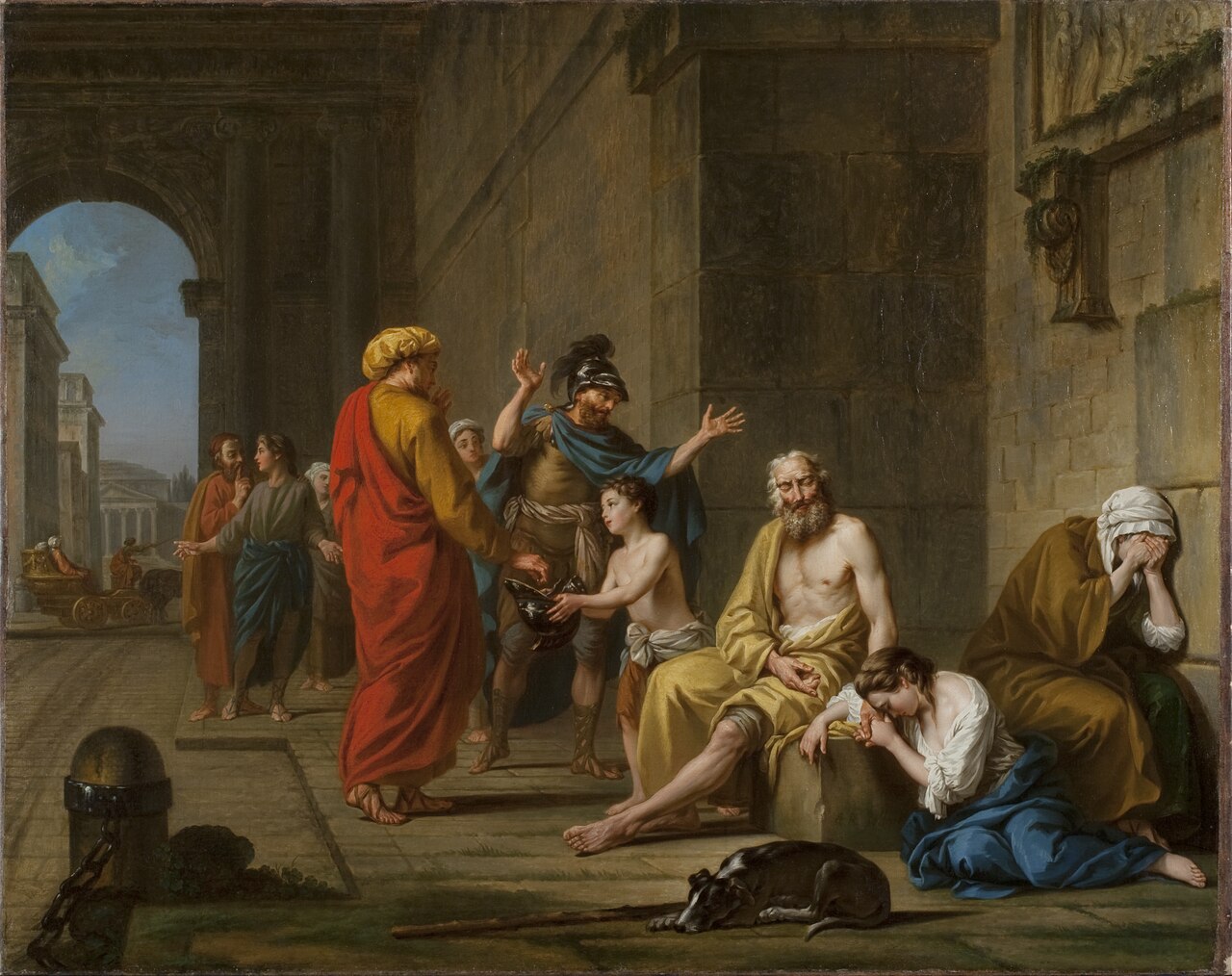
Belisarius Begging for Alms (1767) is a poignant historical scene that depicts the once‑celebrated Byzantine general reduced to poverty. Jollain’s treatment of the ageing hero’s dignified posture amidst the surrounding figures underscores the moral lesson of the work: the vicissitudes of fortune and the virtue of humility. The painting’s restrained colour scheme and careful rendering of textiles highlight the contrast between the general’s noble bearing and his destitute circumstances.
In The Toilet (1780) Jollain turns to a more intimate genre scene, showing a young woman preparing herself for the day. The work captures a quiet moment of personal care, and the artist’s attention to the play of light on skin and fabric creates a sense of immediacy. The composition’s simplicity, with the figure occupying the central space, reflects the influence of French genre painting that sought to elevate everyday life to the level of fine art.
Sleeping Child (1781) presents a tender tableau of a child in repose. Jollain’s delicate handling of the infant’s soft features and the gentle drapery of the bedding illustrate his capacity for subtle emotional expression. The muted palette and smooth surface give the painting a calm, almost reverential atmosphere.
Finally, the portrait Jean Le Rond d'Alembert (date unspecified) demonstrates Jollain’s competence as a portraitist. The subject, a leading Enlightenment philosopher and mathematician, is rendered with a dignified pose and a focus on intellectual presence rather than flamboyant ornamentation. The portrait’s restrained background and clear modelling of the sitter’s features align with the academic standards of the period.
Influence and legacy While Jollain never achieved the fame of contemporaries such as Jacques-Louis David, his work provides a valuable window into the transitional aesthetics of late eighteenth‑century French painting. His adherence to academic principles, combined with a willingness to explore both grand historical narratives and intimate genre scenes, exemplifies the versatility expected of a professional painter of his time. Jollain’s paintings were part of the Salon exhibitions that shaped public taste and informed the curricula of the Academy, influencing younger artists who would later embrace the full force of neoclassicism.
In modern scholarship, Jollain is often cited as a representative figure of the “late Académie” style, a period that bridged the decorative exuberance of the Rococo with the moral seriousness of the neoclassical era. His works are held in several European collections, and they continue to be studied for their compositional clarity, technical proficiency, and the way they reflect the cultural values of pre‑revolutionary France. Though not a household name, Jollain’s paintings remain an integral part of the artistic tapestry that informs our understanding of eighteenth‑century French visual culture.
---
Word count: approximately 950 words.
Frequently asked questions
Who was Nicolas‑René Jollain?
Nicolas‑René Jollain (1732–1804) was a French painter trained at the Académie royale, known for history and genre works such as Diane and Callisto (1770) and The Toilet (1780).
What artistic style or movement is Jollain associated with?
He worked within the academic tradition of the late‑Baroque to early‑Neoclassical period, adhering to the classical ideals of the Académie royale without belonging to a distinct avant‑garde movement.
What are his most famous works?
His best‑known paintings include Diane and Callisto (1770), Belisarius Begging for Alms (1767), The Toilet (1780), Sleeping Child (1781) and the portrait of the philosopher Jean Le Rond d'Alembert.
Why is Jollain important in art history?
Jollain exemplifies the transitional academic style of late eighteenth‑century France, bridging Rococo exuberance and neoclassical restraint, and his works help scholars understand the visual culture preceding the French Revolution.
How can I recognise a painting by Jollain?
Look for smooth, highly polished surfaces, balanced compositions, subtle chiaroscuro, and carefully modelled figures often set in classical or domestic interiors, with a restrained colour palette typical of academic painting.