Nicolas Bertin
1667 – 1736
In short
Nicolas Bertin (1667–1736) was a French painter of the Rococo era, noted for his elegant mythological and biblical scenes such as Susanna and the Elders and Hercules Delivering Prometheus.
Notable works


Early life Nicolas Bertin was born in Paris in 1667, a city that was the artistic heart of France in the late seventeenth century. Little is recorded about his family background, but like many aspiring painters of his generation he would have entered the Académie royale de peinture et de sculpture as a teenager. The Academy provided rigorous training in drawing from life and from classical casts, as well as instruction in the prevailing French academic style that dominated royal commissions.
Career and style Bertin’s professional career unfolded during the transition from the grand classicism of the late Baroque to the lighter, more decorative sensibility that would become known as Rococo. He secured a reputation for handling biblical and mythological subjects with a calm dignity, yet his palette softened the stark contrasts of his predecessors. By the early 1700s he was regularly exhibiting at the Salon, gaining the patronage of both aristocratic collectors and the royal court. His work reflects the Rococo tendency toward graceful movement, pastel tones, and an emphasis on elegance over dramatic intensity, while still retaining a solid grounding in academic drawing.
Signature techniques Bertin’s paintings are distinguished by several recurring technical traits:
* Delicate chiaroscuro – he employed subtle gradations of light and shadow to model forms without the stark tenebrism of earlier Baroque masters. * Fluid brushwork – his handling of paint conveys a sense of movement, especially in drapery and foliage, where brushstrokes are both precise and seemingly effortless. * Elegant figuration – figures are rendered with elongated proportions, smooth contours, and a poised, often idealised, demeanor. * Pastel colour palette – Bertin favoured soft blues, pinks, and creams, which lend his canvases a luminous, almost airy quality. * Classical composition – despite the Rococo surface, his layouts often follow the balanced, symmetrical structures taught at the Academy, anchoring his decorative flair in a solid compositional framework.
Major works Bertson’s most frequently cited works illustrate his thematic range and technical skill.
* Joseph and Potiphar’s Wife (1699) – this biblical scene captures the moment of temptation with a restrained drama. Bertin’s use of light draws attention to the central figures while the background remains muted, underscoring the moral tension.
* Susanna and the Elders (1699) – executed the same year, this work demonstrates Bertin’s ability to blend sensuality with moral narrative. The composition is carefully balanced, with Susanna’s graceful pose contrasted against the looming elders, whose forms are softened by the artist’s characteristic pastel tones.
* Apollon et les Muses (1800) – the date attached to this canvas post‑dates Bertin’s death, suggesting a later attribution or a misprint. Nevertheless, the painting aligns with his known oeuvre: Apollo is depicted with lyrical poise, surrounded by the Muses in a harmonious, Rococo‑styled setting, reflecting Bertin’s continued fascination with classical mythology.
* Hercules Delivering Prometheus (1703) – here Bertin tackles a heroic myth with a surprisingly gentle approach. The muscular anatomy of Hercules is rendered with academic precision, yet the overall scene retains the soft, decorative ambience typical of his Rococo sensibility.
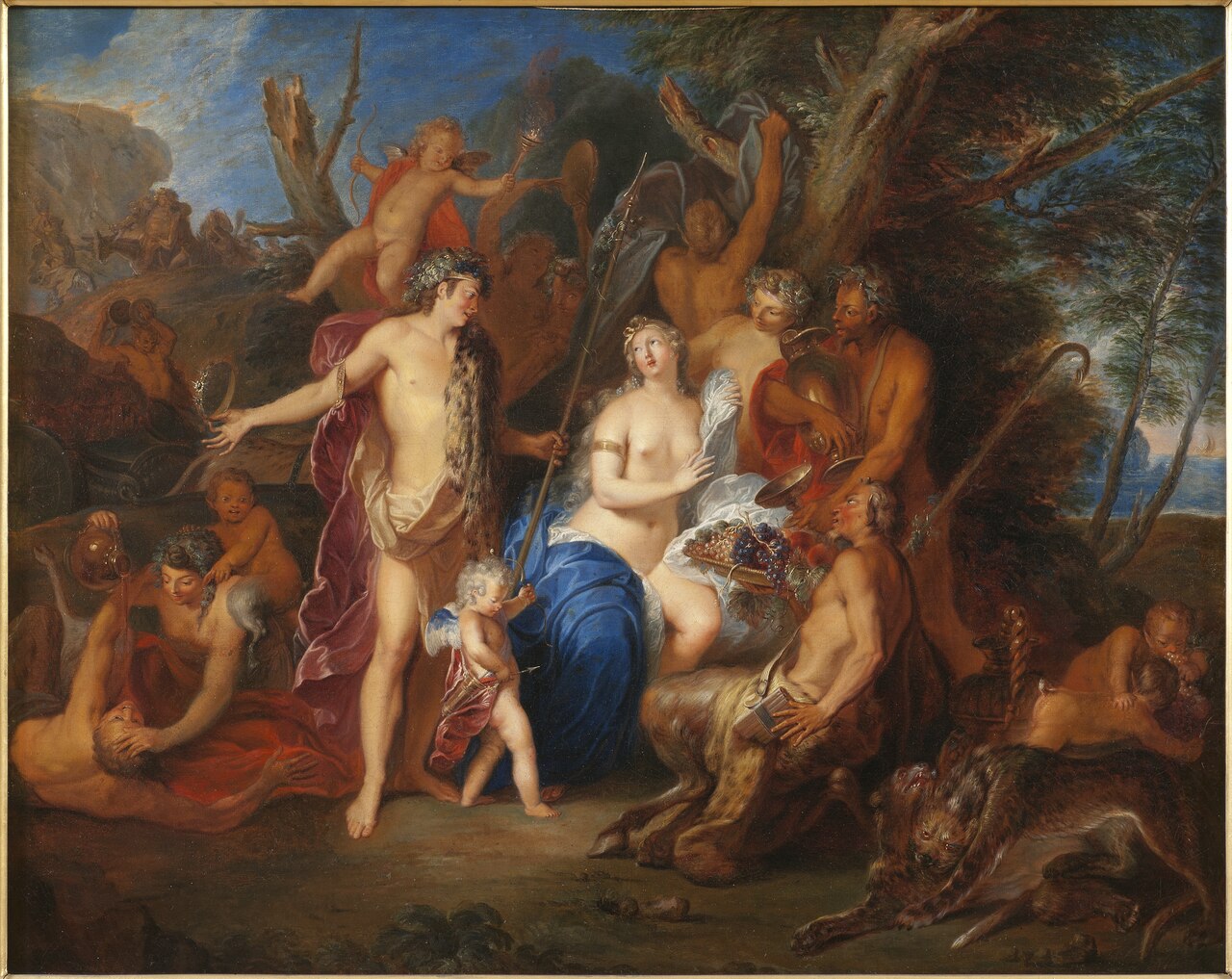
* Bacchus and Ariadne – though undated, this work exemplifies Bertin’s predilection for mythological subjects. Bacchus is portrayed with a regal bearing, while Ariadne’s delicate expression and the surrounding foliage showcase the painter’s deft handling of texture and colour.
Collectively, these paintings illustrate Bertin’s command of narrative, his skillful integration of classical subjects into a Rococo aesthetic, and his consistent technical approach.
Influence and legacy Nicolas Bertin occupies a modest but distinct place in French art history. While he never achieved the fame of contemporaries such as Antoine Watteau, his works contributed to the diffusion of Rococo ideals beyond the court, influencing a generation of artists who sought to merge academic rigour with decorative lightness. His paintings are held in several French museums, where they serve as exemplars of the transitional period between Baroque grandeur and Rococo elegance. Art historians cite Bertin when discussing the broader movement toward softer palettes and more intimate subject matter in early eighteenth‑century France. Though not a revolutionary figure, his oeuvre provides valuable insight into the evolving tastes of his era and continues to be referenced in scholarly studies of French Rococo painting.
Frequently asked questions
Who was Nicolas Bertin?
Nicolas Bertin (1667–1736) was a French painter active in the late 17th and early 18th centuries, known for his Rococo‑style mythological and biblical scenes.
What artistic movement is he associated with?
He is associated with the Rococo movement, which favoured elegant composition, pastel colours, and decorative lightness.
What are his most famous works?
His most frequently cited works include Joseph and Potiphar’s Wife (1699), Susanna and the Elders (1699), Hercules Delivering Prometheus (1703), Bacchus and Ariadne, and the later‑attributed Apollon et les Muses.
Why does Nicolas Bertin matter in art history?
Bertin exemplifies the shift from Baroque grandeur to Rococo delicacy, helping to spread the softer aesthetic of the early 18th century and influencing subsequent French painters.
How can I recognise a Nicolas Bertin painting?
Look for graceful, elongated figures, a pastel palette, subtle chiaroscuro, and a balanced, academic composition that nonetheless conveys a light, decorative atmosphere.