Napoléon Bourassa
1827 – 1916
In short
Napoléon Bourassa (1827–1916) was a Canadian architect, painter and writer based in Montreal. He is remembered for his eclectic paintings such as L'Apothéose de Christophe Colomb and for his contribution to 19th‑century Canadian art and architecture.
Notable works


Early life Napoléon Bourassa was born in 1827 in the small settlement of L'Acadie, a community that later became part of the province of Quebec. Little is recorded about his family background beyond the fact that his mother, Geneviève Patenaude, later married François Bourassa and was known as Madame François Bourassa. Bourassa grew up in a period when French‑Canadian culture was beginning to assert itself against the dominant Anglo‑British influences in the colonies. His early education combined a modest formal schooling with exposure to the religious and artistic traditions of the Catholic Church, which would later inform much of his visual vocabulary.
Career and style Bourassa moved to Montreal in his early twenties, setting up a modest studio and a private architectural practice. The city, then a bustling hub of commerce and culture, offered him opportunities to work on both civic commissions and private residences. While his architectural work adhered to the prevailing neoclassical and Gothic Revival trends, his paintings displayed a more eclectic sensibility. He drew on Romantic, Symbolist and emerging nationalist motifs, blending them with a personal fascination for mysticism and historical narrative. Though he never aligned himself with a single, formally recognised movement, his oeuvre can be placed within the broader context of 19th‑century Canadian Romanticism, where artists sought to articulate a distinct cultural identity through mythic and historical subjects.
Signature techniques Bourassa’s paintings are characterised by a careful handling of light and a layered approach to colour. He often employed a muted palette punctuated by vibrant accents to draw the eye toward focal points, a technique evident in his treatment of sky and water. His brushwork varies between smooth, almost academic passages for background architecture and looser, expressive strokes for figures, suggesting an interest in contrasting the permanence of structures with the transience of human life. In his later works, particularly those dated after the mid‑1890s, he incorporated a subtle glazing method that gave his canvases a luminous depth, a technique he likely adapted from his study of European masters during trips to Paris and Rome.
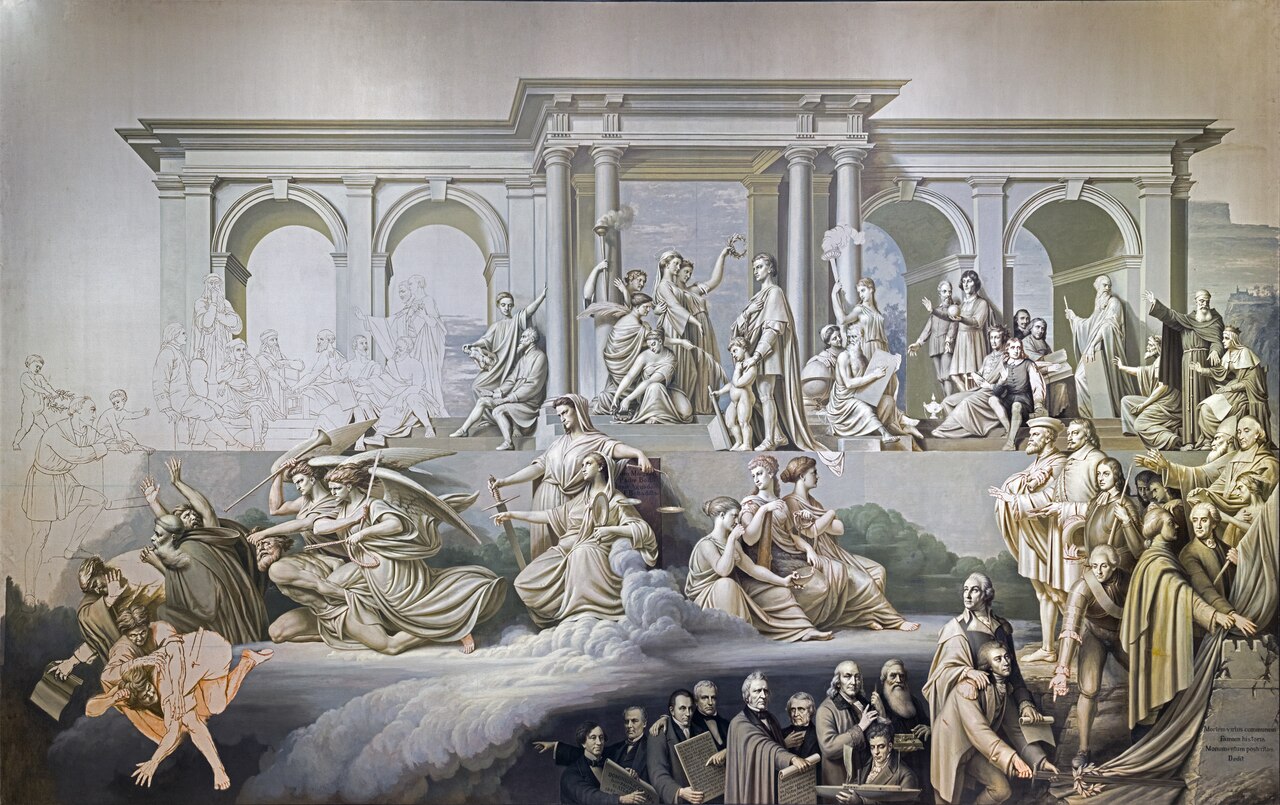
Major works - **L'Apothéose de Christophe Colomb** – This ambitious canvas presents the explorer Christopher Columbus in a heroic, almost mythic setting. Bourassa situates the figure among a celestial tableau, surrounded by allegorical figures that celebrate discovery and the spread of civilisation. The composition reflects his fascination with historical narrative and his ability to combine academic rigour with romantic idealisation. - **La Peinture mystique (1896)** – Completed toward the end of his career, this work exemplifies Bourassa’s turn toward spiritual themes. The painting depicts an ethereal scene where a solitary artist is bathed in a soft, otherworldly light, suggesting the transcendental nature of creative act. The date, 1896, is one of the few firm chronological anchors for his output, confirming his continued productivity well into his sixties. - **Les Petits Pêcheurs (1865)** – A genre scene that captures the everyday labour of young fishermen on the banks of a river. Bourassa renders the figures with empathy, using naturalistic detail to convey the harshness of their environment while also celebrating their resilience. The work is notable for its balanced composition and the delicate handling of water reflections. - **Madame François Bourassa, née Geneviève Patenaude, mère de l'artiste (1851)** – A portrait of his mother, painted when Bourassa was in his mid‑twenties. The piece demonstrates his early mastery of portraiture, with careful attention to facial expression and the textures of clothing. The work also serves as a personal homage, anchoring his artistic identity in familial ties.
Influence and legacy Napoléon Bourassa occupied a unique position at the intersection of architecture and fine art in 19th‑century Canada. His architectural commissions contributed to Montreal’s urban fabric, while his paintings added a distinct voice to the emerging Canadian artistic narrative. By integrating historical, mystical and everyday subjects, he helped broaden the thematic scope available to Canadian artists. Though he never achieved the international fame of some of his contemporaries, his works are now part of public and private collections across Canada and serve as reference points for scholars studying the evolution of Canadian visual culture. His legacy endures in the way later Canadian painters approached the synthesis of national history and personal spirituality, and his architectural drawings continue to inform restoration projects in historic Montreal districts.
Frequently asked questions
Who was Napoléon Bourassa?
Napoléon Bourassa (1827–1916) was a Canadian architect, painter and writer based in Montreal, known for his eclectic paintings and contributions to 19th‑century Canadian art and architecture.
What artistic style or movement is he associated with?
He is not tied to a single movement but his work aligns with Canadian Romanticism, blending historic, mystical and nationalist themes within an eclectic, often Symbolist‑inspired style.
What are his most famous works?
His most noted paintings include L'Apothéose de Christophe Colomb, La Peinture mystique (1896), Les Petits Pêcheurs (1865) and a portrait of his mother, Madame François Bourassa (1851).
Why does he matter in art history?
Bourassa helped expand the thematic range of Canadian art, linking architecture and painting, and his works provide early examples of a distinctly Canadian visual narrative that influenced later artists.
How can I recognise a Bourassa painting?
Look for a combination of careful light handling, layered colour, a mix of smooth architectural detail with looser figure work, and subjects that often blend historic or mystical themes with a Romantic sensibility.