Mola Ram
1743 – 1833
In short
Mola Ram (1743–1833) was an Indian painter who founded the Garhwal School of miniature painting and also worked as a poet, historian and diplomat in Srinagar.
Notable works
_series_-_1974.112_-_Arthur_M._Sackler_Museum.jpg)

Early life Mola Ram was born in 1743 in the town of Srinagar, located in the mountainous region of what is today northern India. Contemporary records of his family background are sparse, and his precise national identity is not documented. The cultural environment of his birthplace blended Hindu, Buddhist, and Islamic artistic traditions, providing a fertile ground for a budding visual artist. Little is known about his formal training, but it is likely that he apprenticed with local court artists who were themselves influenced by the Mughal miniature tradition that had spread throughout the subcontinent. Early exposure to religious texts and courtly poetry would later inform both his visual and literary output.
Career and style Mola Ram emerged as a multifaceted cultural figure, simultaneously pursuing painting, poetry, historiography, and diplomatic service. By the late eighteenth century he had established himself as the principal exponent of a new regional style that would later be recognised as the Garhwal School of miniature painting. This style retained the delicate brushwork and rich colour palette of Mughal miniatures while incorporating local iconography, narratives from Hindu epics, and motifs drawn from the Himalayan landscape. His paintings often depict scenes from the Bhagavata Purana and other devotional texts, rendered with an emphasis on narrative clarity and emotive expression. Throughout his career he served as an intermediary between local rulers and visiting dignitaries, a role that afforded him access to patronage networks and a platform to disseminate his artistic ideas.
Signature techniques Mola Ram’s technique is characterised by meticulous line work, the use of fine sable brushes, and a layered approach to colour that yields luminous surfaces. He frequently employed gold leaf to highlight divine halos and ornamental borders, a practice that enhances the ceremonial quality of his miniatures. The pigments he used were derived from natural sources—minerals for blues and greens, plant extracts for reds and yellows—allowing for a vivid yet harmonious palette. In composition, he favoured a balanced arrangement of figures within a confined pictorial space, often employing a shallow perspective that draws the viewer’s eye toward the central narrative action. His attention to detail extends to the rendering of textiles, jewellery, and architectural elements, each depicted with a degree of realism that coexists with the overall stylised aesthetic.
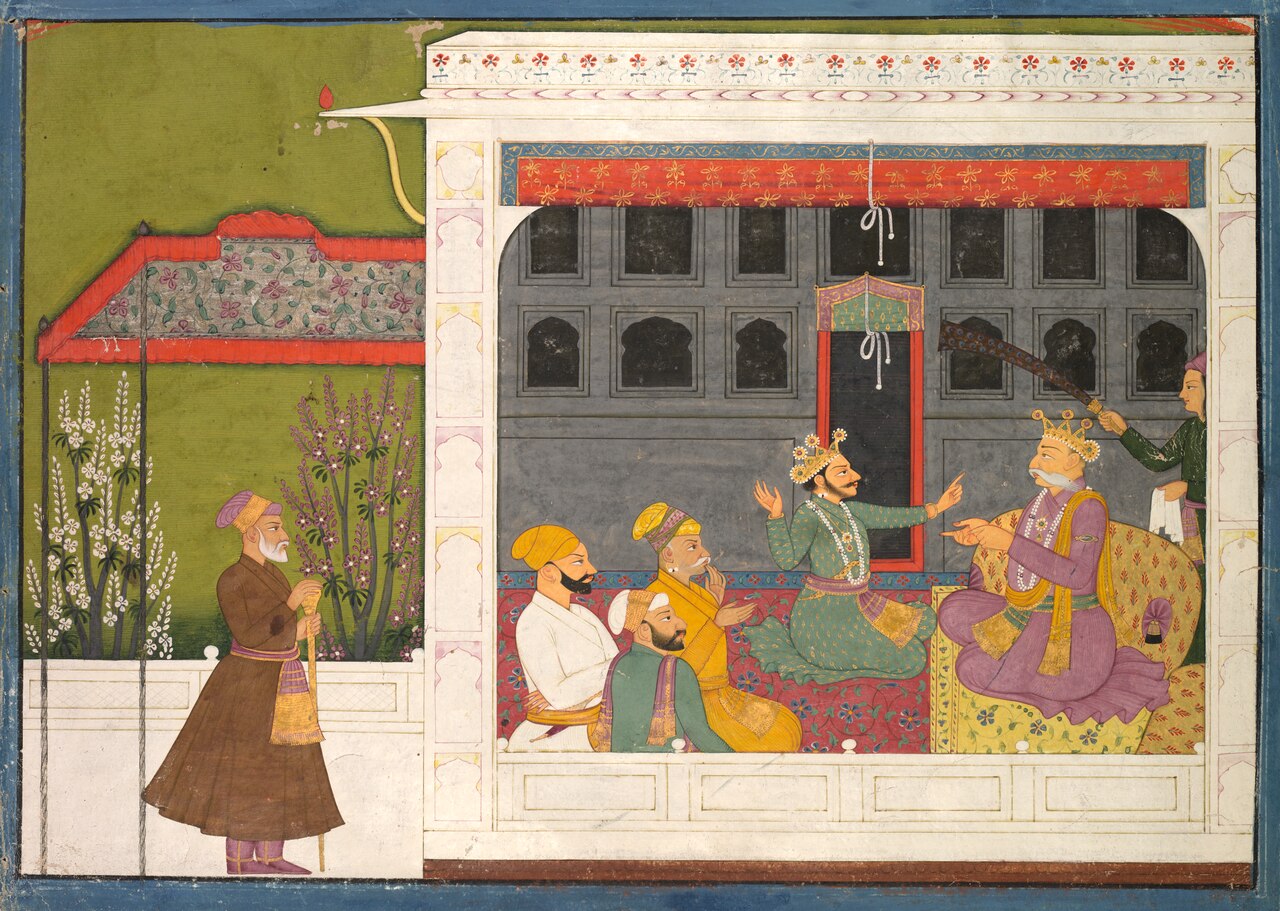
Major works Among Mola Ram’s surviving oeuvre, three works illustrate his mastery of narrative and technical skill. *Shispul Arguing with Rukmini’s Father, Bhishmaka* (c. 1800) is a page from a Rukmini Mangal series that captures a pivotal moment in the legend of Krishna’s courtship of Rukmini. The scene is populated with finely drawn figures, each rendered with distinct expressions that convey tension and drama. *Krishna Quells the Serpent Kaliya* appears as a folio from a Bhagavata Purana series and depicts the mythic episode in which the deity subdues the poisonous serpent Kaliya. The composition uses dynamic diagonal lines to suggest movement, while the surrounding flora and water are rendered with delicate brushstrokes that contrast with the intense central action. Finally, *Krishna Holding Mount Govardhan* (1790) portrays the young god lifting the hill to protect villagers from a deluge. The painting emphasizes the protective aspect of the deity, with a serene Krishna perched atop the mountain, surrounded by grateful villagers. In each of these works, Mola Ram combines narrative clarity with a rich ornamental vocabulary, reinforcing his reputation as a leading miniaturist of his time.
Influence and legacy Mola Ram’s establishment of the Garhwal School created a lasting artistic tradition that persisted well into the nineteenth century. His synthesis of Mughal techniques with local themes provided a template for subsequent generations of painters in the Himalayan region, who continued to produce miniature works for both devotional and courtly purposes. Modern scholarship, notably the research of Mukandi Lal, has documented Mola Ram’s contributions and helped situate his work within the broader narrative of Indian art history. Although many of his paintings remain in private collections, the surviving pieces are valued for their historical significance and aesthetic quality. Today, Mola Ram is recognised as a pivotal figure who bridged classical miniature traditions with regional expression, ensuring the continuity of a distinctive visual language in northern India.
Frequently asked questions
Who was Mola Ram?
Mola Ram (1743–1833) was a painter, poet, historian and diplomat from Srinagar who founded the Garhwal School of miniature painting.
What style or movement is he associated with?
He is linked to the Garhwal School of miniature painting, a regional style that blends Mughal techniques with local Himalayan themes.
What are his most famous works?
His best‑known works include *Shispul Arguing with Rukmini’s Father, Bhishmaka* (c.1800), *Krishna Quells the Serpent Kaliya* from a Bhagavata Purana series, and *Krishna Holding Mount Govardhan* (1790).
Why is he important in art history?
Mola Ram established a distinct regional school, preserving miniature painting traditions in the Himalayas and influencing later artists through his innovative synthesis of styles.
How can one recognise a painting by Mola Ram?
His paintings typically feature fine line work, natural pigments, gold‑leaf highlights, balanced compositions of mythological scenes, and a blend of Mughal miniaturist techniques with local Himalayan motifs.