Mir Mossavvir
1450 – 1555
In short
Mir Mossavvir (1450–1555) was a Persian painter who worked for the Safavid court in Tabriz and later for the Mughal court in Kabul. He is known for his contributions to illustrated manuscripts such as the Shahnameh of Shah Tahmasp and for a series of folios that depict legendary Persian scenes.
Notable works


.jpg)

Early life Mir Mossavvir was born around 1450, but the exact location of his birth and details of his family background remain unknown. Contemporary records do not specify his nationality, though his artistic language is unmistakably Persian. Little is recorded about his training, yet the high quality of his early work suggests that he was educated within the traditional workshop system that supplied the Safavid court with manuscript painters.
Career and style By the early 16th century Mossavvir had secured a position in the royal workshop of Shah Tahmas I in Tabriz, the cultural heart of the Safavid Empire. The Safavid atelier was renowned for its collaborative production of illuminated manuscripts, especially the Shahnameh (the Persian "Book of Kings"). Within this environment Mossavvir refined a style that combined the delicate line work of earlier Persian traditions with a richer, more naturalistic colour palette that was emerging under Safavid patronage.
Around the 1530s Mossavvir moved to the Mughal court in Kabul, where he continued to work on Persian‑inspired projects for a new imperial audience. The Mughal environment encouraged a synthesis of Persian and Central Asian influences, and Mossavvir’s later pieces display a greater emphasis on three‑dimensional modelling and atmospheric perspective. Throughout his career, he maintained a consistent interest in narrative illustration, focusing on heroic and mythological subjects drawn from the Shahnameh and other Persian epic literature.
Signature techniques Mossavvir’s paintings are characterised by several recurring technical hallmarks:
* Fine linear drawing – He employed an intricate, almost calligraphic line to define the contours of figures and architectural elements, a hallmark of Safavid manuscript illumination. * Layered washes of colour – His palette often combined luminous reds, deep blues, and gold leaf, applied in successive translucent layers that give depth without sacrificing the flat decorative quality of the surface. * Dynamic composition – Scenes are arranged to guide the viewer’s eye across the page, using diagonal lines of movement and strategic placement of foreground and background elements. * Expressive facial features – While adhering to the stylised conventions of Persian portraiture, Mossavvir gave his characters subtle emotional cues through the tilt of the head, the gaze, and the curvature of the mouth. * Use of gold and lapis – In many of his court commissions, he incorporated gold leaf and mineral pigments such as lapis lazuli, both to signify royal patronage and to enhance visual richness.
Major works Mossavvir’s surviving oeuvre is limited to a handful of manuscript folios that have been catalogued by major institutions. Among these, the following pieces are most frequently cited:
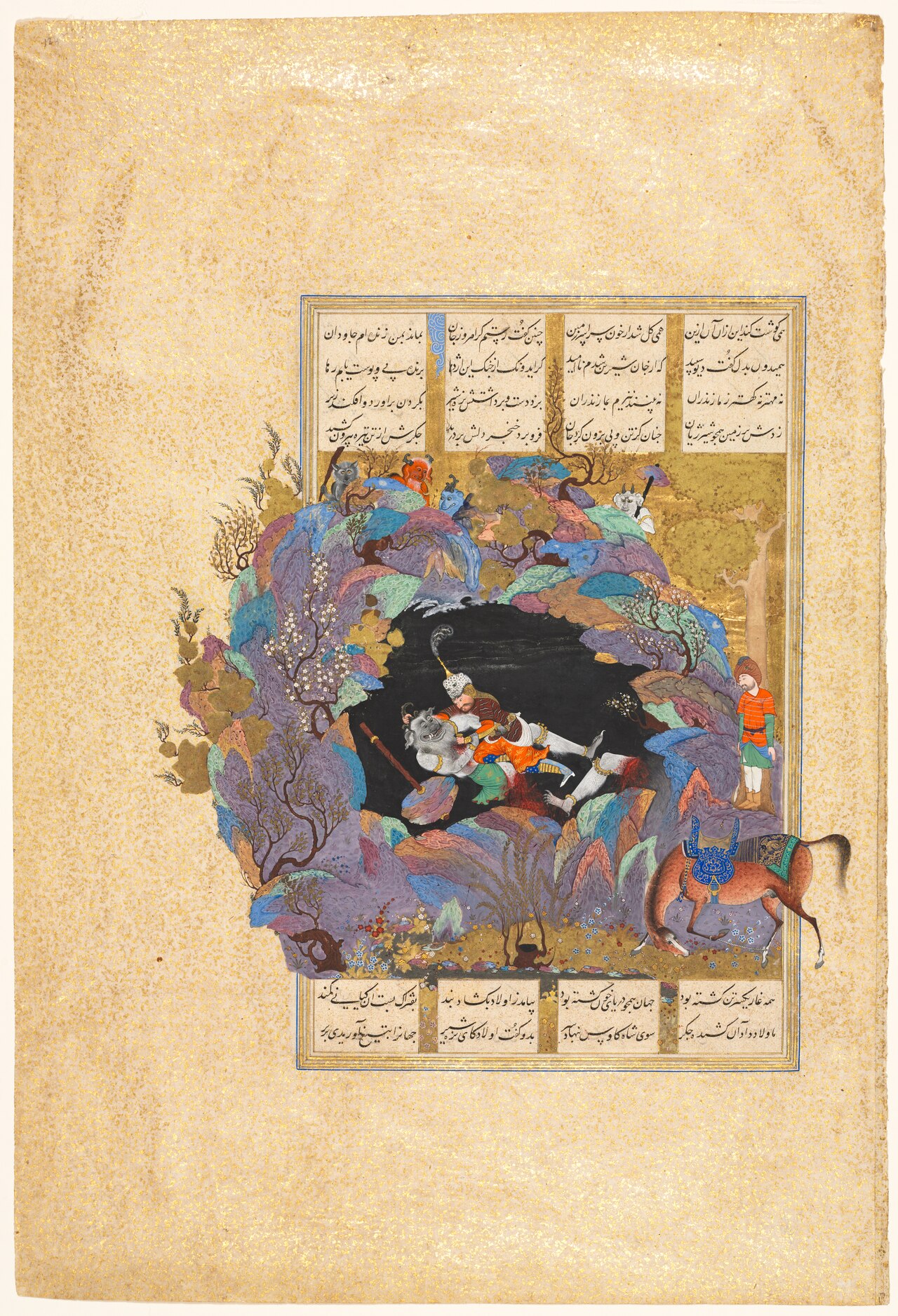
1. Rustam’s seventh course: He kills the White Div (folio 124, Shah‑nama of Firdausi, 1600) – This illustration captures the climactic moment in which the hero Rustam slays the demon White Div. Mossavvir’s handling of the combat scene demonstrates his skill in rendering movement; the swirling clouds and the tension in Rustam’s pose are achieved through sharp line work and a contrasting palette of deep indigo and fiery orange.
2. Zahhak discusses his dream with Arnavaz (Museum of Islamic Art, Doha, Ms 41, 1530) – In this folio, the tyrant Zahhak is shown in a moment of contemplation, a departure from the usual martial depictions of the figure. Mossavvir uses a muted colour scheme and a restrained composition to focus attention on the psychological exchange between the two characters.
3. Ardavan’s slave‑girl Gulnar with the young Ardashir (1527) – This scene highlights Mossavvir’s capacity for intimate portraiture. The delicate rendering of the girl’s veil and the tender interaction with the youthful prince reveal his attention to texture and subtle narrative nuance.
4. Self‑portrait of Mir Musavvir; Portrait of a scholar (album page, 1600) – Although the attribution is sometimes debated, this album page is widely regarded as a rare self‑portrait. The scholar’s contemplative pose, the finely rendered turban, and the soft shading of the face illustrate Mossavvir’s mastery of individual likeness within the conventions of Persian miniature.
5. Manuchihr enthroned (1530) – This regal depiction of the legendary king Manuchihr showcases Mossavvir’s use of gold leaf to emphasize royal authority. The throne’s intricate carving and the surrounding courtiers are rendered with a compositional balance that underscores the central figure’s dominance.
These works, together with his contributions to the Shahnameh of Shah Tahmas I, solidify Mossavvir’s reputation as a leading exponent of Persian manuscript painting during a period of artistic transition.
Influence and legacy Mir Mossavvir’s impact on the development of Persian miniature painting is evident in several ways. First, his stylistic synthesis of Safavid elegance and Mughal realism paved the way for later court painters who sought to blend these traditions. Second, his son, Mir Sayyid Ali, continued the family workshop and became a celebrated painter in his own right, suggesting a direct lineage of technique and aesthetic values.
Mossavvir’s works also serve as primary visual sources for scholars studying the transmission of Persian epic narratives across the Islamic world. By preserving episodes from the Shahnameh in vivid visual form, his illustrations have informed both literary criticism and comparative art history. Contemporary curators and collectors continue to value his surviving folios for their technical brilliance and their insight into the cultural exchanges between Safavid Iran and the Mughal empire.
Overall, Mir Mossavvir remains a pivotal figure whose paintings embody the artistic vitality of the late medieval Persian world, while also foreshadowing the more naturalistic directions that would dominate South‑Asian court art in the centuries that followed.
Frequently asked questions
Who was Mir Mossavvir?
Mir Mossavvir (1450–1555) was a Persian painter who worked for the Safavid court in Tabriz and later for the Mughal court in Kabul, known for his contributions to illustrated manuscripts such as the Shahnameh.
What artistic style or movement is he associated with?
He is linked to the late Safavid manuscript tradition, blending classic Persian miniature techniques with early Mughal naturalism.
What are his most famous works?
Key works include the folios "Rustam’s seventh course: He kills the White Div" (1600), "Zahhak discusses his dream with Arnavaz" (1530), "Ardavan’s slave‑girl Gulnar with the young Ardashir" (1527), his self‑portrait, and "Manuchihr enthroned" (1530).
Why is Mir Mossavvir important in art history?
He exemplifies the artistic exchange between Safavid Iran and the Mughal empire, influencing later miniature painters and preserving Persian epic narratives in visual form.
How can I recognise a Mir Mossavvir painting?
Look for finely drawn outlines, layered translucent colours, gold‑leaf highlights, dynamic compositions, and expressive yet stylised facial features typical of his court miniatures.