Michele Pace del Campidoglio
1610 – 1670
In short
Michele Pace del Campidoglio (1610–1670) was a Roman-born painter who specialised in still‑life depictions of fruit in the mid‑17th century. His works are celebrated for their precise rendering of texture, colour and light, exemplifying the flourishing still‑life tradition of Baroque Italy.
Notable works
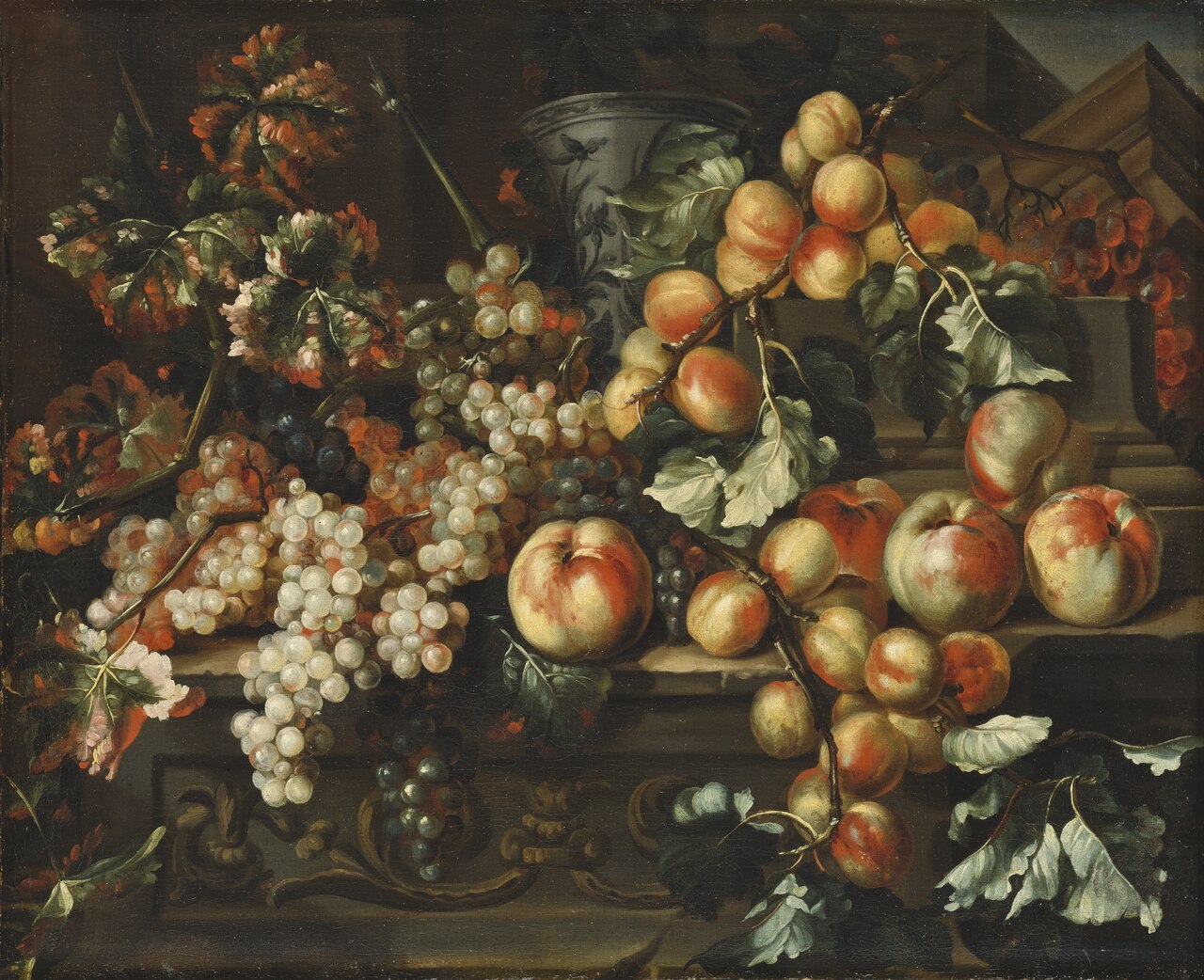


_(1591-1666)_-_Fr%C3%BCchtestillleben_mit_Melonen_-_1409_-_F%C3%BChrermuseum.jpg)
Early life Michele Pace del Campidoglio was born in Rome in 1610. Details of his family background and early education are scarce, and his nationality is recorded simply as unknown, reflecting the limited archival material on many peripheral artists of the period. Rome in the early seventeenth century was a vibrant artistic centre, where the legacy of Caravaggio’s dramatic chiaroscuro co‑existed with a growing interest in genre and still‑life painting. It is probable that Pace del Campidoglio was exposed to this milieu from a young age, absorbing the visual language of the city's workshops and the markets that supplied fresh produce for the capital’s elite households.
Career and style Pace del Campidoglio’s professional activity is documented from the late 1620s through the 1660s, a span that aligns with the height of Baroque still‑life production in Italy. He worked primarily for private patrons who commissioned decorative panels for domestic interiors, a market that prized realistic depictions of abundance and luxury. His style is characterised by a meticulous naturalism, with an emphasis on the tactile qualities of fruit skins, peels and flesh. The compositions often employ a restrained yet harmonious colour palette, dominated by deep reds, golden yellows and muted greens, which enhances the sense of three‑dimensionality.
The artist’s handling of light reflects a subtle chiaroscuro influence: a single, diffused light source illuminates the objects from the side, casting soft shadows that model form without overwhelming the delicate surface details. This approach creates a quiet drama that distinguishes his work from the more theatrical still‑lifes of contemporaries such as Tommaso Salini.
Signature techniques Pace del Campidoglio’s technique relies on layered oil glazes to achieve the luminous quality of fruit skins. He would begin with a detailed underdrawing, often in charcoal, to establish the arrangement of the objects on a stone or wooden support. Subsequent layers of thin, translucent paint build up the flesh tones, allowing the underlying colour to shine through and produce a realistic depth. The artist paid particular attention to the rendering of water droplets and the reflective sheen on smooth surfaces, employing fine brushwork to suggest the transient glisten of condensation.
Another hallmark of his practice is the use of a stone ground or slab as a compositional base. The rough texture of the stone provides a natural contrast to the polished surfaces of the fruit, and it also serves as a visual anchor that grounds the composition in a tangible space. This technique, combined with a balanced diagonal arrangement of the objects, creates a dynamic yet orderly visual rhythm.
Major works - **Still Life with Apples and Grapes** – Although undated, this early piece showcases Pace del Campidoglio’s skill in juxtaposing the smooth, glossy skin of apples with the translucent, clustered grapes. The careful placement on a stone surface highlights his interest in textural contrast. - **Still Life with Grapes (1650)** – Executed in 1650, the painting presents a generous bunch of grapes rendered with a nuanced palette of purples and greens. The composition’s simplicity underscores the artist’s confidence in allowing the fruit itself to command the viewer’s attention. - **Still Life with Grapes, Figs and Pumpkin (1650)** – Also dated 1650, this work expands the visual vocabulary by introducing figs and a pumpkin. The inclusion of the pumpkin adds a warm, earthy tone that balances the cooler hues of the grapes, while the figs provide a tactile reference to soft, velvety surfaces. - **Still Life with Melons, Peaches, Figs, and Grapes (1640)** – This 1640 composition is notable for its elaborate grouping of varied fruit, each rendered with distinct surface qualities. The melons’ thick rind, the peaches’ delicate fuzz, and the figs’ mottled skin are each treated with meticulous care, demonstrating the artist’s mastery of material differentiation. - **A watermelon, squash, peaches and plums on a stone ground (1616)** – One of the earliest dated works, this painting reflects a youthful vigor in its bold colour contrasts. The watermelon’s bright red interior, juxtaposed with the muted greens of squash and the soft reds of plums, exemplifies the artist’s early experimentation with colour harmony.
Each of these works illustrates Pace del Campidoglio’s consistent focus on fruit as a vehicle for exploring light, texture and colour. The paintings have survived in various private and public collections, offering scholars insight into the development of Italian still‑life during the Baroque era.
Influence and legacy While Michele Pace del Campidoglio never achieved the fame of some of his more celebrated Baroque contemporaries, his contributions to the still‑life genre are significant. His precise treatment of fruit surfaces helped to establish a visual standard that later Italian still‑life painters would emulate. Moreover, his compositions, which balance opulence with restraint, reflect a distinctly Roman interpretation of the still‑life tradition that was otherwise dominated by the more flamboyant approaches of the northern European schools.
Modern scholarship has begun to reassess his oeuvre, recognizing the subtle innovations in colour modulation and textural rendering that prefigure later developments in the genre. Though the documentation of his life remains limited, the surviving works continue to be exhibited in museums and cited in academic studies, ensuring that his artistic legacy endures within the broader narrative of 17th‑century European art.
--- In summary, Michele Pace del Campidoglio stands as a representative figure of Roman still‑life painting, whose meticulous technique and restrained compositional style contributed to the richness of Baroque visual culture.
Frequently asked questions
Who was Michele Pace del Campidoglio?
He was a Roman-born painter (1610–1670) who specialised in still‑life paintings of fruit during the mid‑17th century.
What style or movement is he associated with?
His work belongs to the Baroque still‑life tradition, characterised by realistic detail, careful light modelling and a subdued yet rich colour palette.
What are his most famous works?
Key works include *Still Life with Apples and Grapes*, *Still Life with Grapes* (1650), *Still Life with Grapes, Figs and Pumpkin* (1650), *Still Life with Melons, Peaches, Figs, and Grapes* (1640) and *A watermelon, squash, peaches and plums on a stone ground* (1616).
Why does Michele Pace del Campidoglio matter in art history?
He exemplifies the meticulous naturalism of Roman still‑life painting, influencing later artists and enriching our understanding of how 17th‑century Italian painters rendered everyday luxury.
How can I recognise a painting by Michele Pace del Campidoglio?
Look for finely rendered fruit on a stone surface, subtle chiaroscuro, layered glazes that give a luminous quality, and a composition that balances texture and colour without excessive ornamentation.