Master of the View of Saint Gudula
In short
The Master of the View of Saint Gudula was an anonymous Early Netherlandish painter active in Brussels during the last quarter of the 15th century. Their oeuvre includes devotional panels such as the Madonna and Child with Donor and a series of works dated around 1480‑1500, characterised by meticulous detail and a nascent naturalism.
Notable works




Early life The identity of the Master of the View of Saint Gudula remains unknown, and consequently details of their birth, family background and artistic training are not recorded. The moniker is derived from a now‑lost altarpiece that depicted the interior of the Saint Gudula church in Brussels, a city that was a flourishing centre of artistic production in the Burgundian Netherlands. Scholars infer that the artist was likely born in or near Brussels, given the local focus of their surviving commissions and the stylistic affinities with other regional masters.
Career and style The Master worked in the final quarter of the 15th century, a period when Early Netherlandish painting was transitioning from the highly symbolic International Gothic style toward a more observational, naturalistic approach. Their paintings display a careful balance between the decorative elegance of the earlier generation and the emerging interest in three‑dimensional space, light, and atmospheric effects. The artist’s palette favours rich, but muted, earth tones—deep reds, ochres, and verdant greens—combined with delicate glazes that give skin tones a luminous quality.
The figures are rendered with a calm dignity, often positioned in interiors that suggest a tangible architecture. Architectural elements—arched windows, stone columns, and tiled floors—are delineated with precise linear perspective, a technique that was becoming increasingly common among Netherlandish painters after the innovations of Jan van Eyck and Rogier van der Weyden. Yet the Master retains a certain ornamental restraint, avoiding the flamboyance of later Renaissance exuberance.
Signature techniques A hallmark of the Master’s hand is the meticulous treatment of textiles. Fabrics are portrayed with fine, almost microscopic attention to weave, pattern and the way light catches the folds. This attention extends to the rendering of metal objects, such as chalices, crowns and armor, where reflective surfaces are suggested through subtle gradations of colour rather than stark highlights.
Another recurring device is the use of a narrow, vertical compositional format. Many panels are tall and narrow, a shape that accommodates devotional figures flanked by donor portraits or narrative scenes. The artist frequently employs a soft, atmospheric background—often a muted landscape or a simple interior wall—that recedes gently, allowing the central figures to command the viewer’s focus.
The Master also favours a restrained, yet expressive, facial modelling. Eyes are rendered with a delicate glazing technique that imparts a sense of inner contemplation, while the mouths are often rendered as thin lines, reinforcing the solemnity of the religious subjects.
Major works **Madonna and Child with Donor (1500)** – This panel presents the Virgin and Child seated on a richly draped throne, accompanied by a kneeling donor whose identity is unknown. The composition is anchored by a finely detailed canopy and a background that hints at a distant cityscape, possibly Brussels itself. The painting exemplifies the Master’s skill in integrating donor portraiture within a sacred narrative, a common practice in Netherlandish devotional art.
Mary Magdalene (1500) – In this work, Mary Magdalene is depicted in a penitential pose, her hair loosely gathered and a single tear visible on her cheek. The figure’s garment is rendered with luxurious silk folds, and a subtle halo of light suggests sanctity. The emotional restraint of the figure aligns with the period’s shift toward a more personal piety.
Young Man Holding a Book (1480) – The portrait of a youthful male figure is notable for its psychological depth. The subject holds an open book, his gaze directed toward the viewer, inviting contemplation of the text’s content. The background is a simple, darkened wall, allowing the sitter’s expressive face and the delicate handling of the book’s leather binding to dominate the visual field.
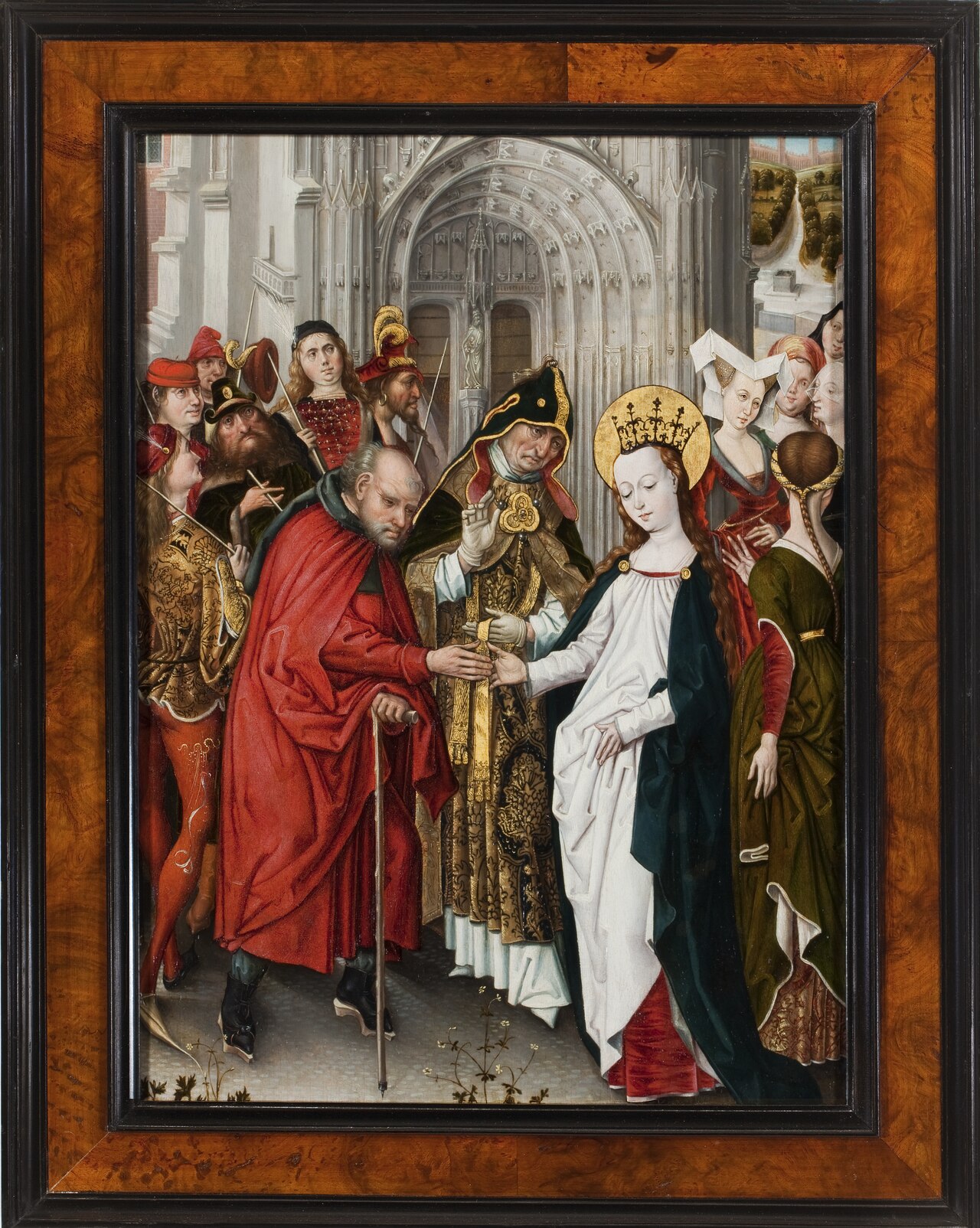
Marriage of Mary and Joseph (1480) – This narrative scene captures the betrothal of the Virgin Mary and Saint Joseph within an interior space defined by an ornate archway. The figures are arranged in a balanced composition, each rendered with careful attention to clothing detail. The scene reflects contemporary interest in domestic intimacy and the sanctification of marital union.
The Preaching of Saint Gaugericus (1480) – Depicting the 7th‑century bishop Saint Gaugericus delivering a sermon, this panel showcases the Master’s ability to render crowd scenes. The figures are arranged in a semi‑circular formation, each individual distinguished by varied gestures and attire, illustrating a lively yet orderly congregation.
The Marriage of the Virgin (1480) – In this work, the Virgin Mary is shown being presented to Saint Joseph in a richly ornamented chapel. The delicate rendering of the Virgin’s veil and the intricate stonework of the chapel’s columns demonstrate the Master’s command of texture and spatial perspective.
Collectively, these works illustrate a consistent visual language: measured compositions, refined surface treatment, and an emphasis on devotional intimacy.
Influence and legacy Although the Master of the View of Saint Gudula has never been identified by name, their oeuvre contributes valuable insight into the artistic climate of late‑15th‑century Brussels. By blending the meticulous detail of early Netherlandish masters with an emerging naturalism, the artist occupies a transitional position that foreshadows the work of later Flemish painters such as Hugo van der Goes and Gerard David.
The surviving panels have been studied for their contribution to the development of donor portraiture, a genre that would become a staple of Northern Renaissance art. Moreover, the Master’s handling of light and texture influenced workshop practices in Brussels, where apprentices often copied successful compositional formulas.
In modern scholarship, the Master is frequently referenced in discussions of anonymous masters whose names are derived from a characteristic work or location. This naming convention reflects both the scarcity of documentary evidence and the importance of visual analysis in attributing works to a cohesive hand. Contemporary exhibitions of Early Netherlandish painting often include the Master’s panels to illustrate the diversity of artistic production beyond the celebrated figures of van Eyck and van der Weyden.
Overall, the Master of the View of Saint Gudula remains a testament to the richness of Brussels’ artistic output at the close of the medieval period, offering scholars and viewers alike a window into the devotional and aesthetic concerns of the time.
Frequently asked questions
Who was the Master of the View of Saint Gudula?
The Master of the View of Saint Gudula was an anonymous Early Netherlandish painter active in Brussels during the last quarter of the 15th century.
What artistic style or movement does the Master belong to?
The artist worked within the Early Netherlandish painting tradition, blending detailed Gothic decoration with emerging naturalistic techniques.
What are the most famous works by the Master?
Key works include *Madonna and Child with Donor* (1500), *Mary Magdalene* (1500), *Young Man Holding a Book* (1480), *Marriage of Mary and Joseph* (1480), *The Preaching of Saint Gaugericus* (1480) and *The Marriage of the Virgin* (1480).
Why is the Master of the View of Saint Gudula important in art history?
The Master exemplifies the transitional phase of late‑15th‑century Netherlandish art, influencing later Flemish painters and providing insight into Brussels’ devotional visual culture.
How can I recognise a painting by the Master of the View of Saint Gudula?
Look for tall, narrow panels, meticulous textile and metal rendering, a calm, dignified figure, subtle atmospheric backgrounds, and precise architectural perspective.