Marie-Victoire Jaquotot
1772 – 1855
In short
Marie-Victoire Jaquotot (1772–1855) was a French painter renowned for her portraiture and decorative works, who earned the title First Porcelain Painter to the King in 1816. She worked in Paris and later Toulouse, producing notable pieces such as a self‑portrait (1790) and a series of courtly portraits.
Notable works
_by_Marie-Victoire_Jaquotot,_Toledo_Museum_of_Art.jpg)

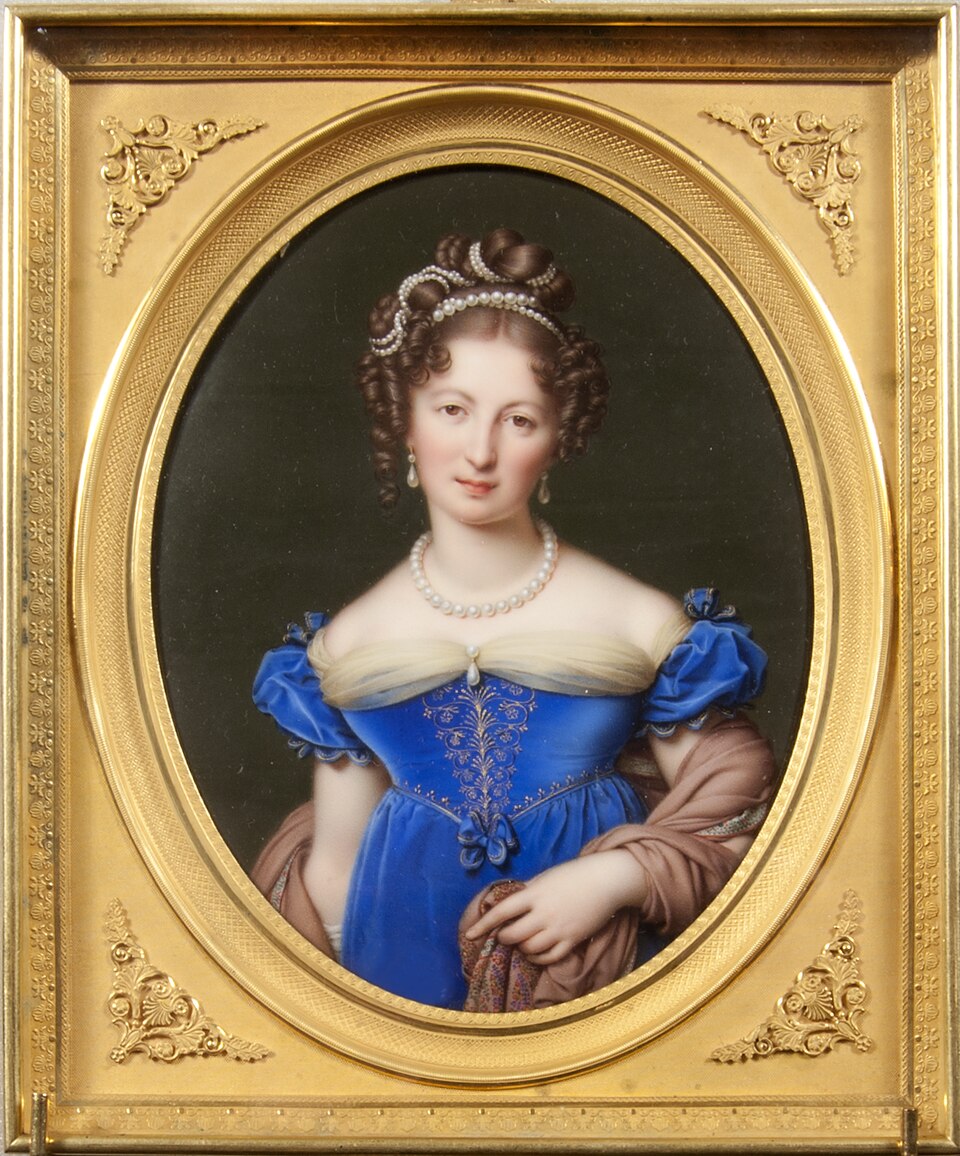

Early life Marie‑Victoire Jaquotot was born in Paris in 1772, into a family that, while not aristocratic, valued artistic education. The French capital at the turn of the eighteenth century offered a vibrant network of ateliers, academies, and salons, and Jaquottot's early exposure to these institutions shaped her ambition to become a professional artist. Records indicate that she received formal training in drawing and painting, likely under the guidance of a master in the Académie de Saint‑Luc, a common route for women who sought academic instruction when the École des Beaux‑Arts remained largely inaccessible to them. By the late 1780s, Jaquotot was already producing works in oil and was preparing to exhibit publicly, a bold step for a young woman in a still‑predominantly male profession.
Career and style Jaquotot’s career unfolded against the backdrop of the French Revolution, the Napoleonic era, and the Restoration of the Bourbon monarchy. The political turbulence of the 1790s limited official patronage, but her early self‑portrait (1790) demonstrates a confident handling of chiaroscuro and a willingness to confront the viewer with an introspective gaze. Throughout the early nineteenth century she cultivated a reputation as a portraitist capable of capturing the subtle psychological nuances of her sitters. Her style blended the academic rigour of the French Academy with a softer, often sentimental approach that appealed to the emerging bourgeois clientele.
The restoration of the monarchy in 1814–1816 proved decisive for Jaquotot. In 1816 she was appointed *Première Peintre de Porcelaine du Roi* (First Porcelain Painter to the King), a title that placed her among a select group of court artists tasked with designing decorative motifs for royal porcelain. This appointment reflected both her technical skill and her ability to navigate the patronage networks of the restored regime. While the title primarily concerned decorative porcelain, it also enhanced her visibility as a painter of fine art, leading to commissions from aristocratic patrons such as the Russian Countess Woronzow.
Jaquotot’s oeuvre does not align neatly with a single artistic movement. She worked during a period when Neoclassicism was giving way to Romanticism, and her paintings exhibit elements of both. Her compositions often employ the clear contours and idealised forms associated with Neoclassicism, yet the emotional intensity of her subjects—particularly in mythological scenes like *Danaé* (1827)—anticipates Romantic sensibilities.
Signature techniques Jaquotot’s technical repertoire was marked by a meticulous approach to surface texture and colour modulation. In portraiture she favoured a restrained palette of muted earth tones, allowing the flesh tones of the sitter to emerge with subtle gradations. Her handling of light is noteworthy: she frequently employed a soft, diffused illumination that envelops the figure, a technique that softens facial features while preserving a three‑dimensional presence.
When working on porcelain designs, Jaquotot adapted her brushwork to the constraints of glazed ceramic surfaces. She employed fine, linear detailing for decorative borders and motifs, often using a limited set of pigments that would survive the high‑temperature firing process. This duality—large‑scale oil painting and delicate porcelain decoration—required a versatile hand and an understanding of material chemistry that was rare among her contemporaries.
Major works - **Self‑portrait (1790)** – Executed when Jaquotot was only eighteen, this early work showcases her confidence and technical proficiency. The portrait presents the artist in a modest, dark‑toned dress, with a direct gaze that conveys both determination and a hint of vulnerability. The background is minimally rendered, focusing attention on the face and the subtle modelling of light. - **Woman with Mirror (after Titian) (1819)** – This piece is a homage to Titian’s *Venus with a Mirror*, reinterpreted through Jaquotot’s own lens. While the composition echoes the Renaissance master’s sensuality, Jaquotot introduces a more restrained colour scheme, employing a subdued palette of ochres and soft blues. The mirror serves both as a compositional device and a symbolic reflection on feminine identity. - **Countess Woronzow (1819)** – Commissioned by the Russian aristocratic family, the portrait captures the Countess in an elegant dress adorned with intricate embroidery. Jaquotot’s attention to textile detail demonstrates her skill in rendering luxurious fabrics, while the sitter’s poised expression reflects the social expectations of the era. The work was later displayed at the Paris Salon, earning commendation for its refined execution. - **Danaé (1827)** – In this mythological work, Jaquotot portrays the figure of Danaë, mother of Perseus, at the moment of Zeus’s descent in the form of golden rain. The painting merges Neoclassical composition with Romantic drama: the figure is centrally placed, bathed in a warm, luminous glow, while the surrounding clouds convey a sense of movement and emotional intensity. The work illustrates Jaquotot’s capacity to handle narrative subjects beyond portraiture.
These works collectively demonstrate Jaquotot’s versatility, from intimate self‑representation to grand mythological storytelling, and her ability to adapt to different media and patronage contexts.
Influence and legacy Marie‑Victoire Jaquotot occupies a modest yet significant place in French art history. As one of the few women to receive an official royal appointment in the early nineteenth century, she paved the way for later female artists seeking state recognition. Her dual practice—fine‑art portraiture alongside decorative porcelain design—exemplifies the fluid boundaries between high art and applied arts during the Restoration period.
Although she did not found a distinct school or movement, Jaquotot’s work contributed to the broader acceptance of women as professional artists in France. Contemporary critics praised her for the “delicate grace” of her portraits and the “refined elegance” of her decorative designs. Modern scholarship often cites her as a case study in the negotiation of gender, patronage, and artistic identity in post‑revolutionary France.
In Toulouse, where she spent her final years, Jaquotot’s legacy persisted through teaching and mentorship of younger artists, though documentation of this activity remains scarce. Her paintings are now held in several French regional museums, and her porcelain designs are occasionally featured in exhibitions on decorative arts of the Restoration era.
Overall, Jaquotot’s career reflects the adaptability required of artists navigating the volatile political and cultural landscape of early nineteenth‑century France, and her surviving works continue to offer insight into the aesthetic preferences and social dynamics of her time.
Frequently asked questions
Who was Marie‑Victoire Jaquotot?
Marie‑Victoire Jaquotot (1772–1855) was a French painter known for portraiture and decorative porcelain work, appointed First Porcelain Painter to the King in 1816.
What artistic style or movement is she associated with?
Jaquotot’s style blends academic Neoclassicism with early Romantic elements, reflecting the transitional period of early nineteenth‑century French art.
What are her most famous works?
Her most recognised pieces include the self‑portrait (1790), *Woman with Mirror* (after Titian, 1819), the portrait of Countess Woronzow (1819), and the mythological canvas *Danaé* (1827).
Why is she important in art history?
She was one of the few women to receive a royal artistic title in the Restoration era, illustrating the expanding role of women in professional art and bridging fine‑art painting with decorative porcelain design.
How can I recognise a painting by Jaquotot?
Look for a restrained colour palette, soft diffused lighting, meticulous rendering of fabrics, and a balance between precise academic drawing and subtle emotional expression.