Marie-François Firmin-Girard
1838 – 1921
In short
Marie‑François Firmin‑Girard (1838–1921) was a French Realist painter born in Poncin and died in Montluçon. He is noted for his genre scenes and urban views that capture everyday life in 19th‑century France.
Notable works
_Ulysse_et_les_sir%C3%A8nes_-_Firmin_Girard_-_Mus%C3%A9e_des_Beaux-Arts_de_Narbonne.jpg)


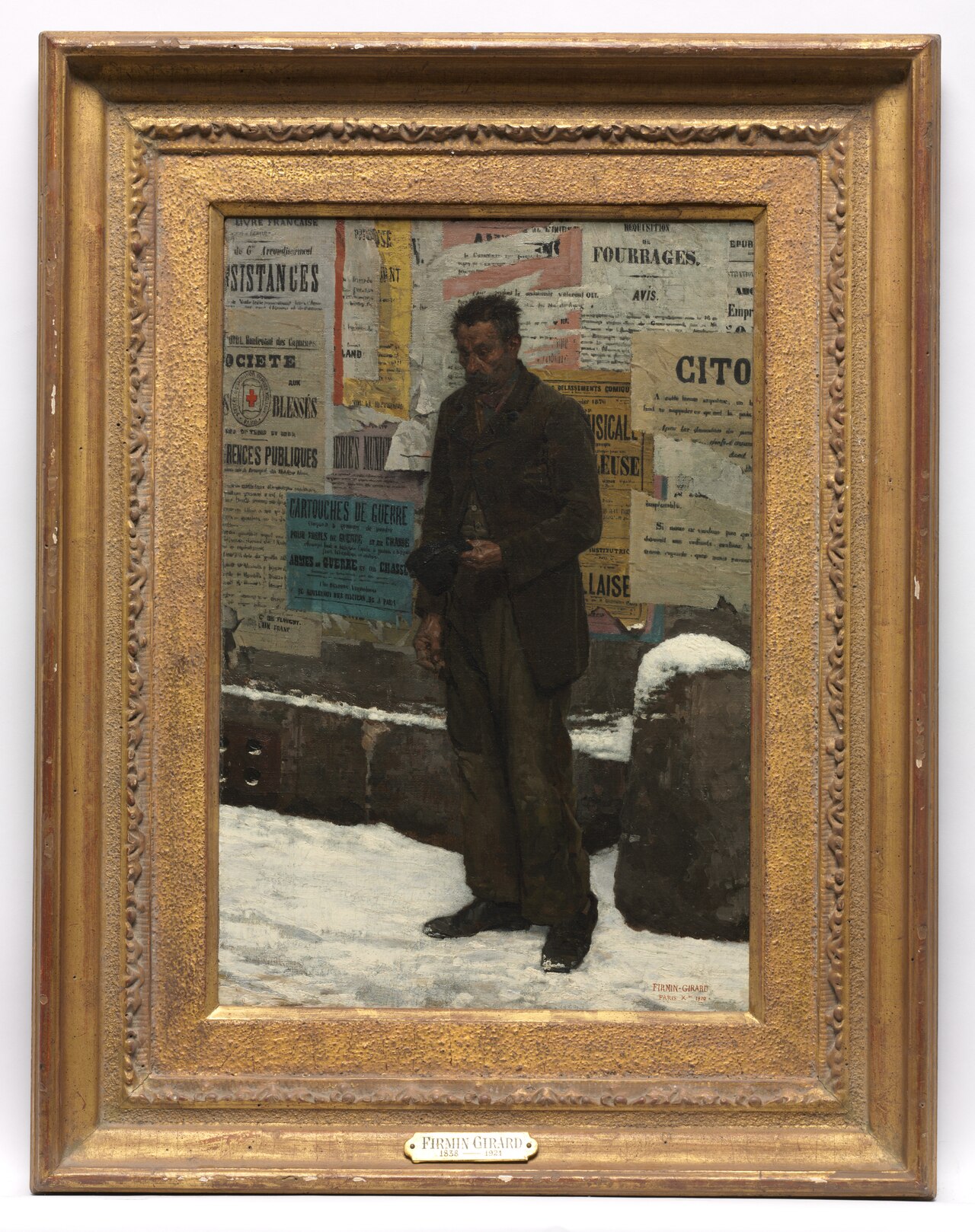
,_by_Marie-Fran%C3%A7ois_Firmin-Girard.jpg)
Early life
Marie‑François Firmin‑Girard was born in 1838 in the small town of Poncin, situated in the Ain department of eastern France. Little is recorded about his family background, but the rural environment of his childhood would later inform his sensitivity to ordinary people and everyday settings. As a young man, Firmin‑Girard moved to Paris to pursue artistic training, a common path for provincial talents seeking exposure to the capital’s vibrant art world. He enrolled in the ateliers that dominated French academic instruction, where he encountered the doctrines of Realism that were reshaping the artistic landscape.
Career and style
By the early 1860s Firmin‑Girard had begun exhibiting works that reflected the Realist commitment to depicting contemporary life without idealisation. His style combined a clear, sober palette with careful observation of light and atmosphere. Unlike the Romantic excesses of earlier generations, his paintings foreground the ordinary—workers, street scenes, and modest interiors—rendered with a compassionate yet unsentimental eye. The artist’s career spanned the turbulent decades of the Second Empire, the Franco‑Prussian War, and the early Third Republic, periods that provided ample subject matter for his socially engaged approach.
The realist impulse in his work is evident in the way he treats his subjects as individuals rather than allegorical symbols. He favoured a naturalistic handling of form, often employing loose brushwork to suggest texture while maintaining a solid underlying draftsmanship. His compositions are balanced, frequently structured around a central figure or activity that draws the viewer’s gaze into the narrative of the scene.
Signature techniques
Firmin‑Girard’s technique is characterised by three recurring elements. First, he employed a restrained colour scheme, favouring earth tones, muted blues, and occasional touches of ochre to convey the modest ambience of his settings. Second, his handling of light was subtle; he captured the diffuse illumination of overcast days or the soft glow of lamplight, allowing the play of shadow to enhance the sense of immediacy. Third, he often used a modestly thick impasto for surfaces such as stone or fabric, giving a tactile quality that invites the viewer to imagine the texture of walls, clothing, or street cobbles.
These techniques, combined with an attentive eye for detail, enabled Firmin‑Girard to render his subjects with a sense of dignity and presence that aligns him with the best practitioners of French Realism.
Major works
- Les sirènes (1864) – This early work presents a group of women, identified as "sirènes" in the colloquial sense of street entertainers, gathered at a bustling Parisian market. Firmin‑Girard captures the lively chatter and the play of light on the wet pavement, highlighting the social dynamics of urban life.
- Convalescents (1861) – Painted before the outbreak of the Franco‑Prussian War, this piece depicts a group of soldiers recuperating in a modest infirmary. The artist’s restrained palette and careful rendering of the weary expressions convey both the physical and emotional toll of conflict.
- The Street in Paris (1875) – A quintessential urban scene, this painting shows a Parisian boulevard lined with shops and pedestrians. Firmin‑Girard’s use of perspective draws the eye down the thoroughfare, while his attention to the varied activities—vendors, children, carriage drivers—creates a vivid snapshot of post‑war Paris.
- The Veteran (1870) – Executed shortly after the war, the work portrays a solitary veteran seated on a bench, his uniform draped over his lap. The composition’s quiet melancholy reflects the nation’s process of healing, and the artist’s subtle handling of the veteran’s weathered features underscores his empathy for the individual soldier.
- The Quai aux Fleurs, Paris (1875) – This later work returns to a riverside setting, focusing on the Quai aux Fleurs along the Seine. Firmin‑Girard captures the interplay of water, sky, and the bustling activity of market stalls, employing his characteristic light treatment to evoke a serene yet lively atmosphere.
Each of these works demonstrates Firmin‑Girard’s commitment to Realist principles, his skillful composition, and his ability to infuse ordinary subjects with narrative depth.
Influence and legacy
Although Marie‑François Firmin‑Girard never achieved the fame of contemporaries such as Gustave Courbet or Jean‑François Millet, his oeuvre provides a valuable record of French society during a period of rapid change. His paintings are frequently cited in studies of 19th‑century urban realism, offering insight into the everyday lives of workers, veterans, and city dwellers.
Later generations of French painters, particularly those associated with the early Impressionist movement, inherited Firmin‑Girard’s attention to light and atmospheric conditions. While he remained firmly within the realist tradition, his nuanced handling of urban environments anticipated the visual concerns of artists who would later depict Paris with a more luminous, fleeting approach.
Today, Firmin‑Girard’s works are held in regional museums across France, and they continue to be the subject of scholarly exhibition catalogues that explore the breadth of Realist painting beyond its most celebrated figures. His legacy endures as a testament to the power of honest, compassionate representation of ordinary life, reminding contemporary audiences of the enduring relevance of realism in art.
Overall, Marie‑François Firmin‑Girard stands as a diligent chronicler of his time, whose paintings combine technical proficiency with a humane perspective, enriching the tapestry of French art history.
Frequently asked questions
Who was Marie‑François Firmin‑Girard?
He was a French Realist painter (1838–1921) born in Poncin and known for genre scenes and urban views that document everyday life in 19th‑century France.
What artistic style or movement is he associated with?
Firmin‑Girard worked within French Realism, emphasizing truthful depictions of contemporary subjects without romanticising or idealising them.
What are his most famous works?
His notable paintings include *Les sirènes* (1864), *Convalescents* (1861), *The Street in Paris* (1875), *The Veteran* (1870) and *The Quai aux Fleurs, Paris* (1875).
Why does his work matter in art history?
His paintings provide a vivid record of social conditions in post‑imperial France and influence later artists’ treatment of light and urban scenes, enriching the broader narrative of Realist art.
How can I recognise a Firmin‑Girard painting?
Look for modest colour palettes, careful light handling, realistic urban or interior settings, and a compassionate focus on ordinary people rendered with solid draftsmanship.
Other French Realism artists
More France artists
References: Wikidata