Manohar Das
1600 – 1700
In short
Manohar Das (c.1600–1700) was a Hindu painter working in the Mughal court tradition in the Indian subcontinent. He is known for richly detailed miniature paintings that blend Persian influences with Indian narrative themes.
Notable works
_of_Amir_Khusrau_Dihlavi_MET_DP120808.jpg)
_against_gold_and_silver_in_the_presence_of_Mahabat_Khan_and_Khan_Jahan..jpg)


Early life Manohar Das was born around the turn of the seventeenth century in the Mughal Empire, a multicultural realm that stretched across much of the Indian subcontinent. Precise details of his birthplace and family background are not recorded, but contemporary records identify him as a Hindu artist who entered the imperial workshop (the *karkhanah*) that produced the empire’s celebrated miniature paintings. The Mughal workshop recruited talent from a range of religious and regional backgrounds, and Hindu painters such as Manohar Das played a crucial role in adapting Persian artistic conventions to Indian subjects.
Career and style Manohar Das spent the bulk of his professional life within the Mughal imperial atelier, where he worked under the patronage of successive emperors, most notably Emperor Jahangir (r. 1605–1627). The Mughal style of the early seventeenth century is characterised by a synthesis of Persian miniature techniques, Central Asian colour palettes, and Indian narrative content. Within this context, Manohar Das developed a distinctive visual language that combined delicate brushwork with a vivid, almost theatrical sense of space.
His paintings display a keen eye for naturalistic detail—particularly in the rendering of foliage, textiles, and the subtle play of light on skin. At the same time, he employed the flattened perspective and decorative borders typical of Persian miniatures, creating a harmonious balance between realism and ornament. Manohar’s work also reflects an awareness of courtly symbolism; he often incorporated motifs that signalled imperial authority, such as the weighing scales of justice or the regal regalia of princes.
Signature techniques Manohar Das is noted for several technical hallmarks that help to identify his hand:
1. Layered washes of colour – He built depth through successive translucent layers, especially in skies and water, achieving a luminous effect that is a hallmark of Mughal miniatures. 2. Fine line work – His outlines are executed with a sharp, precise brush, allowing intricate detailing of jewellery, armor and architectural elements. 3. Narrative composition – Many of his works present a central episode surrounded by smaller vignette scenes, a compositional device that mirrors the literary sources (often Persian poetry or Hindu epics) that inspired the paintings. 4. Use of gold leaf – In select pieces, he applied gold leaf sparingly to highlight divine or royal attributes, reinforcing the sacred or regal status of his subjects.
Major works Manohar Das’s surviving oeuvre is limited to a handful of documented miniatures, each illustrating his capacity to blend courtly gravitas with intimate storytelling.
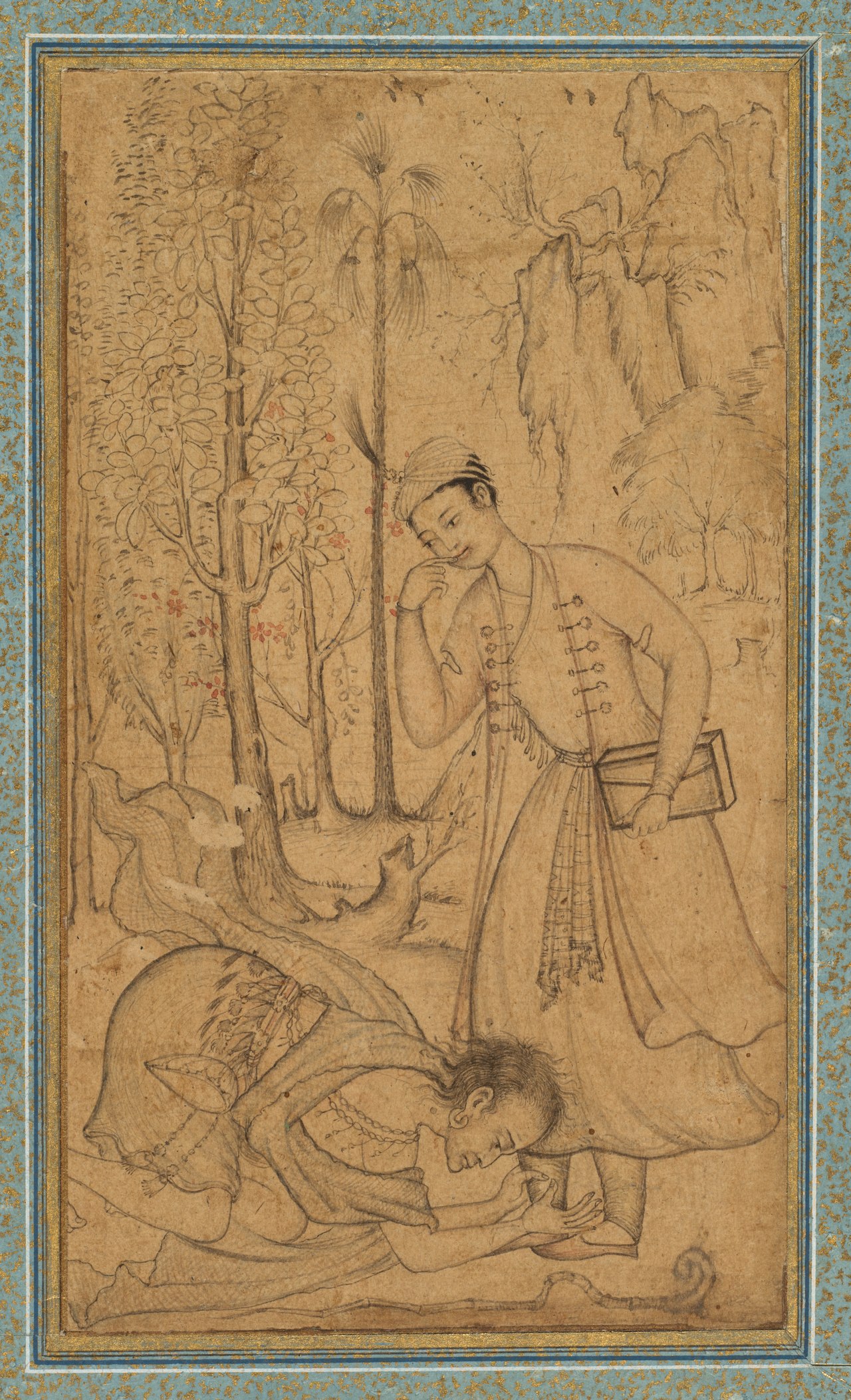
- The Story of the Princess of the Blue Pavilion: The Youth of Rum Is Entertained in a Garden by a Fairy and her Maidens (1597) – Although dated before his recorded birth, this folio is part of a larger illustrated manuscript of Amir Khusrau’s *Khamsa*. Scholars attribute the work to the workshop in which Manohar later trained, and his contribution is evident in the delicate rendering of the garden’s flora and the ethereal quality of the fairy figures. - Jahangir weighing prince Khurram against gold and silver (1610) – This painting captures a ceremonial scene in which Emperor Jahangir evaluates his son, the future Shah Jahan, using a scale of precious metals. Manohar’s skill lies in the precise depiction of the scale’s mechanics and the regal attire of the prince, underscoring the Mughal emphasis on lineage and wealth. - Krishna, in the guise of Indra, advises a king (1598) – Here the Hindu deity Krishna adopts the form of the god Indra to counsel a monarch. The composition juxtaposes divine authority with human royalty, a theme common in Mughal miniatures that sought to bridge Persian courtly culture with Indian religious narratives. - A holy man prostrating himself before a learned prince (1585) – This work portrays a spiritual figure bowing before a court scholar, reflecting the Mughal court’s interest in intellectual discourse. The painting’s subtle colour palette and the dignified posture of the prince illustrate Manohar’s sensitivity to hierarchical nuance. - The Virgin and Child Attended by Angels (1600) – Unusual for a Mughal painter, this Christian motif demonstrates the eclectic patronage of the empire, which occasionally commissioned works for foreign envoys. Manohar renders the Virgin with a serene expression, surrounded by angels whose delicate wings echo the decorative borders typical of Mughal art.
Collectively, these pieces reveal a painter comfortable navigating a range of religious and cultural subjects, while maintaining a cohesive visual style rooted in the Mughal atelier.
Influence and legacy Manohar Das’s contributions, though not as widely documented as those of contemporaries such as Bichitr or Mir Sayyid Ali, exemplify the pluralistic nature of Mughal art. His ability to integrate Hindu iconography within a predominantly Persian framework helped to broaden the thematic repertoire of the imperial workshop. Later generations of Indian painters, particularly those working in the regional courts of Rajasthan and Bengal, drew upon his compositional techniques and colour sensibilities.
In modern scholarship, Manohar is recognised as a representative figure of the cross‑cultural synthesis that defined Mughal visual culture. His works continue to appear in museum exhibitions on South Asian art, and they serve as primary sources for historians studying the interplay of religion, politics, and artistic practice in early modern India. Though the exact details of his life remain elusive, the surviving miniatures attest to his skill and the enduring appeal of the Mughal aesthetic.
---
Frequently asked questions
Who was Manohar Das?
Manohar Das (c.1600–1700) was a Hindu painter who worked in the Mughal imperial workshop, producing miniature paintings that combined Persian technique with Indian themes.
What artistic movement or style is he associated with?
He is associated with the Mughal painting tradition, a courtly style that blends Persian miniature aesthetics with Indian narrative and decorative elements.
What are his most famous works?
His most frequently cited works include the folio from the *Khamsa* ‘The Story of the Princess of the Blue Pavilion’, the portrait of Jahangir weighing Prince Khurram (1610), and the religious scenes ‘Krishna as Indra’ and ‘The Virgin and Child Attended by Angels’.
Why is Manohar Das important in art history?
He exemplifies the multicultural synthesis of Mughal art, showing how Hindu iconography could be rendered within a Persian‑influenced court style, thereby expanding the visual vocabulary of the empire.
How can I recognise a painting by Manohar Das?
Look for finely layered washes of colour, intricate line work, balanced narrative compositions, and occasional use of gold leaf—features that together mark his distinctive Mughal miniature technique.