Ludwig Guttenbrunn
1750 – 1819
In short
Ludwig Guttenbrunn (1750–1819) was a portraitist and history painter born in Vienna who worked across Central Europe, producing aristocratic portraits such as Marie Antoinette as Erato and notable Russian commissions, before dying in Frankfurt.
Notable works


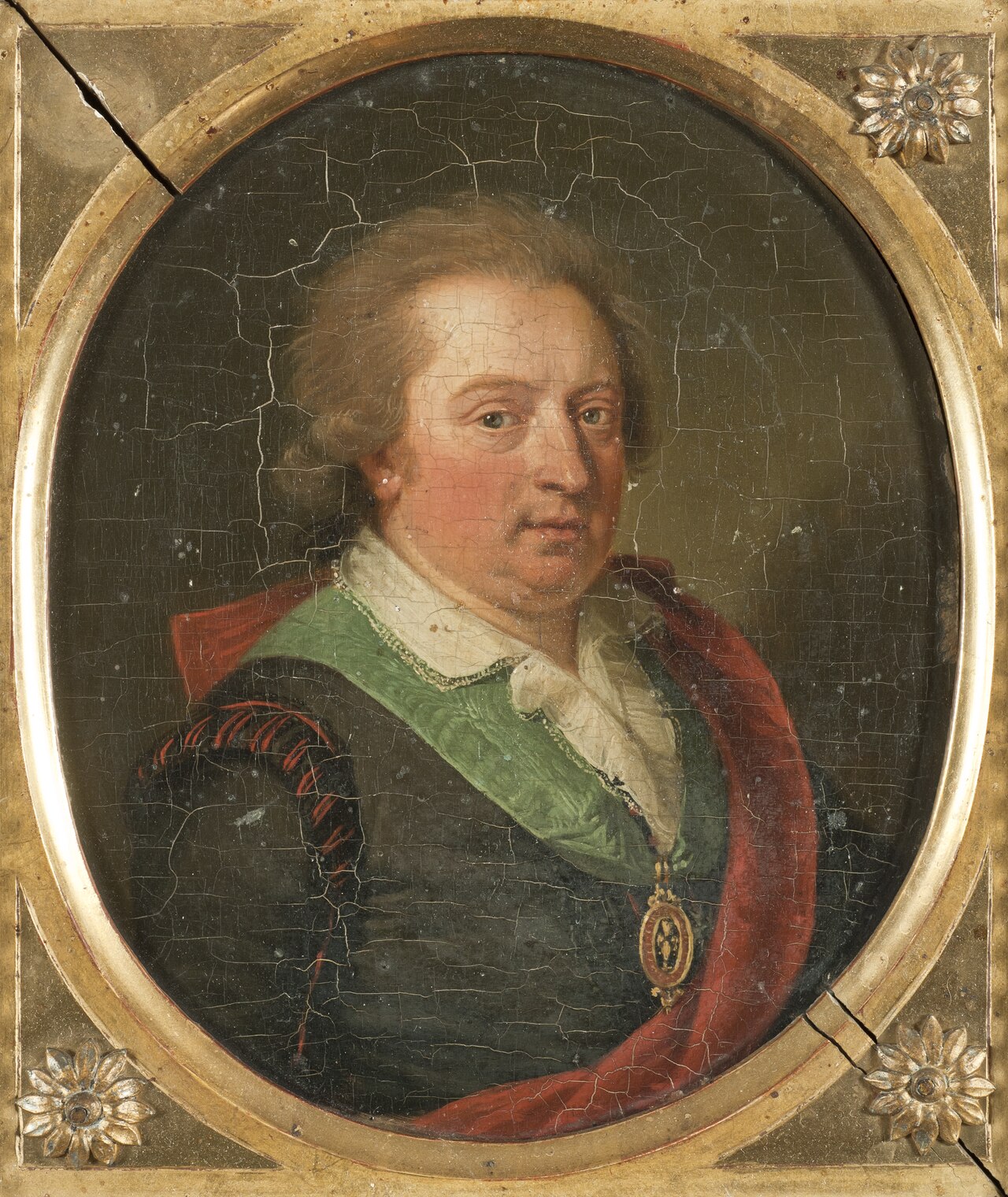
_-_Bildnis_eines_Herren_in_Kniehose_mit_einer_Gitarre_-_2432_-_F%C3%BChrermuseum.jpg)
Early life Ludwig Guttenbrunn was born in 1750 in Vienna, then part of the Holy Roman Empire. Little is recorded about his family background, and his nationality is not definitively established in surviving documentation. Vienna at the turn of the eighteenth century was a vibrant centre of artistic activity, offering numerous apprenticeships for aspiring painters. Guttenbrunn most likely received his initial training in the city's ateliers, where the prevailing academic conventions of portraiture and history painting were taught.
Career and style Guttenbrunn’s professional activity stretched from the 1770s through the early 1800s. He positioned himself primarily as a portraitist, a genre that enjoyed high demand among the aristocracy and emerging bourgeoisie of the Habsburg lands and neighbouring courts. His work also encompassed history painting, a genre that allowed him to display narrative skill and a knowledge of classical iconography. The artist’s style can be characterised as a synthesis of late Baroque richness and early Neoclassical restraint. He employed a relatively restrained palette, favouring muted earth tones punctuated by luminous flesh tones to bring his sitters to life. The compositional arrangements often place the figure against a modest interior or a subtly suggested landscape, allowing the viewer to focus on facial expression and attire.
Signature techniques Guttenbrunn’s technique reveals several hallmarks that help to identify his hand. First, his brushwork in rendering textiles is particularly detailed; the delicate folds of silk, velvet and lace are achieved with fine, layered strokes that convey both material texture and the play of light. Second, his handling of flesh tones demonstrates a careful modelling that avoids the flatness common in many provincial works of the period. He builds the skin’s volume through a series of semi‑transparent glazes, producing a gentle glow that suggests vitality. Third, Guttenbrunn often incorporates symbolic objects into his portraits—musical instruments, books, or classical attributes—that serve to communicate the sitter’s status, education or personal interests. Finally, his signatures, when present, appear in a discreet, cursive script near the lower right corner of the canvas, a habit that aligns with contemporary practice among Central European painters.
Major works The surviving oeuvre of Ludwig Guttenbrunn includes a handful of documented paintings that illustrate his range.
* Marie Antoinette as Erato (1788) – This portrait presents the French queen in the guise of Erato, the Muse of lyric poetry. The work combines regal elegance with allegorical nuance; Marie Antoinette is depicted wearing a flowing, pastel‑coloured gown, a lyre delicately held in her hands. The composition reflects Guttenbrunn’s ability to merge portraiture with classical themes, a skill prized by courts that valued both personal likeness and cultural erudition.
* Portrait of Prince Alexander B. Kurakin (1801) – Executed for the Russian diplomatic corps, this portrait shows the prince in a formal military uniform, complete with epaulettes and a sash. Guttenbrunn captures the sitter’s dignified bearing while subtly rendering the texture of the fabric. The background is a muted, darkened space that lifts the focus onto the figure’s face, emphasizing the prince’s sharp gaze.
* Portrait of Princess Ye. Golenishcheva‑Kutuzova (1797) – In this work, the princess is portrayed seated beside a window that hints at an interior garden. Her attire is richly embroidered, and a small brooch rests on her chest, hinting at familial lineage. Guttenbrunn’s treatment of light—reflected from the window onto the princess’s cheek—demonstrates his mature handling of chiaroscuro.
* Johan Tobias Sergel (1783) – A portrait of the Swedish sculptor, this painting situates Sergel amid a studio setting, surrounded by sketches and a partially completed marble figure. The inclusion of artistic tools underscores the sitter’s profession and provides a narrative layer. Guttenbrunn’s careful rendering of the sculptor’s hands, a focal point in the composition, highlights his interest in the physicality of artistic creation.
* Interior portrait of a musician or composer (date uncertain) – Although the exact dating is ambiguous, this interior scene depicts a seated musician surrounded by sheet music and a period instrument, perhaps a harpsichord. The work exemplifies Guttenbrunn’s capacity to blend portraiture with genre elements, capturing both the individual’s likeness and the ambience of a creative space.
These works collectively illustrate Guttenbrunn’s adaptability to diverse patronage networks—French, Russian, Swedish and local Central European—while maintaining a coherent visual language.
Influence and legacy Ludwig Guttenbrunn operated at a time when the European art market was becoming increasingly international. His ability to secure commissions from courts far beyond his native Vienna attests to a reputation that extended across political boundaries. While he never achieved the fame of contemporaries such as François Boucher or Angelica Kauffman, his portraits provide valuable insight into the visual culture of late eighteenth‑century aristocracy. They also serve as documentary evidence of the fashion, insignia and personal attributes valued by elite patrons.
In present‑day scholarship, Guttenbrunn is referenced primarily in studies of portraiture that examine the diffusion of Viennese artistic practices into the broader Holy Roman Empire and beyond. His works are held in several European collections, where they are occasionally exhibited alongside other Central European painters of the period. Though his name remains relatively obscure to the general public, the clarity of his technique and the elegance of his compositions continue to attract interest from curators and art historians seeking a nuanced picture of transitional styles between the Baroque and Neoclassical eras.
Overall, Ludwig Guttenbrunn’s career exemplifies the journeyman‑artist model of the late eighteenth century: a skilled practitioner who navigated patronage networks, produced works of high technical quality, and contributed to the visual documentation of his age.
Frequently asked questions
Who was Ludwig Guttenbrunn?
Ludwig Guttenbrunn (1750–1819) was a Viennese‑born portrait and history painter who worked across Central Europe, known for aristocratic portraits such as Marie Antoinette as Erato.
What style or movement is he associated with?
His style blends late Baroque richness with early Neoclassical restraint, reflecting the academic portrait traditions of the late eighteenth century.
What are his most famous works?
Among his most recognised paintings are Marie Antoinette as Erato (1788), the Portrait of Prince Alexander B. Kurakin (1801), and the Portrait of Princess Ye. Golenishcheva‑Kutuzova (1797).
Why does he matter in art history?
Guttenbrunn illustrates the cross‑court patronage networks of his time and provides a clear example of transitional portraiture between Baroque and Neoclassicism.
How can I recognise a Ludwig Guttenbrunn painting?
Look for finely modelled flesh tones, detailed textile rendering, subtle symbolic objects, and a discreet cursive signature near the lower right corner of the canvas.