Louis Robbe
1806 – 1887
In short
Louis Robbe (1806–1887) was a Belgian painter known for his pastoral scenes featuring cattle, sheep and rural landscapes. Working primarily in the mid‑19th century, he produced works such as Cattle in the Meadow (1878) and Landscape with Animals near Knokke‑Heist (1857).
Notable works
.jpg)
.jpg)

Early life Louis Robbe was born in 1806 in the Flemish city of Kortrijk, Belgium, a region steeped in agrarian traditions and a strong visual culture of countryside life. Little is recorded about his family background or formal education, but the environment of West Flanders—characterised by open fields, livestock, and a network of small towns—undoubtedly shaped his visual sensibility. By the time he reached adulthood, the Belgian art world was undergoing a period of consolidation after the country’s independence in 1830, with academies in Brussels and Antwerp promoting academic drawing and genre painting. It is plausible that Robbe received some academic training, as his later works display a competent handling of anatomy and perspective.
Career and style Robbe’s professional career unfolded in the middle decades of the 19th century, a time when the Belgian art market was receptive to both academic history paintings and the growing demand for genre scenes that celebrated everyday life. While his oeuvre does not align neatly with a single avant‑garde movement, his paintings exhibit a realist approach, focusing on the faithful depiction of rural subjects rather than the romanticised or historicised narratives favoured by many of his contemporaries. The absence of overt stylistic labels in the historical record suggests that Robbe operated largely as an independent painter, catering to patrons who appreciated the quiet dignity of agrarian subjects. His choice of subject matter—cattle, sheep, hay‑carts, and coastal vistas—places him within a broader European tradition of pastoral realism that includes artists such as Jean-François Millet and the Belgian painter Charles-Philippe Larivière.
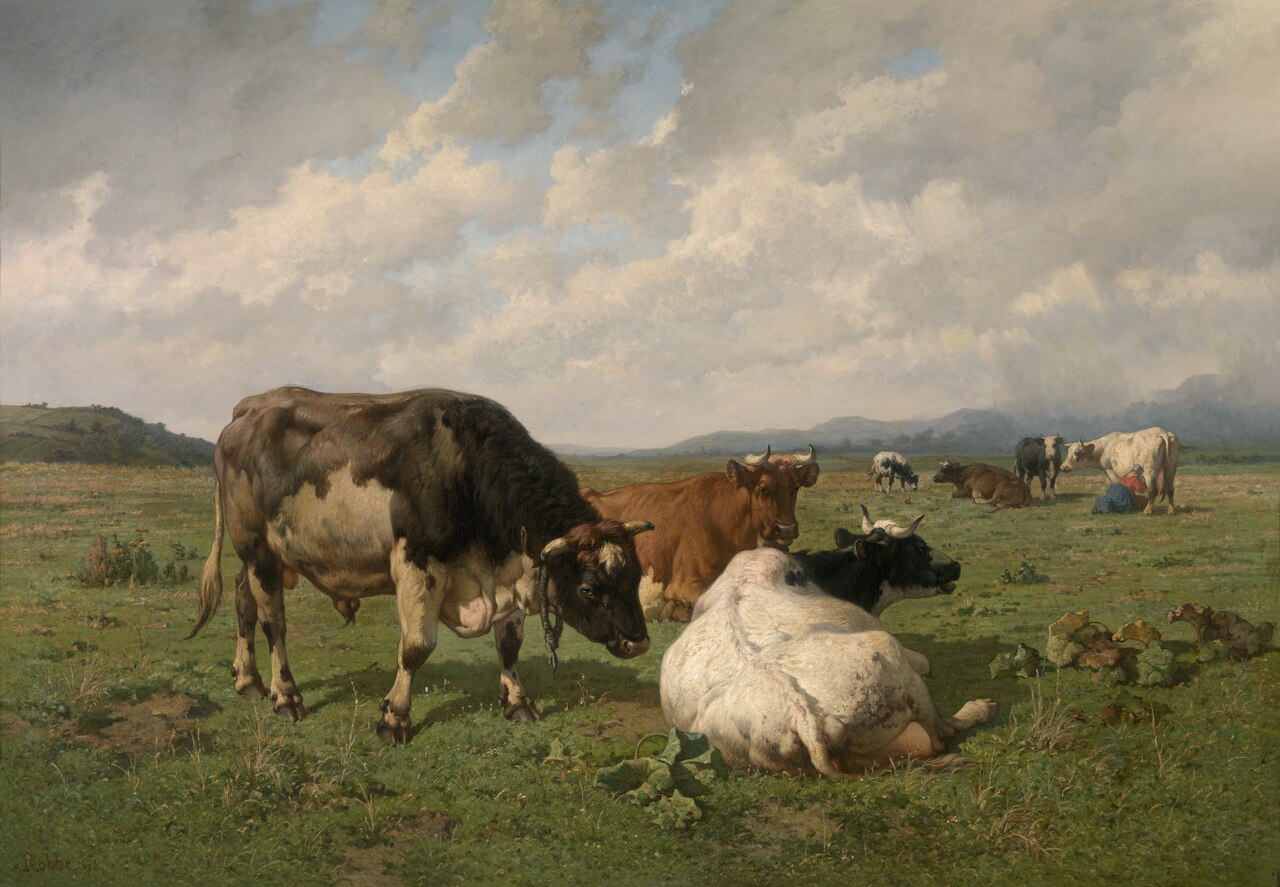
Robbe’s work shows a balanced composition where the landscape often frames the animals, creating a harmonious relationship between nature and its inhabitants. Light is rendered with subtle gradations, emphasizing atmospheric conditions—particularly in works like *Before the Storm* where the impending weather is suggested through a muted sky and the tense posture of the herd. This measured handling of light and colour reflects an adherence to observation rather than theatrical effect.
Signature techniques Robbe’s paintings are distinguished by several recurring technical traits. Firstly, his handling of animal anatomy is precise yet softened; he captures the bulk of cattle and the delicate contours of sheep without excessive detail, allowing the viewer to sense texture while maintaining compositional clarity. Secondly, his palette favours earth tones—ochres, muted greens, and soft blues—that mirror the natural hues of the Flemish countryside. These colours are layered in thin glazes, producing a luminous surface that suggests the play of daylight across fields and water. Thirdly, he employs a restrained brushwork: broader strokes delineate sky and ground, while finer, more controlled strokes render the fur and foliage. Finally, his compositions often incorporate a low horizon line, a device that expands the sky and foreground, thereby accentuating the vastness of the rural environment.
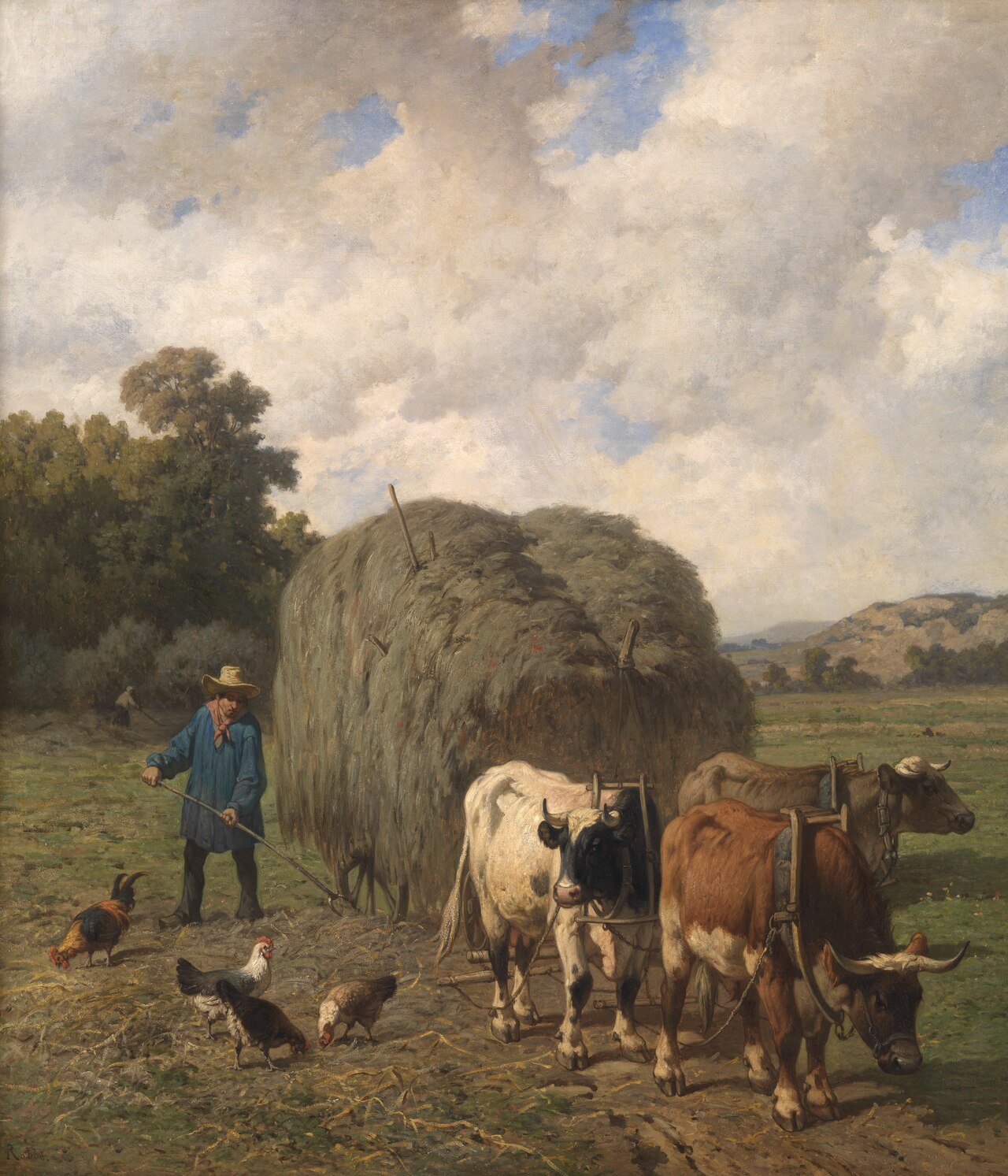
Major works - **Cattle in the Meadow (1878)** – One of Robbe’s later works, this painting presents a tranquil herd grazing beneath a sky streaked with soft clouds. The composition centres the cattle, using the meadow’s gentle slope to lead the eye toward the horizon, where a faint line of trees hints at distant habitation. The piece exemplifies his mature handling of light, with a warm, golden glow that suffuses the scene. - **Haycart** – Although undated, *Haycart* depicts a simple agrarian device positioned against a backdrop of rolling fields. The cart, laden with sheaves of hay, serves as a focal point that underscores the labour‑intensive nature of rural life. The work’s muted palette and careful modelling convey a sense of quiet industry. - **Landscape with Animals near Knokke‑Heist (1857)** – This earlier painting situates livestock near the coastal town of Knokke‑Heist, integrating seascape elements with the pastoral. The inclusion of water and distant dunes expands the visual field, while the animals remain central, illustrating Robbe’s skill at merging varied environments within a single cohesive scene. - **Before the Storm** – In this atmospheric work, Robbe captures the tension preceding an approaching storm. Darkening clouds loom over a field where a solitary cow stands, its posture suggesting alertness. The dramatic shift in lighting—contrasting bright patches with looming shadows—highlights his capacity to convey mood through weather. - **Pasture with Sheep and a Goat (1850)** – One of his earliest documented works, this painting presents a small flock of sheep and a solitary goat grazing amidst low‑lying grasses. The composition is intimate, with the animals rendered in soft focus, emphasising the peaceful rhythm of pastoral life. The work’s modest scale and gentle colour scheme reflect a youthful sensitivity to the subject.
Influence and legacy Although Louis Robbe never achieved the fame of some of his contemporaries, his paintings contribute valuable insight into mid‑19th‑century Belgian rural life. By concentrating on everyday agrarian scenes, he preserved visual records of livestock breeds, agricultural practices, and the Flemish landscape during a period of gradual industrialisation. His works were likely circulated among local collectors and may have appeared in regional exhibitions, influencing younger artists who sought to depict the countryside with authenticity. In contemporary scholarship, Robbe is referenced as an example of the realist tradition within Belgian art, illustrating how regional painters balanced academic training with personal observation. Today, his paintings are held in private collections and occasionally surface in auction houses, where they are appreciated for their technical proficiency and evocative serenity. While his name may not dominate art‑historical narratives, his oeuvre remains a testament to the quiet dignity of rural subjects and continues to inform studies of 19th‑century European genre painting.
Frequently asked questions
Who was Louis Robbe?
Louis Robbe (1806–1887) was a Belgian painter born in Kortrijk who specialised in realistic depictions of rural landscapes and livestock.
What artistic style or movement is he associated with?
Robbe is not linked to a specific avant‑garde movement; his work aligns with 19th‑century realist genre painting that focuses on everyday countryside scenes.
What are his most famous works?
His best‑known paintings include *Cattle in the Meadow* (1878), *Landscape with Animals near Knokke‑Heist* (1857), *Before the Storm*, *Haycart*, and *Pasture with Sheep and a Goat* (1850).
Why is Louis Robbe significant in art history?
He provides a valuable visual record of Belgian rural life in the mid‑1800s, illustrating the realist approach to genre painting and influencing later artists who sought authentic countryside representations.
How can I recognise a painting by Louis Robbe?
Look for calm pastoral scenes featuring cattle or sheep, an earth‑tone palette, subtle lighting, and a balanced composition where the landscape frames the animals, often with a low horizon line.
More Belgium artists
References: Wikidata