Louis-Jean-François Lagrenée
1725 – 1805
In short
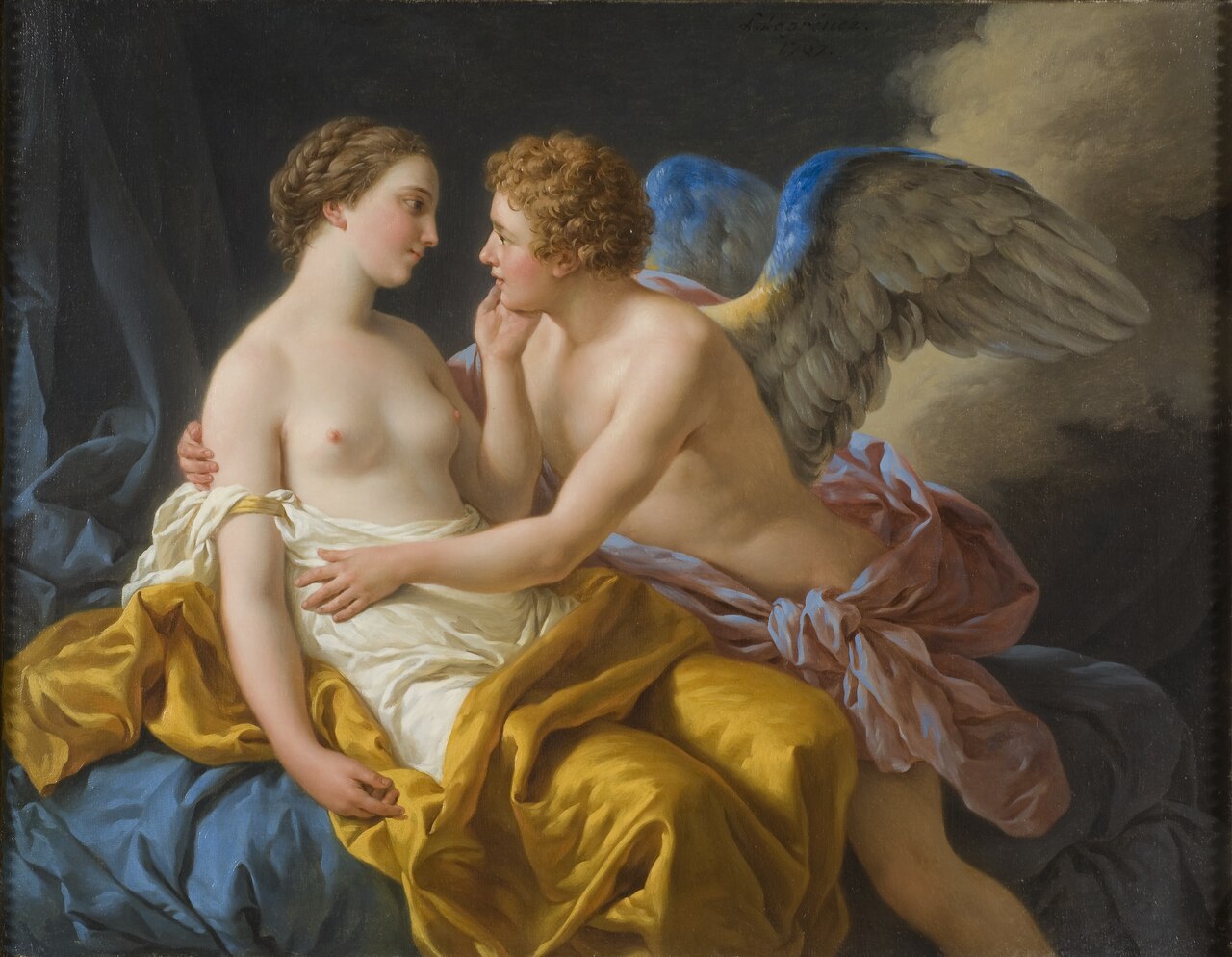
Louis-Jean-François Lagrenée (1725–1805) was a French Rococo painter, a student of Carle van Loo, winner of the 1749 Grand Prix de Rome, and a member of the Académie royale de peinture et de sculpture from 1755. He is known for mythological and historical canvases such as *Cupid and Psyche* (1767) and *Mars and Venus, Allegory of Peace* (1770).
Notable works



Early life Louis-Jean-François Lagrenée was born in Paris in 1725 into a family that would produce two notable painters. His father was a modest artisan, but the artistic talent of the Lagrenée brothers was evident early on. Louis‑Jean‑François entered the workshop of the prominent French painter Carle van Loo while still a teenager, absorbing van Loo's academic rigor and the decorative elegance that characterised the late Rococo style. The young Lagrenée quickly distinguished himself in the competitive Parisian art world, winning the prestigious Grand Prix de Rome for painting in 1749, a prize that granted him a formative stay at the French Academy in Rome.
Career and style Upon his return to Paris in the early 1750s, Lagrenée was admitted to the Académie royale de peinture et de sculpture in 1755, cementing his status among the elite of French artists. His career flourished under the patronage of the French aristocracy and the royal court, where his graceful compositions, luminous colour palette, and refined handling of mythological subjects earned him commissions for both private salons and public institutions. Although primarily identified with the Rococo movement, Lagrenée’s later work shows a gradual shift towards the neoclassical ideals that began to dominate French art in the 1770s, reflecting the broader cultural transition from the frivolity of the early Rococo to the moral seriousness of neoclassicism.
Throughout his professional life, Lagrenée maintained a close relationship with his younger brother Jean‑Jacques Lagrenée, also a painter. The brothers occasionally collaborated on large decorative projects, and their parallel careers illustrate the familial networks that were common among French academicians of the period.
Signature techniques Lagrenée’s paintings are distinguished by several recurring technical hallmarks. First, he employed a delicate, almost silken brushstroke that rendered flesh and drapery with a subtle sense of translucency. Second, his use of a luminous, pastel colour scheme—soft pinks, sky blues, and warm ochres—enhanced the decorative quality of his canvases while preserving a sense of depth. Third, he often arranged his figures in a harmonious, diagonal composition that guided the viewer’s eye across the narrative space, a device inherited from van Loo and typical of Rococo choreography. Finally, Lagrenée’s attention to detail in the rendering of mythological attributes—such as Cupid’s arrows, the jeweled diadems of deities, or the ornate armor of warriors—provided a visual vocabulary that made his works instantly recognisable.
Major works Lagrenée’s oeuvre includes a number of celebrated canvases that exemplify his mastery of mythological and historical themes. *Cupid and Psyche* (1767) portrays the tender moment when the god of love discovers Psyche’s beauty, a scene rendered with luminous skin tones and an ethereal atmosphere that captures the Rococo fascination with love and enchantment. In *Psyche surprising sleeping Cupid* (1768), Lagrenée revisits the same narrative with a more dynamic composition: Psyche is caught mid‑step, her hand hovering over the sleeping Cupid, creating a tension between secrecy and revelation.
The 1770 work *Mars and Venus, Allegory of Peace* merges classical mythology with contemporary political symbolism. Here, the war god Mars is shown laying down his sword before the goddess Venus, whose presence heralds a return to peace—a theme resonant with the diplomatic climate of Louis XV’s later reign. Lagrenée’s handling of the allegorical content demonstrates his ability to embed moral messages within decorative frameworks.
The painting dated 1773, though untitled in the surviving catalogue, exemplifies Lagrenée’s mature style, combining a more restrained colour palette with a heightened emphasis on linear clarity—a nod to the emerging neoclassical aesthetic. Finally, *La mort de la femme de Darius* (Louvre INV20142, 1785) marks a departure from mythological subjects toward a historical narrative drawn from ancient Persia. The canvas depicts the tragic death of Darius’s wife, rendered with dramatic chiaroscuro and a sober, almost theatrical composition, reflecting the artist’s adaptability to the tastes of the post‑Rococo era.
Influence and legacy Louis-Jean-François Lagrenée occupies a transitional position in French art history. While his early works embody the elegance and lightness of the Rococo, his later canvases anticipate the neoclassical turn that would dominate the late eighteenth century. As a professor at the Académie royale, he trained a generation of artists who inherited his blend of decorative finesse and academic discipline. His influence can be traced in the works of artists such as François-Guillaume Ménageot and later neoclassicists who valued narrative clarity and moral gravitas.
Lagrenée’s paintings remain in major museum collections, including the Louvre, where *La mort de la femme de Darius* is displayed alongside other pivotal works of the period. His legacy is also preserved through the continued study of Rococo art, where scholars cite his compositions as exemplary of the movement’s synthesis of beauty, storytelling, and technical virtuosity. Though less celebrated than some of his contemporaries, Lagrenée’s contributions provide a nuanced understanding of the artistic shifts that defined the latter half of the eighteenth century in France.
In summary, Louis‑Jean‑François Lagrenée’s career reflects the evolution of French painting from the ornamental exuberance of the Rococo to the disciplined rationality of neoclassicism, making him a key figure for scholars examining the complex interplay of style, patronage, and cultural change in pre‑revolutionary France.
Frequently asked questions
Who was Louis-Jean-François Lagrenée?
He was a French Rococo painter (1725–1805), a student of Carle van Loo, Grand Prix de Rome winner in 1749, and a member of the Académie royale from 1755.
What artistic style or movement is he associated with?
Lagrenée is primarily linked to the Rococo, though his later works show early neoclassical influences.
What are his most famous works?
Key paintings include *Cupid and Psyche* (1767), *Psyche surprising sleeping Cupid* (1768), *Mars and Venus, Allegory of Peace* (1770), and *La mort de la femme de Darius* (1785).
Why is Lagrenée important in art history?
He bridges the Rococo and neoclassical periods, taught at the Académie royale, and his works exemplify the decorative elegance and emerging moral seriousness of late‑eighteenth‑century French art.
How can I recognise a Lagrenée painting?
Look for soft pastel colours, graceful, diagonal compositions, delicate brushwork, and meticulous rendering of mythological details such as Cupid’s arrows or classical armour.