Louis Jean Desprez
1743 – 1804
In short
Louis Jean Desprez (1743–1804) was a French painter and architect who spent the last two decades of his life working in Sweden, where he produced a range of historic paintings and architectural projects, including the Obelisk at Slottsbacken in Stockholm.
Notable works



Early life Louis Jean Desprez was born in 1743 in the town of Auxerre, in the Burgundy region of France. Little is recorded about his family background, but contemporary sources suggest that he received a conventional education before entering the artistic world. He is believed to have studied at the Académie Royale de Peinture et de Sculpture in Paris, where he would have been exposed to the academic tradition of drawing, history painting and architectural design that dominated French art in the mid‑eighteenth century. This training equipped Desprez with the technical skills that later defined his dual career as a painter and an architect.
Career and style Desprez’s professional trajectory took a decisive turn in the 1780s when he accepted an invitation to work at the Swedish court of King Gustav III. The king, a passionate patron of the arts, was actively recruiting foreign talent to enrich Sweden’s cultural life, and Desprez’s expertise in both painting and architecture made him a valuable addition. In Sweden, Desprez operated within a courtly environment that favoured classicising aesthetics, yet he did not belong to a formally recognised movement. His style can be described as a synthesis of French academic classicism and the emerging neoclassical taste that was spreading through northern Europe. He employed clear compositional structures, a restrained palette, and a focus on historical and allegorical subject matter, aligning his work with the Enlightenment’s emphasis on rationality and moral instruction.
Signature techniques Desprez’s oeuvre is characterised by several recurring technical approaches. In his paintings, he favoured meticulous draughtsmanship, often beginning with detailed charcoal or ink studies before applying oil. His figures are rendered with a measured anatomical accuracy, and his use of chiaroscuro is subtle, serving to model forms rather than to create dramatic contrast. Architectural projects reveal his proficiency in perspective drawing; he was adept at producing large‑scale, site‑specific designs that integrated ornamental sculpture with structural form. In decorative commissions, Desprez frequently employed allegorical motifs—such as classical gods, mythological scenes, and symbolic emblems—to convey the political or ceremonial significance of the subject.
Major works Desprez’s most visible legacy in Sweden lies in a handful of works that documented contemporary events and contributed to the urban fabric of Stockholm.
- Obelisk at Slottsbacken (1800) – Ordered by the Swedish authorities to commemorate the reign of Gustav III, the obelisk stands on the prominent Slottsbacken avenue near the Royal Palace. Desprez supervised its design, which combined a classical Egyptian form with inscriptions that praised the king’s cultural reforms. The monument remains a focal point of Stockholm’s historic centre.
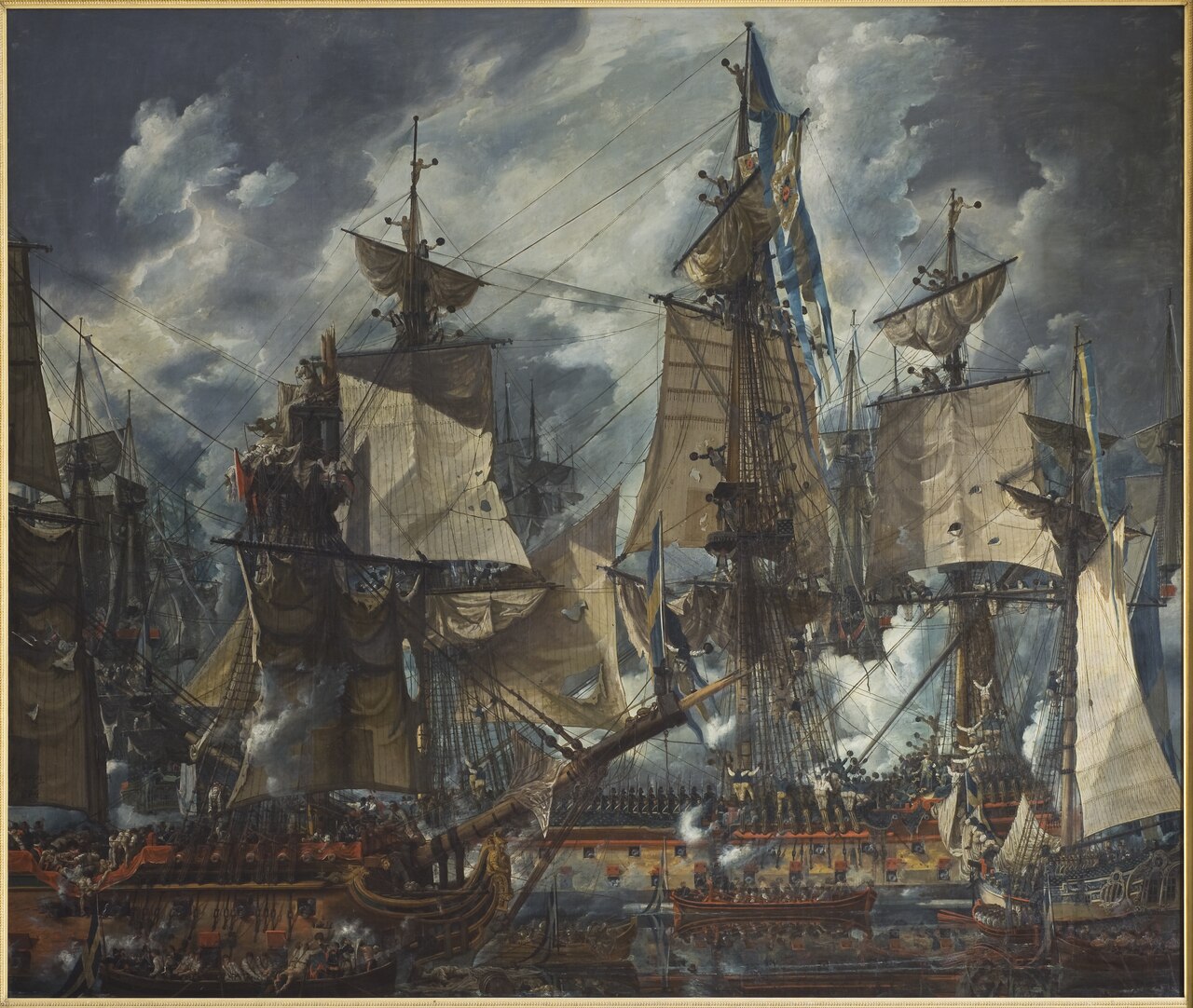
- Svenska chefsskeppet Gustaf III efter slaget vid Hogland 1788 (1794) – This oil painting portrays the Swedish flagship after the naval battle of Hogland (17 July 1788). Desprez captured the ship’s damaged hull against a stormy sea, using a muted colour scheme that underscores the drama of the conflict while maintaining a documentary precision that was valued by the court.
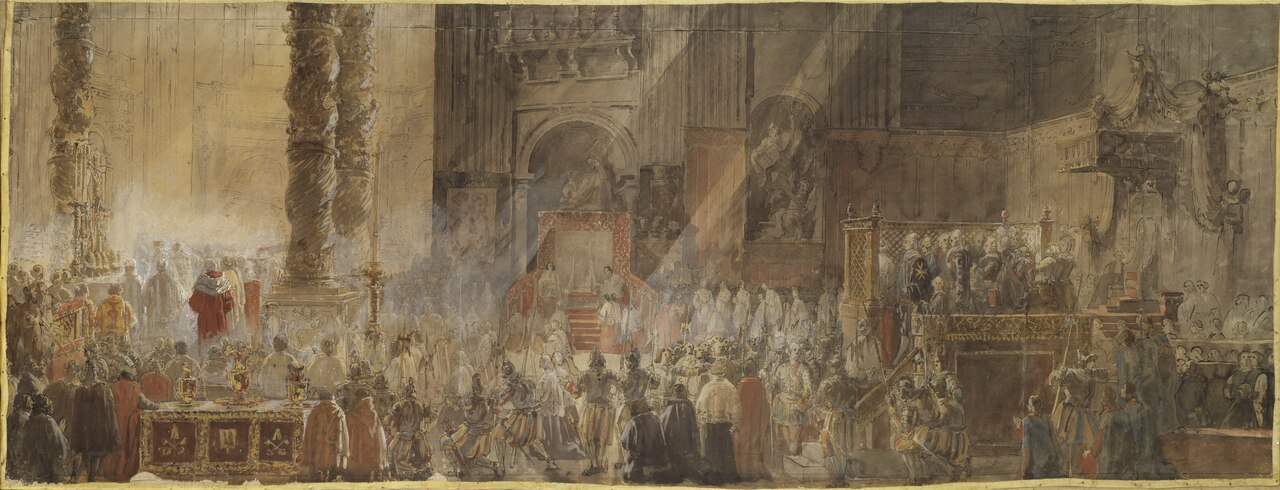
- Gustavus III Attending Christmas Mass in St Peter’s, Rome – A larger‑scale history painting, this work illustrates the king’s participation in a Roman liturgical ceremony, reflecting Gustav III’s diplomatic ties with the Papal States. Desprez rendered the interior of St Peter’s with careful attention to architectural detail, highlighting his ability to blend portraiture with expansive interior spaces.
- Gustav III:s besök i Tivoli (1784) – This composition records the monarch’s visit to the Tivoli gardens, a popular leisure destination. Desprez depicted the king strolling among ornamental fountains and classical statues, employing a light, almost Rococo‑tinged palette that contrasts with the more sober tone of his historic battle scenes.
- Sjöslaget vid Hogland den 17 juli 1788 – Another depiction of the same naval engagement, this piece focuses on the broader fleet action rather than a single vessel. Desprez’s treatment of water and smoke demonstrates his facility with dynamic, atmospheric effects while preserving the clarity of individual ships.
These works collectively illustrate Desprez’s capacity to document contemporary Swedish history, to celebrate royal patronage, and to apply his French academic training to a northern context.
Influence and legacy Louis Jean Desprez’s two‑decade residence in Sweden coincided with a period of vigorous cultural modernization under Gustav III. Though he never founded a distinct artistic school, his presence helped to disseminate French academic practices among Swedish artists and architects. His architectural designs, particularly the Slottsbacken obelisk, contributed to the neoclassical transformation of Stockholm’s public spaces, influencing later projects by native architects such as Carl Gustaf Mannerheim.
In the realm of painting, Desprez’s historical canvases served as visual records of pivotal events, providing future historians with a pictorial account of late‑eighteenth‑century Swedish military and ceremonial life. His careful rendering of architectural interiors also offered a valuable reference for scholars studying the diffusion of neoclassical décor in Scandinavia.
Although his name is not as widely recognised as some of his contemporaries, Desprez’s dual expertise and his cross‑cultural career exemplify the mobility of artists in the Enlightenment era. Today, his works remain in Swedish museum collections and public spaces, and they continue to be cited in art‑historical discussions of Franco‑Swedish exchanges during the late eighteenth century.
Desprez died in Stockholm in 1804, leaving behind a modest but enduring body of work that bridges French academic tradition and Swedish national expression.
Frequently asked questions
Who was Louis Jean Desprez?
Louis Jean Desprez (1743–1804) was a French painter and architect who spent the last twenty years of his life working in Sweden, producing historic paintings and architectural designs for the court of Gustav III.
What artistic style or movement is Desprez associated with?
Desprez did not belong to a formal movement; his style blends French academic classicism with the neoclassical taste that was popular in late‑eighteenth‑century Europe.
What are Desprez’s most famous works?
His best‑known works include the Obelisk at Slottsbacken (1800), the paintings ‘Svenska chefsskeppet Gustaf III efter slaget vid Hogland 1788’ (1794), ‘Gustavus III Attending Christmas Mass in St Peter’s, Rome’, ‘Gustav III:s besök i Tivoli’ (1784) and ‘Sjöslaget vid Hogland den 17 juli 1788’.
Why is Desprez important in art history?
Desprez helped introduce French academic techniques to Sweden, contributed to the neoclassical redesign of Stockholm’s public spaces, and provided visual documentation of key Swedish historical events.
How can I recognise a work by Desprez?
Look for precise draftsmanship, a restrained colour palette, clear classical composition, and subjects that combine historical narrative with architectural detail, often featuring allegorical or royal themes.