Louis Hersent
1777 – 1860
In short
Louis Hersent (1777‑1860) was a French painter of the early‑19th century, known for his history paintings and portraits. He trained in the neoclassical tradition, exhibited regularly at the Paris Salon, and produced works such as Ruth and Boaz (1822) and Daphnis and Chloé (1842).
Notable works


Early life Louis Hersent was born in Paris in 1777, a period of great political and artistic upheaval. He grew up in a city that was the heart of French cultural life, and his early education was shaped by the legacy of the Académie Royale and the emergence of neoclassicism as the dominant aesthetic. Hersent entered the atelier system, where he received formal training in drawing and composition, a foundation that would inform his later career.
Career and style Hersent first appeared on the Paris Salon in the early 1800s, quickly establishing himself as a competent practitioner of the neoclassical idiom. His style combined the rigorous line work and idealised forms championed by his mentors with a subtle sensitivity to emotion, a quality that presaged the Romantic movement. Throughout his career he balanced historical subjects—often drawn from biblical or classical sources—with portraiture, a genre that provided both financial stability and social prestige.
The artist’s palette was restrained, favouring muted earth tones and a controlled use of colour to highlight narrative focus rather than decorative effect. His compositions typically feature clear, balanced arrangements, with central figures rendered in a sculptural manner. While the overall tone remains academic, Hersent’s later works display a softer modelling of flesh and a heightened attention to atmospheric effects, suggesting an evolution toward a more lyrical approach.
Signature techniques Hersent’s technical repertoire is characterised by several recurring methods:
* Precise drawing – He employed a tight, preparatory drawing phase, often using charcoal or fine ink to establish anatomical accuracy before applying paint. * Chiaroscuro – Light and shadow are used to model forms and to direct the viewer’s eye toward focal points; his handling of light is subtle rather than theatrical. * Smooth surface – The finished canvas typically shows a polished, almost enamel‑like surface, indicative of the academic practice of eliminating visible brushwork. * Narrative clarity – In history paintings, Hersent arranges figures and props so that the story is instantly recognizable, a technique that aligns with the didactic aims of the Salon jury.
These methods allowed him to produce works that were both technically accomplished and accessible to a broad audience.
Major works Among Hersent’s most noted pieces are the following:
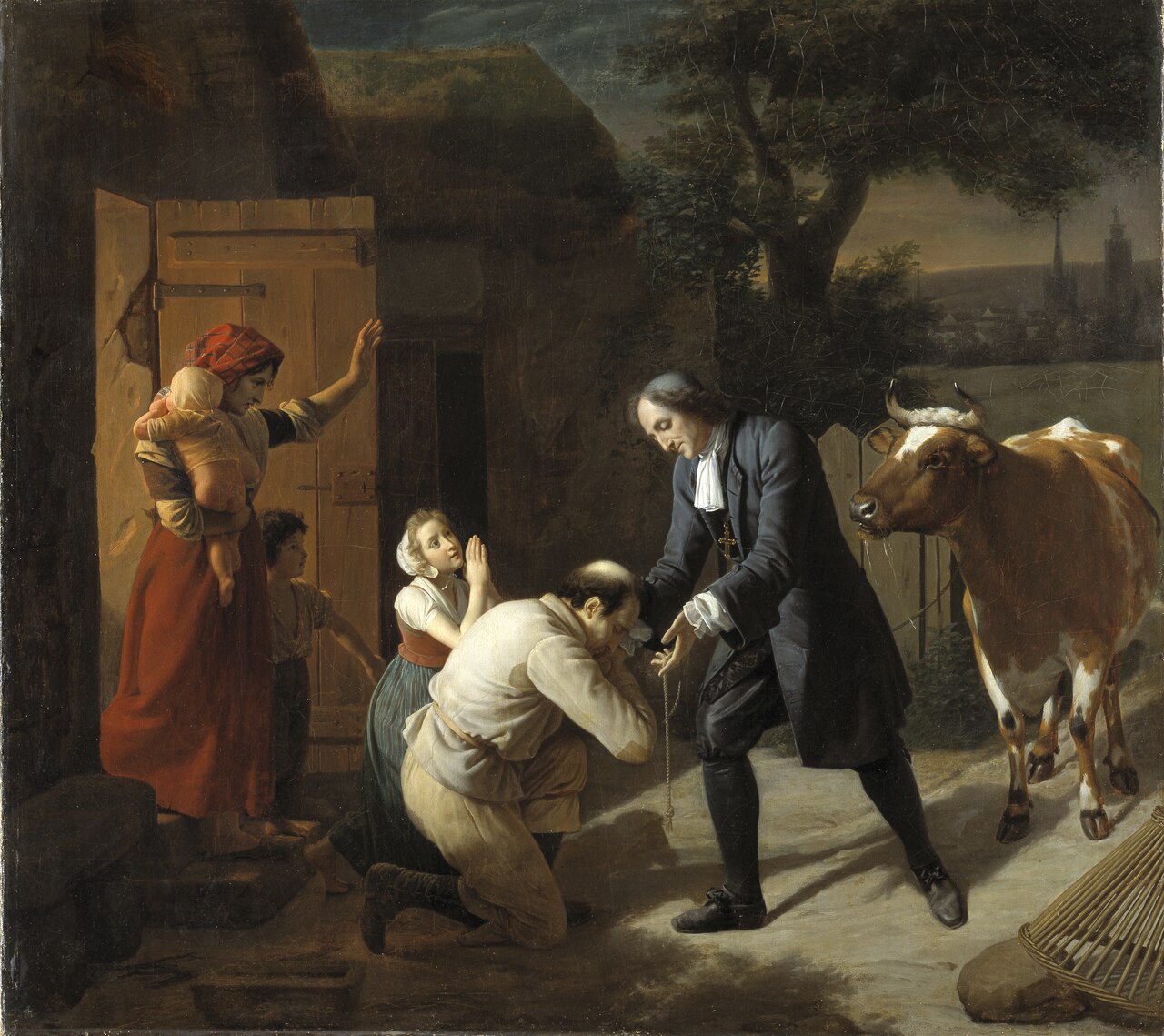
* Sophie Crouzet (1801) – An early portrait that demonstrates his skill in rendering delicate fabrics and a restrained yet expressive facial expression. The work reflects the neoclassical emphasis on ideal beauty while hinting at a personal intimacy. * Fénélon returns a Stolen Cow to a Peasant (1810) – A history painting illustrating a charitable act, notable for its balanced composition and the dignified portrayal of rural figures. Hersent’s use of light accentuates the moral virtue of the central character. * Ruth and Boaz (1822) – This biblical scene showcases Hersent’s mature handling of narrative drama; the figures are rendered with a sculptural solidity, and the surrounding landscape is treated with a gentle chiaroscuro that enhances the emotional resonance. * Religieux de l'hospice du mont Saint Gothard (1824) – A work depicting a religious figure in a contemplative pose, featuring a muted colour scheme and a focus on interior space that underscores the solemnity of the subject. * Daphnis and Chloé (1842) – One of his later mythological compositions, it reflects a shift toward a more romantic sensibility. The figures are placed in a lush, idyllic setting, and the painter employs softer modelling to convey a sense of pastoral bliss.
These works collectively illustrate Hersent’s evolution from strict neoclassicism toward a more nuanced, emotive language, while retaining his commitment to technical excellence.
Influence and legacy Louis Hersent remained an active participant in the French art world for more than four decades, regularly exhibiting at the Salon and receiving official commissions. His adherence to academic standards helped sustain the institutional framework that governed French painting well into the mid‑19th century. Though he never achieved the fame of contemporaries such as Ingres or Delacroix, his oeuvre contributed to the continuity of the neoclassical tradition during a period of rapid stylistic change.
Hersent’s paintings are held in several public collections, where they serve as exemplars of the transitional period between neoclassicism and early Romanticism. His portraits provide valuable visual documentation of Parisian society, while his history paintings reflect the moral and civic ideals promoted by the post‑revolutionary state. Modern scholarship often cites Hersent when discussing the broader network of artists who upheld academic conventions while subtly integrating emerging romantic tendencies.
In summary, Louis Hersent occupies a respectable position within 19th‑century French art. His disciplined technique, clear narrative approach, and capacity to adapt stylistic elements ensure that his work remains a useful reference point for scholars studying the evolution of academic painting in France.
Frequently asked questions
Who was Louis Hersent?
Louis Hersent (1777‑1860) was a French painter known for his neoclassical history paintings and portraits, active in the Paris Salon during the early 19th century.
What style or movement is he associated with?
He worked within the academic neoclassical tradition, later incorporating softer, more romantic touches into his compositions.
What are his most famous works?
Key works include Sophie Crouzet (1801), Fénélon returns a Stolen Cow to a Peasant (1810), Ruth and Boaz (1822), Religieux de l'hospice du mont Saint Gothard (1824) and Daphnis and Chloé (1842).
Why does he matter in art history?
Hersent helped sustain the academic standards of French painting after the Revolution, bridging neoclassicism and early Romanticism and providing valuable examples of moral and civic themes in art.
How can I recognise a painting by Hersent?
Look for precise drawing, smooth brushwork, balanced compositions, subtle chiaroscuro and a calm, dignified portrayal of figures, often with clear narrative focus.