Louis Dubois
1830 – 1880
In short
Louis Dubois (1830–1880) was a Belgian painter from Brussels who worked in a naturalistic style, producing landscapes, portraits, genre scenes and still‑lifes. He is best known for works such as The Storks (1858) and Marshland (1863), and died in Schaerbeek.
Notable works

_-_1911-HL_-_Museum_of_Fine_Arts_Ghent_(MSK).jpg)
.jpg)
.jpg)
Early life Louis Dubois was born in 1830 in Brussels, the capital of what was then the United Kingdom of the Netherlands and later the independent Kingdom of Belgium. Little is recorded about his family background, but contemporary accounts suggest he grew up in a milieu that valued the visual arts. Brussels, with its flourishing academies and active exhibition scene, offered young artists opportunities for formal training and exposure to the burgeoning realist tendencies that were reshaping European painting in the mid‑nineteenth century. Dubois is believed to have taken his first drawing lessons locally, developing a solid foundation in academic drawing before moving on to oil painting.
Career and style Dubois began exhibiting publicly in the early 1850s, aligning himself with a generation of Belgian painters who embraced naturalism rather than the more idealised romanticism of earlier decades. His work is characterised by a careful observation of light, atmosphere and the tactile qualities of his subjects. Whether rendering a quiet rural scene or a seated portrait, Dubois pursued a faithful representation of colour and form, often employing a restrained palette that highlighted the subtle shifts of daylight. Although he did not affiliate himself with a formal movement, his paintings resonated with the broader European Realist current, sharing affinities with the French Barbizon school and the Dutch Hague School in their emphasis on everyday subjects rendered with sincerity.
Dubois’s oeuvre includes landscapes, portrait studies, genre scenes and still‑life compositions. In landscape paintings he favoured low‑lying marshes, riverbanks and orchard settings, where he could explore the interaction of water, sky and foliage. His portraits, while less numerous, reveal a keen psychological insight; he captured the individuality of his sitters through attentive modelling of the face and a modest, often neutral background that kept the focus on the subject.
Signature techniques A hallmark of Dubois’s technique was his handling of paint to convey texture. In his landscapes he layered thin glazes of muted greens and blues to suggest mist over water, then applied more opaque strokes for reeds and vegetation, achieving a sense of depth without relying on dramatic chiaroscuro. For portraits and figure studies he employed a tighter brushwork around the face, allowing subtle tonal variations to model the skin. In still‑life works such as Still Life with Studio Objects, Dubois arranged everyday items—books, a glass bottle, a painted canvas—so that the interplay of light on different surfaces created a quiet, contemplative atmosphere. His use of a limited colour range, combined with careful modulation of value, gave his paintings a cohesive, almost photographic quality.
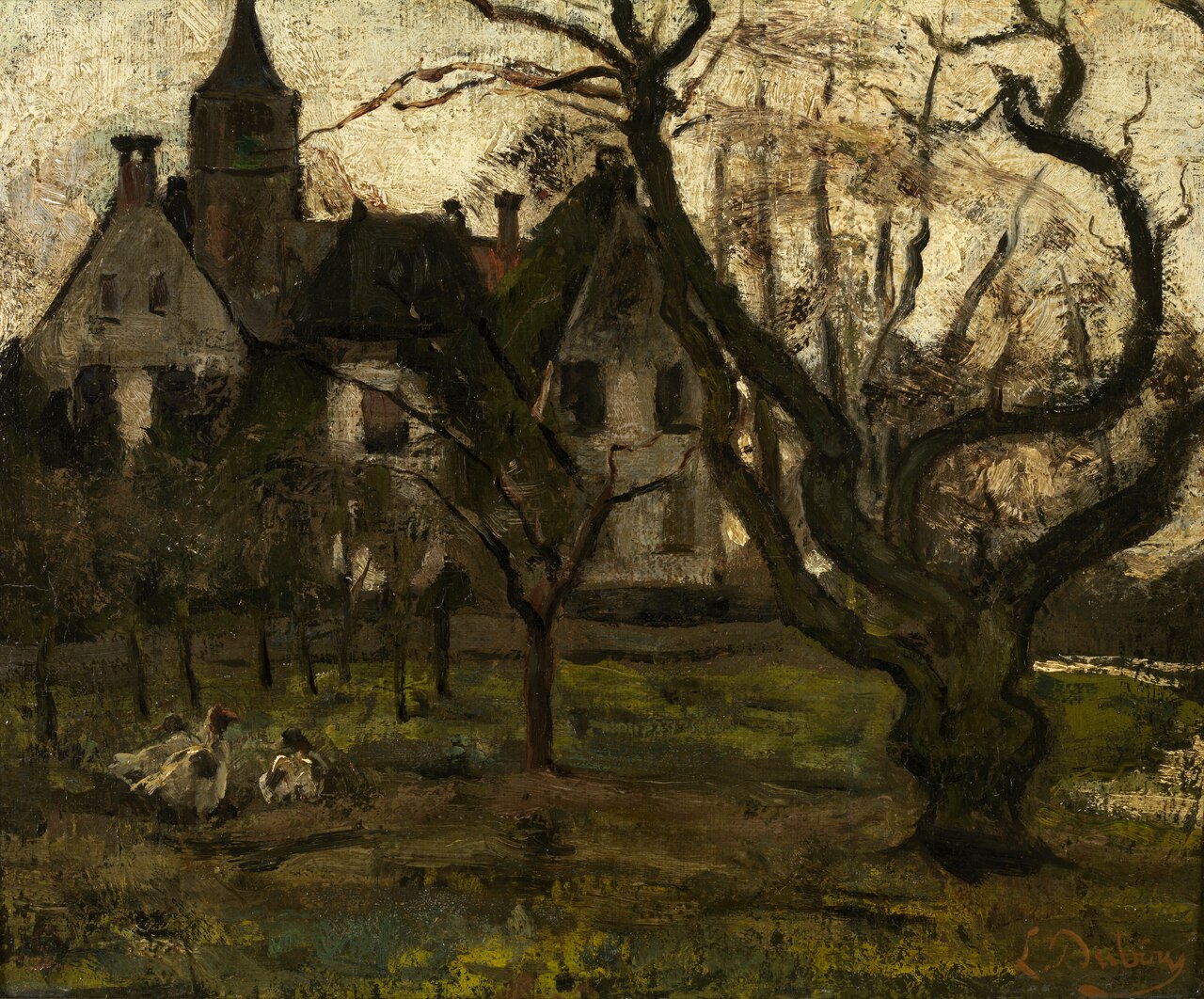
Major works Dubois’s most frequently cited pieces illustrate his range. **The Storks (1858)** depicts a pair of birds standing in shallow water against a hazy sky; the composition balances the stark silhouette of the storks with the soft reflections on the surface, exemplifying his skill in rendering atmosphere. **Marshland (1863)** expands on this theme, presenting an expansive wetland scene where reeds and distant trees dissolve into a muted horizon, inviting the viewer into a contemplative space. **The Orchard of the Castle** showcases a more narrative subject, with a cultivated orchard set against the backdrop of a medieval fortress; here Dubois combines his naturalistic eye with a subtle historic interest, rendering the trees with delicate foliage while suggesting the solidity of the stone walls. **Head of a Man (study) (1869)** is a study in portraiture, focusing on the detailed rendering of a male head, from the texture of hair to the nuanced expression in the eyes, reflecting his dedication to capturing character. Finally, **Still Life with Studio Objects** gathers a selection of everyday items—paintbrushes, a palette, a partially painted canvas—arranged on a wooden table, allowing Dubois to explore the materiality of paint and the quiet dignity of the artist’s workspace.
Influence and legacy Although Louis Dubois never achieved the international fame of some of his contemporaries, his work contributed to the solidification of naturalistic painting in Belgium. By consistently portraying ordinary subjects with dignity and technical competence, he helped to broaden the acceptance of genre and landscape painting as worthy artistic pursuits. His paintings were regularly shown at the Salon de Bruxelles, where they influenced younger Belgian artists who sought to move beyond academic idealisation toward a more truthful depiction of their environment. In the decades after his death in Schaerbeek in 1880, Dubois’s works were collected by regional museums and private patrons, ensuring that his careful observation of light and atmosphere remained accessible to later generations. Today, his paintings are studied as examples of mid‑nineteenth‑century Belgian naturalism, valued for their quiet elegance and technical restraint.
Frequently asked questions
Who was Louis Dubois?
Louis Dubois was a Belgian painter (1830–1880) from Brussels who worked in a naturalistic style, creating landscapes, portraits, genre scenes and still‑lifes.
What style or movement is he associated with?
He is not linked to a specific named movement, but his work aligns with mid‑nineteenth‑century naturalism and shares affinities with the realist tendencies of the Barbizon and Hague schools.
What are his most famous works?
His best‑known paintings include The Storks (1858), Marshland (1863), The Orchard of the Castle, Head of a Man (study) (1869) and Still Life with Studio Objects.
Why is Louis Dubois important in art history?
Dubois helped establish naturalistic painting in Belgium, demonstrating that everyday subjects could be rendered with dignity and technical skill, and influencing younger artists to move beyond academic idealisation.
How can I recognise a painting by Louis Dubois?
Look for a restrained colour palette, careful modelling of light and atmosphere, and meticulous texture—especially in water, foliage and the surfaces of everyday objects.