Louis Douzette
1834 – 1924
In short
Louis Douzette (1834–1924) was a German landscape painter born in Tribsees and active mainly in northern Germany. He is best known for atmospheric moonlit and winter scenes, such as Moonlight in Winter and Landscape with Windmill.
Notable works

_Douzette_-_Landscape_with_Windmill_-_1969.186_-_Fogg_Museum.jpg)
.jpg)
Early life Louis Douzette was born on 28 July 1834 in the small town of Tribsees, located in the Mecklenburg‑Vorpommern region of what is now Germany. His birth name was Carl Ludwig Christoph Douzette, but he adopted the francophone spelling "Louis" as a professional moniker, a practice not uncommon among German artists seeking broader European recognition. Details of his family background are sparse, but contemporary records indicate that he grew up in a modest, rural environment that exposed him early to the coastal and marshland landscapes that would later dominate his oeuvre.
In his teenage years, Douzette showed an aptitude for drawing, and local patrons encouraged him to pursue formal training. By the early 1850s he had secured a place at the Kunstakademie Düsseldorf, the leading centre for landscape painting in Germany at the time. The academy’s curriculum emphasized drawing from nature, the study of light, and a disciplined approach to composition—principles that would shape Douzette’s artistic development.
Career and style After completing his studies, Douzette returned to the north‑eastern coast of Germany, establishing a studio in the port town of Barth. Throughout the latter half of the 19th century he worked as a freelance painter, supplying works to private collectors, municipal galleries, and the growing market for decorative art in seaside resorts. His career coincided with a period of heightened interest in naturalistic depictions of the German countryside, a movement loosely tied to the broader Romantic tradition but increasingly grounded in realistic observation.
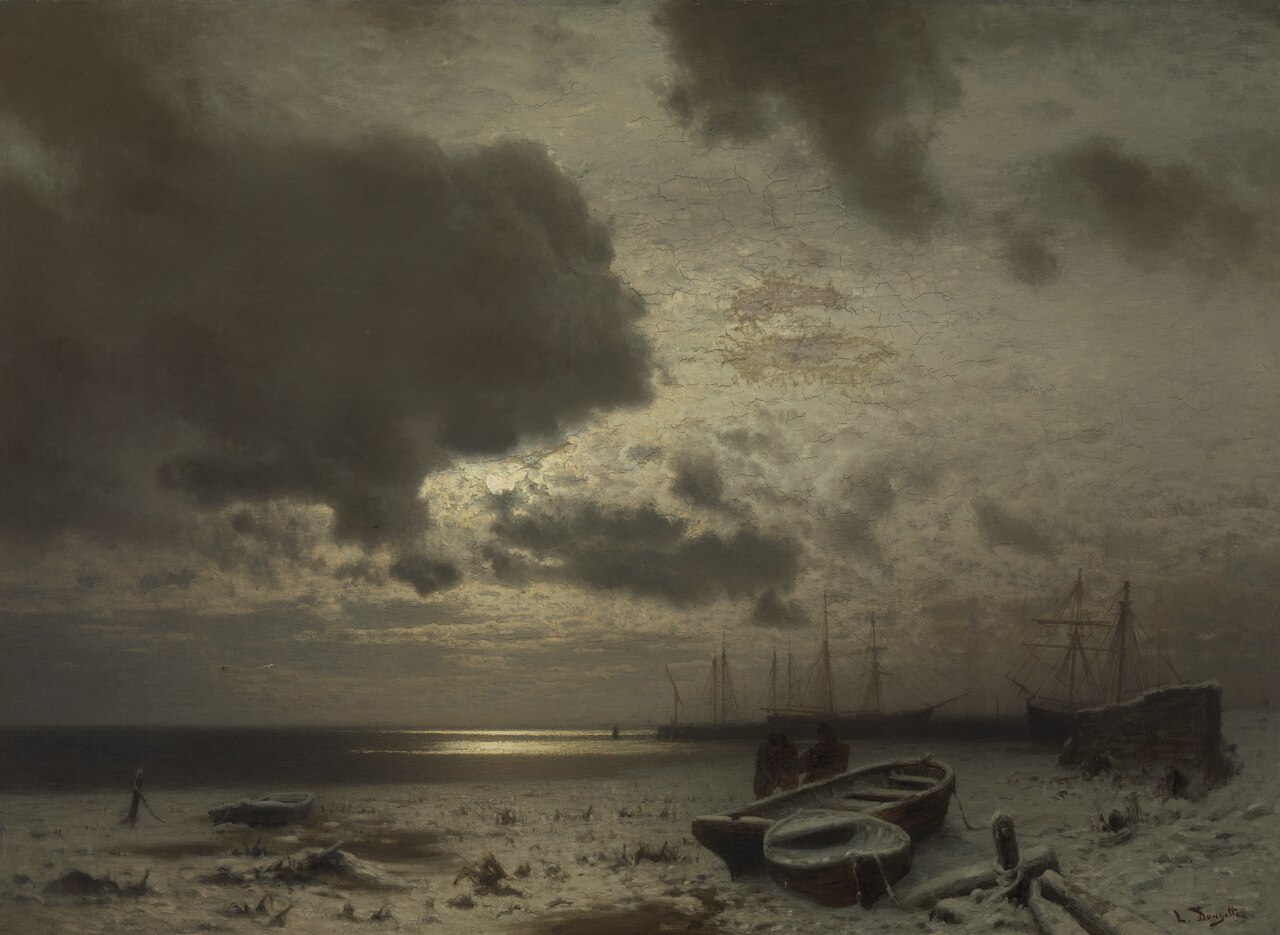
Douzette’s style is characterised by a restrained palette, careful modulation of colour, and a particular fascination with nocturnal illumination. While he never aligned himself formally with a specific avant‑garde movement, his paintings share affinities with the Düsseldorf school’s emphasis on atmospheric effects and the later German Realist focus on everyday scenery. He often depicted winter scenes, marshes, and the flat horizons of the Baltic coast, rendering them with a quiet, contemplative mood. His compositions typically place a solitary element—a windmill, a tree, or a distant figure—against an expansive sky, thereby underscoring the relationship between humanity and the vast natural world.
Signature techniques Douzette’s technical repertoire centres on his handling of light, especially moonlight. He achieved luminous effects by layering thin glazes of muted blues, greys, and whites, allowing the underlying colours to shine through and create a subtle phosphorescence. In many of his winter landscapes, he employed a technique known as "grisaille underpainting"—a monochrome grey base that establishes tonal values before colour is added. This method provided a solid structural foundation for the delicate atmospheric washes that define his nocturnal scenes.
Another hallmark of his work is the precise rendering of frost and snow. Douzette often painted the texture of ice with fine, almost stippled brushstrokes, contrasting the smoothness of the sky with the granular quality of the ground. His handling of the sky, especially during twilight, demonstrates a mastery of gradation: the horizon is painted with a cooler, deeper tone that gradually lightens toward the zenith, suggesting the diffuse glow of a waning moon.
Douzette also favoured a limited, harmonious colour scheme. Rather than relying on bold, saturated hues, he preferred earth tones—soft ochres, muted greens, and desaturated blues—that reinforce the subdued ambience of his subjects. This restrained palette, combined with his careful compositional balance, creates a sense of stillness that invites viewers to linger on the subtle interplay of light and shadow.
Major works Among Douzette’s most celebrated paintings are several that exemplify his preoccupation with moonlit and wintery atmospheres:
- Moonlight in Winter – This canvas captures a frozen landscape under a pale, silvery moon. The foreground is a sparsely treed bank, its bark rendered in delicate brushwork that catches the moon’s glow. The sky dominates the composition, its gradated blues suggesting a clear, cold night. The work exemplifies Douzette’s skill at conveying the quiet intensity of a winter night.
- Moonlit Landscape – In this piece, Douzette expands the vista to include a winding river that reflects the moonlight, creating a luminous ribbon that guides the eye through the composition. The surrounding fields are bathed in a soft, diffused light, while distant hills fade into a muted horizon. The painting demonstrates his ability to integrate water as a reflective surface, enhancing the overall luminosity.
- Landscape with Windmill (1880) – Dated 1880, this work portrays a solitary windmill perched on a low hill, its sails silhouetted against a dusky sky. The setting sun and rising moon share the horizon, producing a transitional light that blends warm amber with cool blue. The windmill, a recurring motif in northern German art, serves as a focal point that anchors the otherwise expansive scene.
- Cold Winter Moon (1890) – Completed a decade later, this painting revisits the winter‑moon theme with greater compositional confidence. A frozen pond mirrors the moon, while a thin veil of fog softens the distant trees. The subtle use of colour—particularly the faint pinks that hint at the moon’s reflection—adds emotional depth to the otherwise stark environment.
These works, together with numerous lesser‑known pieces, solidify Douzette’s reputation as a master of nocturnal landscape painting. They are held in regional museums across Germany, notably in the Kunsthalle in Hamburg and the Staatliches Museum in Schwerin, and continue to be exhibited in retrospectives of 19th‑century German art.
Influence and legacy Louis Douzette did not found a school nor champion a manifesto, yet his paintings contributed to the visual vocabulary of German landscape art at a time when the nation was consolidating its cultural identity. By focusing on the quiet, often overlooked moments of the natural world—moonlit evenings, frost‑covered fields—he broadened the thematic range of landscape painting beyond the grand, heroic vistas favoured by earlier Romantic artists.
His meticulous treatment of light influenced younger painters who sought to capture atmospheric effects with realism rather than dramatisation. In particular, the coastal towns of Mecklenburg and the Baltic islands saw a rise in artists who adopted Douzette’s subdued palette and nocturnal subjects, forming a modest but distinct regional tradition.
In contemporary scholarship, Douzette is recognised as a bridge between the Düsseldorf school’s academic rigor and the emerging plein‑air practices that would dominate the early 20th century. His works are frequently cited in studies of German winter landscapes and are valued for their documentary quality, preserving the visual character of northern Germany’s rural environments before intensive industrialisation.
Today, Douzette’s paintings are sought after by collectors of 19th‑century German art, and his name appears in auction catalogues and museum inventories with steady interest. While he may not be as widely known as some of his contemporaries, his legacy endures through the continued appreciation of his serene, moon‑lit scenes, which offer a timeless meditation on light, weather, and the quiet beauty of the natural world.
Frequently asked questions
Who was Louis Douzette?
Louis Douzette (1834–1924) was a German landscape painter known for his moonlit and winter scenes, born in Tribsees and active mainly in northern Germany.
What artistic style or movement is Douzette associated with?
Douzette is linked to the 19th‑century German landscape tradition, sharing traits with the Düsseldorf school and German Realism, though he did not belong to a formal movement.
What are his most famous works?
His most celebrated paintings include Moonlight in Winter, Moonlit Landscape, Landscape with Windmill (1880), and Cold Winter Moon (1890).
Why does Douzette matter in art history?
He expanded the visual language of landscape painting by focusing on nocturnal and winter atmospheres, influencing later German artists who pursued realistic, atmospheric depictions of nature.
How can I recognise a Douzette painting?
Look for subdued colour palettes, delicate moonlight illumination, meticulous rendering of frost or snow, and compositions that place solitary elements against expansive, quiet skies.