Léopold Flameng
1831 – 1911
In short
Léopold Flameng (1831–1911) was a Belgian‑born engraver, illustrator and painter who worked chiefly in France, becoming renowned for his precise prints and book illustrations in the late 19th century.
Notable works


,_published_1885,_NGA_59741.jpg)

Early life Léopold Flameng was born in 1831 in Brussels, then part of the United Kingdom of the Netherlands. His family was modest, and he showed an early aptitude for drawing. He received his first formal instruction at a local drawing school, where he was introduced to the techniques of line work and composition that would later define his engraving practice. In his teenage years Flameng moved to Paris, attracted by the city’s vibrant artistic community and the opportunities it offered to young illustrators. The move marked the beginning of a lifelong association with French artistic institutions, even though his nationality remained Belgian.
Career and style In Paris, Flameng entered the workshop of a prominent French engraver, quickly mastering the demanding standards of French academic engraving. By the 1850s he was producing illustrations for literary magazines and books, a field that demanded both technical skill and the ability to convey narrative detail. His style combined the meticulous line work of traditional copperplate engraving with a sensitivity to light and texture, allowing him to render atmospheric effects that were unusual for the medium. Flameng’s work reflects the broader 19th‑century interest in realism and historicism, yet he never aligned himself with a single avant‑garde movement. Instead, he remained a versatile practitioner, adapting his approach to the needs of each commission, whether a portrait, a religious scene, or a historic tableau.
Signature techniques Flameng’s engravings are distinguished by several technical hallmarks. He favoured the burin for its capacity to produce crisp, clean lines, and he employed a fine hatching system to suggest volume and depth. In many of his prints, he layered cross‑hatching with stippling to simulate the subtle gradations of shadow, a method that gives his works a painterly quality despite being executed on metal. He also experimented with mezzotint in certain projects, using the technique’s rich tonal range to enhance atmospheric scenes. In his illustrations, Flameng often incorporated decorative borders and ornamental initials, integrating the printed image with the surrounding page design—a practice that made his contributions especially valuable to publishers seeking cohesive visual programs.
Major works Among Flameng’s most noted pieces is his 1858 portrait of the French etcher Charles Meryon. The print captures Meryon’s contemplative expression with a delicate balance of line and shade, showcasing Flameng’s ability to render psychological depth. "The Hundred Guilder Print" demonstrates his facility with larger, more complex compositions; the work presents a bustling market scene rendered with precise architectural detail and a keen observation of human activity. "Portrait of a Man (Le Doreur)" is another striking example, where Flameng’s handling of the subject’s clothing and facial features exemplifies his skill in capturing individuality within a formal portrait format.
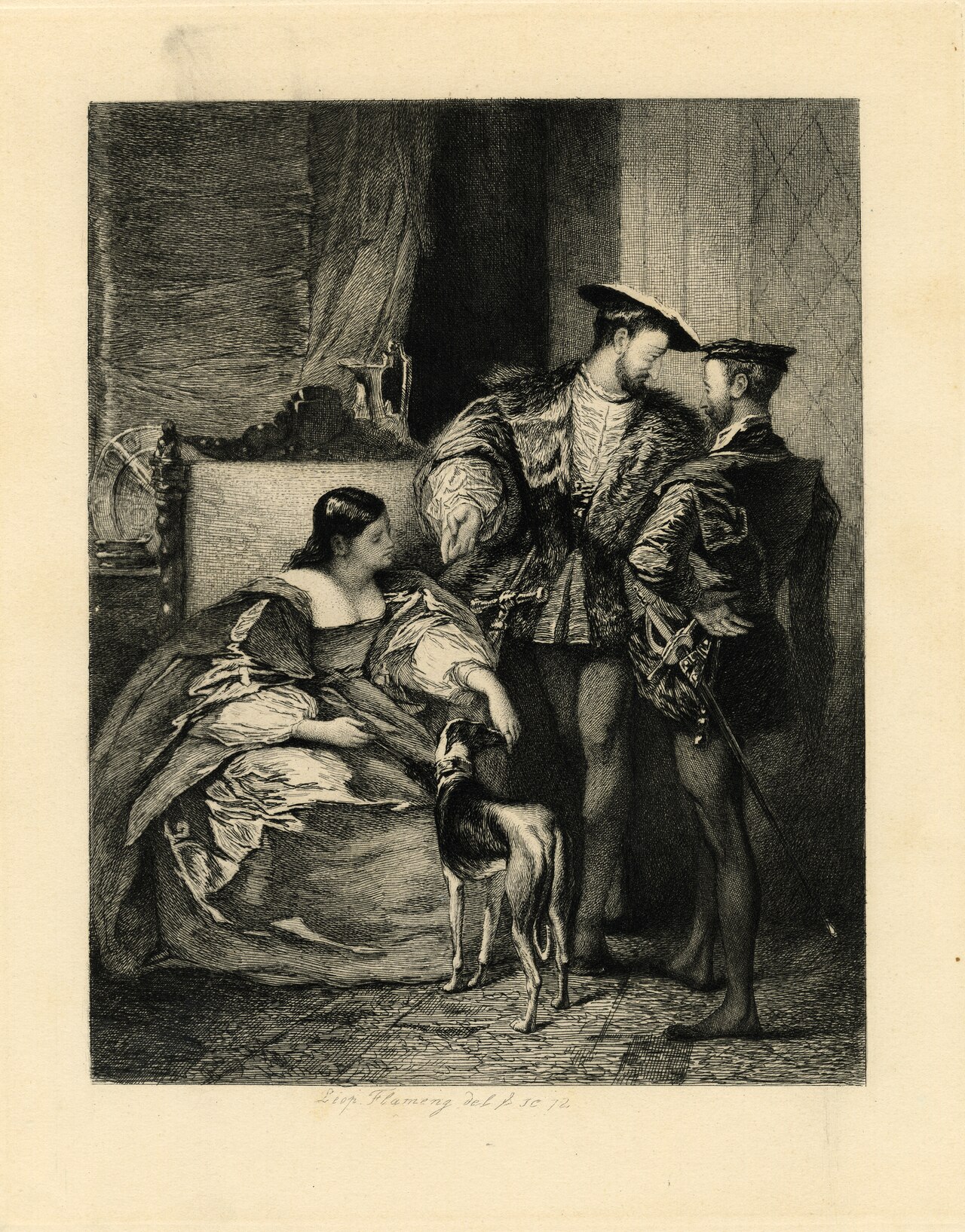
A religious commission, "A Scene from the New Testament," reveals Flameng’s capacity to convey narrative drama. Here he uses dynamic line work to delineate the figures and employs dramatic chiaroscuro to heighten the spiritual intensity of the moment. Finally, his 1872 historical tableau "François I and the Duchess d'Etampes" merges his interest in history with his technical prowess. The composition balances regal grandeur with intimate detail, rendering the courtly setting with a clarity that serves both documentary and aesthetic purposes. Across these works, Flameng’s consistent attention to texture, light, and narrative cohesion underscores his reputation as a master engraver and illustrator.
Influence and legacy Flameng’s output contributed significantly to the visual culture of the late 19th century, particularly in the realms of book illustration and printmaking. His engravings were widely reproduced in literary editions, bringing high‑quality visual art to a broader readership. While he did not found a distinct artistic movement, his meticulous technique influenced a generation of French and Belgian engravers who sought to combine academic rigour with the emerging demands of mass‑produced illustration. Institutions such as the École des Beaux‑Arts in Paris documented his work, and his prints remain part of major museum collections, illustrating the enduring appreciation of his craftsmanship. Today, scholars regard Flameng as a bridge between the classic French engraving tradition and the more commercial, illustrated publishing industry that flourished in the latter half of the 19th century.
Frequently asked questions
Who was Léopold Flameng?
Léopold Flameng (1831–1911) was a Belgian‑born engraver, illustrator and painter who worked primarily in France, known for his detailed prints and book illustrations.
What artistic style or movement is he associated with?
Flameng did not belong to a single avant‑garde movement; his work reflects the 19th‑century realist and historicist traditions, combining academic engraving techniques with narrative illustration.
What are his most famous works?
His notable works include the 1858 portrait of Charles Meryon, "The Hundred Guilder Print," "Portrait of a Man (Le Doreur)," "A Scene from the New Testament," and the 1872 historical piece "François I and the Duchess d'Etampes."
Why is Léopold Flameng important in art history?
He helped elevate the quality of 19th‑century book illustration, influencing later engravers with his precise line work and integration of image and text, and his prints remain key examples of high‑level French engraving.
How can I recognise a Léopold Flameng engraving?
Look for crisp, clean lines created with a burin, fine hatching combined with stippling for tonal depth, and a careful balance of detail and atmospheric shading that gives his prints a subtly painterly feel.