Léon Bazille Perrault
1832 – 1908
In short
Léon Bazille Perrault (1832‑1908) was a French academic painter born in Poitiers, best known for historically and sentimentally charged works such as The Death of Priam, Maternity, Mother’s Happiness and a royal portrait of Louis‑Philippe, and he died in Royan.
Notable works



_-_Meditation_-_1911.29_-_Manchester_Art_Gallery.jpg)
Early life Léon Bazille Perrault was born in 1832 in the provincial city of Poitiers, western France. Little is recorded about his family background, but he showed an early aptitude for drawing and was encouraged to pursue formal training. In his teenage years he moved to Paris, the centre of French artistic education, where he entered the École des Beaux‑Arts. The rigorous curriculum of the school, which combined life‑drawing, anatomy and the study of classical antiquity, shaped his lifelong commitment to the academic tradition.
Career and style After completing his studies, Perrault established himself as a painter of history, genre and portrait subjects. He exhibited regularly at the Paris Salon, the principal venue for academic artists, and earned official recognition through medals and state commissions. His style adhered to the academic ideals of clear narrative, balanced composition and polished finish. He employed a restrained colour palette dominated by earth tones, allowing the modelling of form and the play of light to convey drama. Perrault’s work reflects the influence of earlier French masters such as Ingres and the broader European academic movement, yet he maintained a personal sensitivity to intimate domestic scenes alongside his more monumental historical subjects.
Signature techniques Perrault’s technique is characterised by meticulous draftsmanship and a smooth, almost invisible brushstroke. He favoured a layered approach: an initial underdrawing in charcoal or graphite, followed by successive glazes of oil to build tonal depth. Chiaroscuro— the contrast of light and shadow— was used to model the flesh of figures and to give three‑dimensionality to architectural elements. His colour application is subtle, often employing muted hues to enhance the narrative rather than dominate it. The finish of his canvases is highly refined, a hallmark of academic training, which gives his paintings a luminous, almost photographic quality.
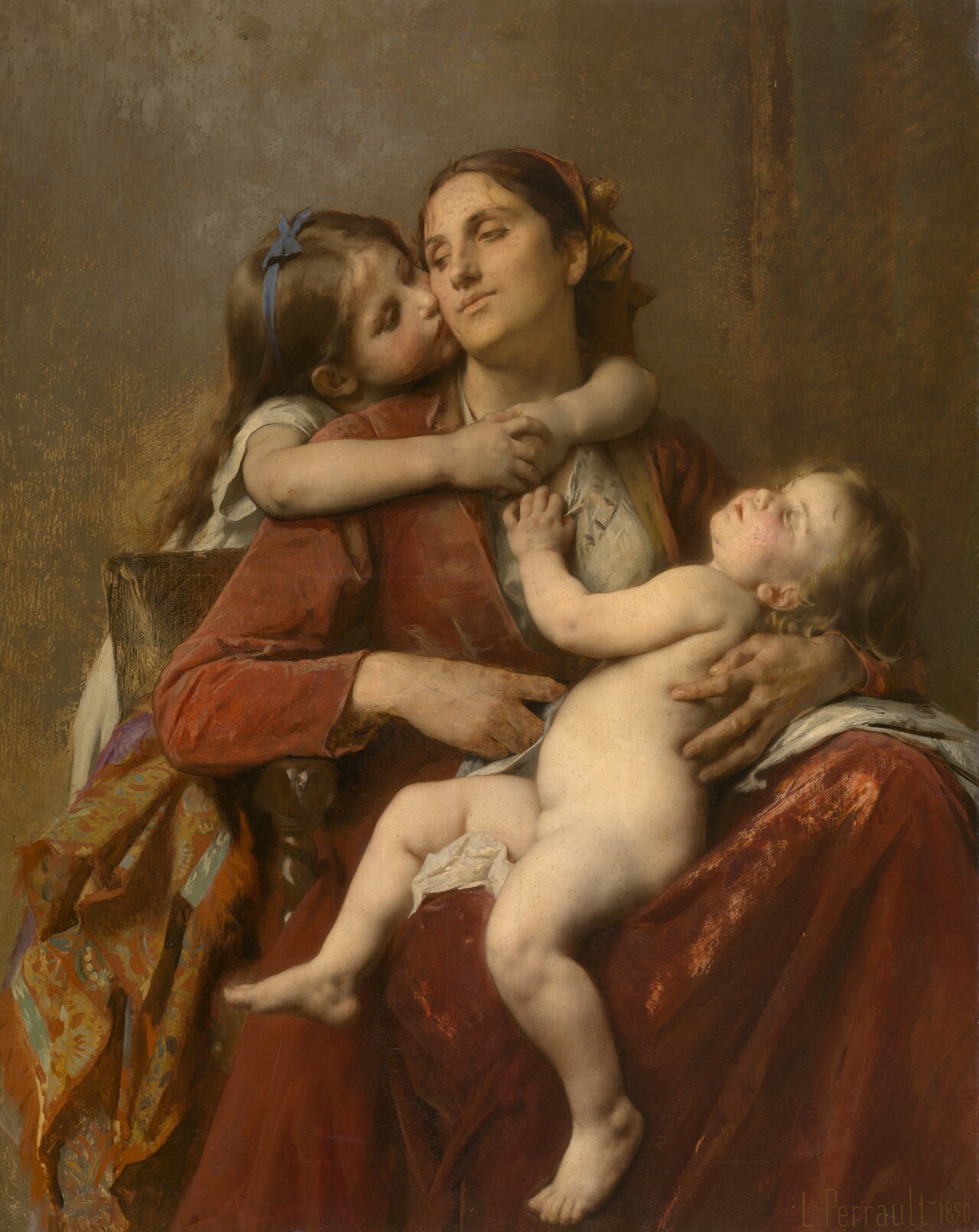
Major works - **The Death of Priam (1861)** – One of Perrault’s earliest major commissions, this large‑scale history painting depicts the brutal murder of the Trojan king at the hands of Achilles’ warriors. The composition is tightly arranged, with Priam’s anguished expression at the centre, surrounded by a chaotic yet controlled crowd. Critics of the Salon praised the work for its dramatic intensity and the fidelity of its classical references. - **Meditation (1870)** – A quieter, genre‑type piece, Meditation shows a solitary figure lost in thought, illuminated by a soft, diffused light that falls across the face and hands. The work demonstrates Perrault’s ability to capture psychological depth within a restrained setting, using delicate tonal variations to suggest introspection. - **Maternity (1873)** – This tender domestic scene portrays a mother cradling her infant, the subject rendered with a gentle tenderness that contrasts with the more heroic themes of his earlier work. The composition is balanced, with the mother’s gaze directing the viewer’s attention to the child, while the surrounding interior is rendered with meticulous detail. - **Mother’s Happiness (1890)** – Continuing his interest in familial subjects, Mother’s Happiness presents a mother surrounded by her children in a sun‑lit interior. The painting’s warm palette and the subtle smile on the mother’s face convey an idealised vision of 19th‑century domestic bliss, reflecting contemporary moral values. - **Louis‑Philippe with his son in Versailles (1900)** – In this late‑career portrait, Perrault was commissioned to depict the former king Louis‑Philippe and his son within the historic setting of the Palace of Versailles. The work combines the grandeur of the architectural backdrop with an intimate portrayal of the royal pair, underscoring Perrault’s skill at integrating portraiture with historical context.
Influence and legacy Perrault remained a steadfast practitioner of academic painting at a time when avant‑garde movements such as Impressionism and Symbolism were gaining prominence. While his name never achieved the fame of contemporaries who broke with academic conventions, his works continued to be displayed in official exhibitions and were acquired by state collections. His meticulous technique and commitment to narrative clarity influenced a generation of younger artists who sought to preserve the academic standards in French art schools. Today, his paintings are held in several regional museums in France and occasionally appear in international exhibitions that explore 19th‑century academic art. Scholars regard Perrault as a representative figure of the late academic tradition, whose oeuvre offers insight into the aesthetic preferences and social values of his era.
Frequently asked questions
Who was Léon Bazille Perrault?
Léon Bazille Perrault (1832‑1908) was a French academic painter known for history, genre and portrait works, born in Poitiers and active mainly in Paris.
What artistic movement did he belong to?
He worked within the academic art tradition, adhering to the classical standards of composition, draftsmanship and polished finish.
What are his most famous works?
His best‑known paintings include The Death of Priam (1861), Meditation (1870), Maternity (1873), Mother’s Happiness (1890) and the royal portrait Louis‑Philippe with his son in Versailles (1900).
Why is Perrault important in art history?
Perrault exemplifies the late‑19th‑century academic painter, preserving traditional techniques and narrative approaches at a time of rapid stylistic change, and his works provide valuable insight into the cultural values of his period.
How can I recognise a painting by Perrault?
Look for a smooth, almost invisible brushstroke, careful modelling of light and shadow, balanced composition, and subjects that range from dramatic historical scenes to intimate domestic moments rendered with refined detail.