Kaigetsudō Ando
1671 – 1743
In short
Kaigetsudō Ando (1671–1743) was a Japanese painter from Kyoto who founded the Kaigetsudō school of ukiyo-e, specialising in paintings of courtesans and actors. He never produced woodblock prints, and his work is noted for its elegant, stylised figures and vivid colours.
Notable works


Early life Kaigetsudō Ando was born in 1671 in Kyoto, a city that was then a vibrant centre of cultural exchange and artistic production. Little is known about his family background, but records indicate that he received a classical education typical of the merchant and artisan classes of the period. This education would have included instruction in calligraphy, poetry, and the visual arts, providing a foundation for his later artistic pursuits. By the time he reached his twenties, Ando was already engaged in the bustling world of the pleasure districts, where the demand for images of courtesans, actors and fashionable women was high.
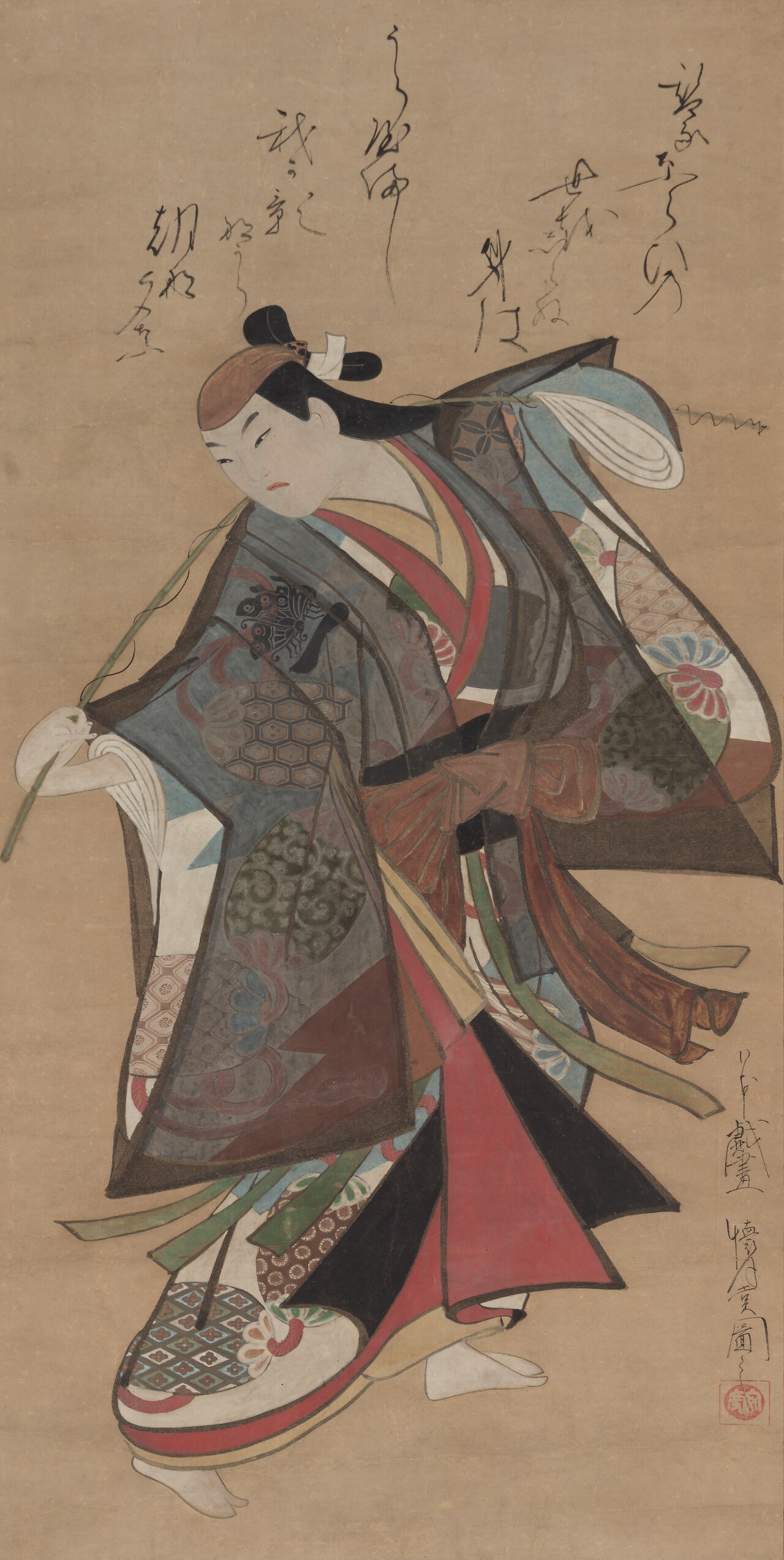
Career and style Ando's career unfolded during the early Edo period, a time when the ukiyo ("floating world") culture flourished. Unlike many of his contemporaries, he never worked in woodblock printmaking; his output consisted solely of paintings on silk or paper. This singular focus gave his work a consistency of technique and a richness of colour that distinguishes it from the more reproducible prints of the era. Ando's style is characterised by a refined elegance, with elongated figures, delicate gestures and a restrained yet expressive use of line. The compositions often centre on a solitary figure, set against a minimal background that emphasises the subject's attire and posture.
His subjects were primarily the high-ranking courtesans (oiran) of the Yoshiwara district, as well as actors and aristocratic women. The clothing depicted in his paintings showcases the latest fashions of the time, including intricate kimono patterns, elaborate hair ornaments and sumptuous textiles. Ando's attention to detail in costume design contributed to his reputation as a chronicler of early 18th‑century urban fashion.
Signature techniques Ando employed a range of techniques that became hallmarks of the Kaigetsudō school. He worked primarily with sumi ink for outlines, applying bold, confident strokes that defined the silhouette of his figures. The interior of the garments was filled with flat, saturated pigments—often imported pigments such as vermilion and indigo—applied in a manner that created a luminous surface. By avoiding heavy shading, he achieved a sense of flatness that aligns with the aesthetic principles of the ukiyo-e tradition while maintaining a distinct painterly quality.
Another distinctive element is his use of decorative motifs. Background elements are frequently reduced to patterned clouds, stylised foliage or abstracted geometric shapes, allowing the figure to dominate the visual field. The subtle use of gold leaf and mica in certain works adds a tactile richness that enhances the luxurious atmosphere of the scenes.
Major works Ando's oeuvre includes several works that are frequently cited in art historical literature. *Sanjo Kantaro II in the Role of Urashima Taro* (1710) portrays the legendary hero in a sumptuous kimono, highlighting Ando's skill in rendering narrative subjects with the same elegance he applied to courtesans. The composition balances a dynamic pose with a restrained background, underscoring the painter’s ability to convey story without overcrowding the visual space.
*Standing Courtesan* (1716) is a quintessential example of Ando's focus on the oiran. The figure stands upright, her posture poised and dignified, while the intricate patterns of her kimono dominate the picture plane. The work demonstrates Ando's mastery of colour and his keen eye for textile design, offering modern viewers a valuable glimpse into the fashions of early Edo Japan.
The later dated pieces—*Standing Beauty* (1834), *Beauty with Letter* (1834) and *Young Actor in Male Role* (1834)—are attributed to the Kaigetsudō school rather than to Ando personally, as they post‑date his death by nearly a century. Their stylistic affinity with Ando’s earlier paintings indicates that his disciples continued to emulate his aesthetic principles long after his passing. These works retain the hallmark flat colour fields and elegant figure types, confirming the lasting influence of his visual language within the school.
Influence and legacy Kaigetsudō Ando’s impact on ukiyo-e is notable for several reasons. First, his exclusive dedication to painting set him apart from the majority of ukiyo-e artists, who produced both prints and paintings. By concentrating on the painted medium, he elevated the status of ukiyo‑e subjects within the realm of fine art, demonstrating that images of courtesans and actors could possess both commercial appeal and artistic merit.
Second, the Kaigetsudō school he founded persisted for several decades, with a number of disciples and followers adopting his stylised approach to figure painting. The school's emphasis on elegant, fashionable women helped shape the visual vocabulary of later ukiyo‑e masters, who incorporated similar motifs into their prints. Moreover, Ando’s meticulous treatment of kimono patterns contributed to the broader appreciation of textile design as an integral component of Japanese visual culture.
Finally, contemporary scholars regard Ando as a crucial conduit between the early Edo period’s courtly aesthetics and the more popular, mass‑produced art of the later 18th and 19th centuries. His paintings serve as primary visual documents of the period’s sartorial trends, social hierarchies and the aesthetic preferences of the floating world. Though many works bearing his name may have been produced by his apprentices, the enduring stylistic consistency across the Kaigetsudō output underscores his role as a pivotal figure in the development of ukiyo‑e painting.
In sum, Kaigetsudō Ando’s legacy lies in his elegant visual representation of the floating world, his influence on subsequent generations of artists, and his contribution to the preservation of early Edo fashion and culture through the medium of painting.
Frequently asked questions
Who was Kaigetsudō Ando?
Kaigetsudō Ando (1671–1743) was a Japanese painter from Kyoto who founded the Kaigetsudō school of ukiyo‑e, specialising in elegant paintings of courtesans and actors.
What artistic style or movement is he associated with?
He is associated with the ukiyo‑e movement, focusing on painted works rather than woodblock prints, and is known for a refined, stylised depiction of figures and fashion.
What are his most famous works?
Key works include *Sanjo Kantaro II in the Role of Urashima Taro* (1710), *Standing Courtesan* (1716) and later school pieces such as *Standing Beauty* (1834) and *Beauty with Letter* (1834).
Why is Kaigetsudō Ando important in art history?
He elevated painted ukiyo‑e subjects, influenced later artists through his school, and provided valuable visual records of early Edo fashion and the floating‑world culture.
How can I recognise a painting by Kaigetsudō Ando or his school?
Look for bold ink outlines, flat saturated colours, elegant elongated figures, detailed kimono patterns and minimal backgrounds that foreground the subject.