Juliette Wytsman
1866 – 1925
In short
Juliette Wytsman (1866–1925) was a Belgian impressionist painter known for luminous landscapes and domestic scenes. Married to fellow artist Rodolphe Wytsman, she exhibited widely in Belgium and her works are held in several national collections.
Notable works
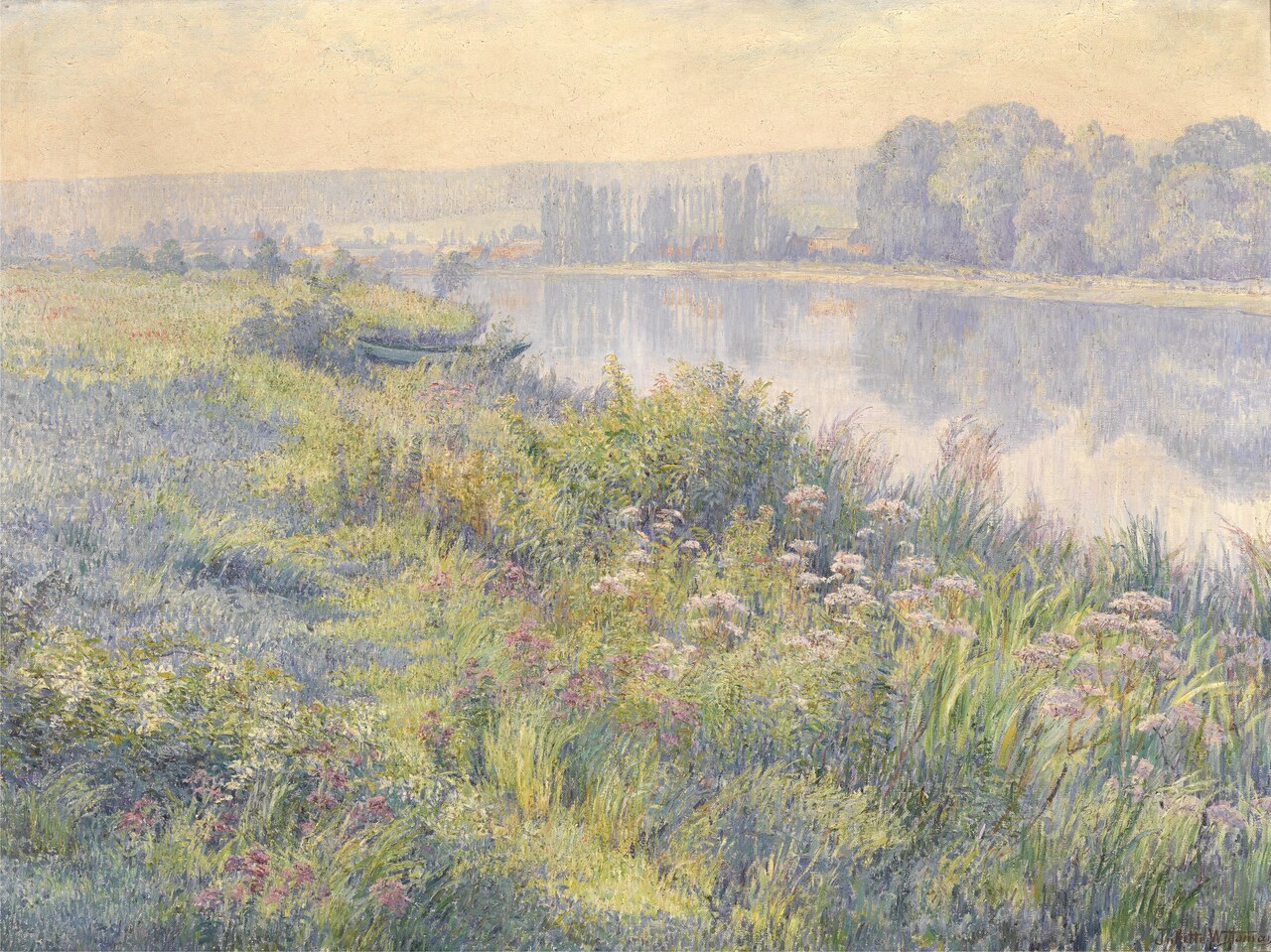


Early life Juliette Wytsman was born in Brussels in 1866 into a culturally engaged family. Growing up in the capital of Belgium, she was exposed early to the city’s thriving artistic circles and the burgeoning interest in modern French painting that was influencing local artists. She pursued formal training in the visual arts, a relatively uncommon path for women at the time, and developed a foundation in drawing and colour theory that would later underpin her impressionist practice. Her early education placed her in contact with the academies and salons that were introducing the ideas of plein‑air painting and the study of light, themes that would become central to her work.
Career and style After completing her studies, Juliette began exhibiting her paintings in the late 1880s, gaining recognition for her delicate handling of atmospheric effects. She married fellow painter Rodolphe Wytsman, a partnership that proved both personal and professional; the two shared studio space and frequently painted side by side, influencing each other’s techniques. Throughout her career, Juliette remained committed to the Impressionist idiom, favouring loose brushwork, vibrant palettes, and an emphasis on the fleeting qualities of light. Her subjects ranged from riverbanks and rural fields to interior courtyards, reflecting a consistent interest in everyday scenes rendered with a sense of immediacy. While she never fully abandoned the academic traditions of her training, her mature style aligns closely with the French Impressionists, yet retains a distinct Belgian sensibility that foregrounds subtle tonal shifts and a restrained compositional balance.
Signature techniques Juliette Wytsman’s paintings are characterised by several recurring technical choices. First, she employed a light, almost translucent application of paint, often layering thin washes to build colour without obscuring underlying forms. This approach enabled her to capture the translucency of water and the delicate glow of sunrise. Second, her brushwork varied according to the texture of the subject: she rendered foliage and foliage‑laden surfaces with quick, stippled strokes, while smoother surfaces such as sky or water were treated with broader, more fluid gestures. Third, she favoured a limited but harmonious colour palette, frequently juxtaposing soft greens, warm ochres, and muted blues to evoke the atmospheric conditions of the Belgian countryside. Finally, she often composed her scenes with a shallow depth of field, positioning the viewer close to the subject and thereby intensifying the sense of intimacy and immediacy.
Major works Among Juliette Wytsman’s most celebrated paintings are three works that exemplify her mature style. *Summer on the Maas* (1911) depicts a sun‑drenched stretch of the Meuse River, where the water reflects a sky washed in pale blues and pinks. The composition balances the rhythmic flow of the river with the static presence of trees along its banks, showcasing her ability to render both movement and stillness. *A Blossoming Apple Tree* captures a garden scene in full bloom, with delicate pink and white blossoms rendered in loose, airy strokes that suggest the fleeting nature of spring. The painting’s focus on a single tree against a softened background highlights her skill in isolating a subject while still conveying the surrounding atmosphere. *Lilies in the Courtyard of a House of Rest at Bruges* (1905) offers an interior view of a tranquil courtyard, where lilies float on a shallow pool surrounded by stone arches. The work demonstrates her talent for integrating architectural elements with natural motifs, using subtle colour transitions to convey the filtered light of an overcast day. Each of these pieces is held in Belgian museum collections, where they continue to be displayed as exemplars of early‑20th‑century Impressionism.
Influence and legacy Juliette Wytsman’s contribution to Belgian art lies in her successful adaptation of French Impressionist techniques to local subjects, thereby enriching the national artistic narrative. Her paintings helped broaden the acceptance of Impressionism in Belgium, a movement that had initially been met with scepticism by more conservative institutions. By exhibiting regularly and participating in artists’ societies, she paved the way for subsequent generations of women painters who sought professional recognition. The presence of her works in public collections ensures that her legacy remains visible to scholars and the public alike, and her paintings are frequently cited in exhibitions exploring the cross‑border dialogue between French and Belgian modernism. Although she did not achieve the fame of some of her male contemporaries, recent scholarship has begun to reassess her oeuvre, positioning Juliette Wytsman as a pivotal figure in the development of Belgian Impressionism and as an exemplar of the often‑overlooked contributions of women artists to early modern art.
Frequently asked questions
Who was Juliette Wytsman?
Juliette Wytsman was a Belgian impressionist painter (1866–1925) known for her luminous landscapes and domestic scenes, and she was married to fellow artist Rodolphe Wytsman.
What artistic movement did she belong to?
She worked within the Impressionist movement, adopting its focus on light, colour, and rapid brushwork while applying these ideas to Belgian subjects.
What are her most famous works?
Her most celebrated paintings include *Summer on the Maas* (1911), *A Blossoming Apple Tree*, and *Lilies in the Courtyard of a House of Rest at Bruges* (1905).
Why is Juliette Wytsman important in art history?
She helped introduce and legitise Impressionism in Belgium, contributed to the visibility of women artists in the early 20th century, and her works continue to be held in major Belgian museum collections.
How can I recognise a painting by Juliette Wytsman?
Look for her characteristic light, translucent paint layers, a restrained palette of greens, blues and ochres, and subjects that capture fleeting light on water, foliage or interior courtyards with a subtle, intimate atmosphere.