Jules Victor Génisson
1805 – 1860
In short
Jules Victor Génisson (1805–1860) was a Belgian Romantic painter celebrated for his meticulous interior architectural scenes, especially of churches. His work combines precise perspective with atmospheric lighting, making him a key figure in 19th‑century Belgian art.
Notable works

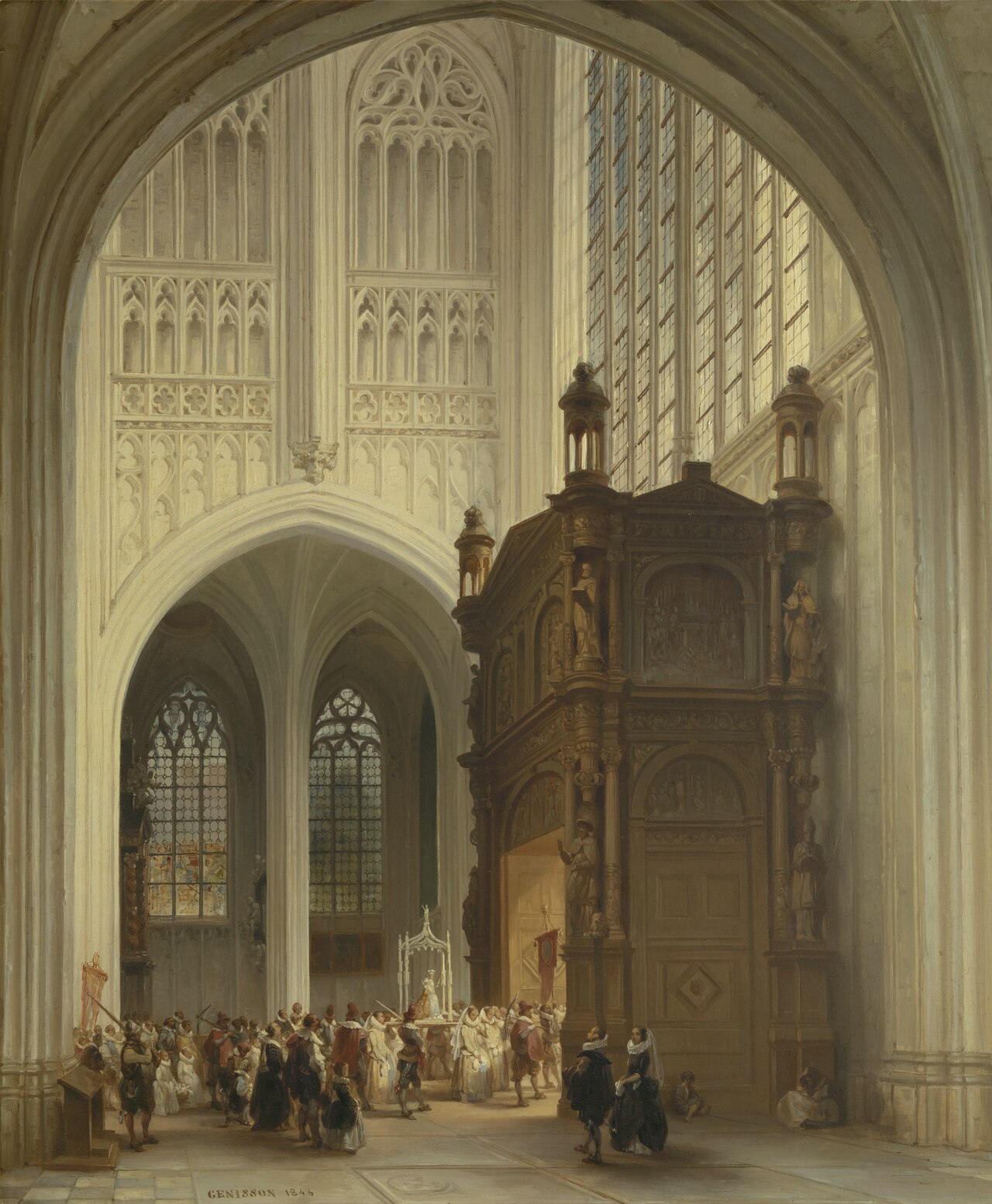

_-_Inneres_einer_Kirche_-_2620_-_F%C3%BChrermuseum.jpg)
_by_Victor-Jules_G%C3%A9nisson_-_Museo_Soumaya_-_Mexico_2024.jpg)
Early life Jules Victor Génisson was born in 1805 in Saint‑Omer, a town that at the time lay near the border of French‑Flemish cultural regions. The son of a modest family, he displayed an early aptitude for drawing, particularly for the structural aspects of buildings. His formative years coincided with the rise of Romanticism, a movement that prized emotion, drama and the sublime in both landscape and architectural subjects. While specific records of his schooling are scarce, it is known that Génisson pursued formal artistic training in Belgium, likely at one of the established academies where the study of perspective and architectural drawing formed a core component of the curriculum. This education provided him with the technical foundation that would later define his mature oeuvre.
Career and style By the 1820s Génisson had begun to exhibit his work in regional salons, attracting attention for his unusual focus on interior spaces rather than the more conventional exterior vistas favoured by many of his Romantic contemporaries. He settled in Brussels for a period, where he mingled with a circle of artists interested in historic architecture and the evocative potential of light within sacred spaces. His style is firmly rooted in Romanticism, yet he diverged from the movement’s typical emphasis on sweeping natural scenery by concentrating on the quiet drama of ecclesiastical interiors. The emotive power of his paintings derives from a careful balance between exacting architectural accuracy and a softened, almost lyrical treatment of illumination and colour. This duality allowed him to convey both the solidity of stone and the transcendent ambience of worship.
Signature techniques Génisson’s paintings are distinguished by a rigorous approach to linear perspective. He employed precise vanishing points and meticulous foreshortening to render the depth of nave, choir and vaulted ceilings with convincing realism. Light plays a central role: he often positioned a single source—such as a high window or a candle‑lit altar—to create dramatic chiaroscuro, where beams of light cut through dust‑laden air, highlighting architectural details while casting surrounding areas into subtle shadow. His palette favoured muted earth tones—ochres, greys and warm browns—interspersed with the occasional burst of colour from stained‑glass windows or lit candles. These choices reinforced the contemplative mood of his interiors. In addition, he rendered ornamental elements—sculpture, frescoes and woodwork—with a delicate hand, ensuring that decorative motifs complemented rather than overwhelmed the overall composition.
Major works Among Génisson’s most celebrated works is the *Interior of the Cathedral of Amiens* (1842). This large‑scale canvas captures the soaring nave of the French Gothic cathedral, its ribbed vaults and intricate stone tracery rendered with exacting perspective. The painting is notable for its treatment of daylight filtering through the cathedral’s stained‑glass windows, casting coloured patches across the stone floor. Four years later, he turned his attention to the *Interior of the Saint Peter’s Church in Louvain* (1846). Here, Génisson explores a more intimate setting, focusing on the interplay of candlelight and the baroque altar, while still preserving the discipline of architectural drawing.
In 1853 he completed the *Interior of a Church in Averbode*, a work that demonstrates his continued fascination with monastic architecture. The composition highlights the austere simplicity of the Cistercian space, with a muted colour scheme that underscores the spiritual stillness of the setting. Earlier, in 1830, Génisson rendered the *Choir of a Baroque Church with Monks at Divine Service*. This piece showcases a vibrant scene of monks gathered for liturgy, their silhouettes illuminated by a central source of light that accentuates the ornate baroque detailing of the choir stalls and frescoed ceiling.
The *Holy Communion in the Church of Saint Gummarus in Lier, Belgium* (1851) stands as a later exemplar of his mature style. The painting depicts a solemn communion service, with the altar bathed in a soft, radiant glow that draws the viewer’s eye to the sacred vessels. The surrounding architecture—characterised by Gothic arches and a richly decorated nave—provides a dignified backdrop that situates the ritual within a timeless sacred space. Across these works, Génisson consistently demonstrates an ability to fuse precise architectural rendering with a Romantic sensibility that elevates the spiritual atmosphere of each interior.
Influence and legacy Jules Victor Génisson’s contribution to 19th‑century art lies in his synthesis of technical mastery and emotive expression within the niche of interior architectural painting. By foregrounding the interior of churches—places of both communal worship and personal contemplation—he offered a visual narrative that resonated with a Romantic fascination for the sublime hidden within human‑made structures. His meticulous perspective influenced a generation of Belgian painters who sought to balance academic rigour with atmospheric mood. Although his name is less widely recognised today than some of his contemporaries, his works remain valuable reference points for scholars studying the intersection of architecture and painting during the Romantic era. Collections in Belgian museums and church archives continue to preserve his canvases, ensuring that his careful depictions of sacred space endure as testaments to a period when the spiritual and the aesthetic were intimately intertwined.
Frequently asked questions
Who was Jules Victor Génisson?
Jules Victor Génisson (1805–1860) was a Belgian painter of the Romantic period, best known for his detailed interior scenes of churches and other sacred architecture.
What artistic style or movement is he associated with?
He worked within the Romantic movement, applying its emphasis on emotion and atmosphere to the precise rendering of architectural interiors.
What are his most famous works?
His most celebrated paintings include *Interior of the Cathedral of Amiens* (1842), *Interior of Saint Peter’s Church in Louvain* (1846), *Interior of a Church in Averbode* (1853), *Choir of a Baroque Church with Monks at Divine Service* (1830) and *The Holy Communion in the Church of Saint Gummarus in Lier* (1851).
Why does he matter in art history?
Génisson is significant for combining rigorous perspective with Romantic lighting, thereby advancing the genre of interior architectural painting and influencing later Belgian artists who explored the spiritual qualities of built space.
How can you recognise a Génisson painting?
His paintings are characterised by meticulous perspective, a focus on church interiors, dramatic yet subtle lighting, and a restrained palette that together create a contemplative, reverent atmosphere.