Juan Rizi
1600 – 1681
In short
Juan Rizi (1600–1681) was a Spanish Benedictine monk who worked as a painter, architect and writer in the Baroque era, producing religious canvases such as St. Benedict Destroying Idols and contributing theological and geometric treatises.
Notable works


Early life Juan Rizi was born in 1600 in Madrid, the capital of a Spain that was at the height of its imperial power. Little is recorded about his family background, but it is clear that he entered the Benedictine order at a young age, adopting the religious name Juan Andrés Ricci de Guevara. The Benedictine habit provided him with a disciplined environment that combined spiritual devotion with scholarly pursuits, a typical feature of monastic life in early‑modern Spain. His formative years were therefore spent in a milieu where art, architecture and theological study were often intertwined, laying the groundwork for his later multidisciplinary output.
Career and style Rizi’s artistic career unfolded within the broader framework of the Spanish Baroque, a style characterised by dramatic chiaroscuro, emotional intensity and a strong emphasis on religious subject matter. As a monk‑artist, he was primarily commissioned by ecclesiastical patrons, which meant that his work was closely aligned with Counter‑Reformation ideals. The Baroque language he employed—deep shadows, luminous highlights and dynamic compositions—served the didactic purpose of the Church, aiming to inspire piety and awe among viewers.
In addition to painting, Rizi was trained in architecture, a common duality for monastic artists who were often tasked with designing or refurbishing conventual buildings. His architectural sensibility is evident in the way he organised pictorial space, using architectural elements within his canvases to frame sacred narratives. Although he never achieved the fame of contemporaries such as Velázquez or Zurbarán, his oeuvre demonstrates a competent, if not groundbreaking, mastery of the visual vocabulary of his time.
Signature techniques Rizi’s paintings reveal several recurring technical choices that help to identify his hand. First, he favoured a restrained palette of earth tones—ochres, umbers and muted reds—punctuated by bright highlights on garments or illuminated objects. This colour strategy heightens the contrast between the divine and the earthly realms. Second, his handling of light often follows a single, dramatic source, typically positioned off‑canvas to cast deep shadows and create a sculptural modelling of figures. Third, he employed a meticulous underdrawing, visible in infrared examinations of his works, where he carefully plotted the placement of architectural arches, columns and altarpieces before committing pigment to the surface. Finally, his brushwork varies between tight, controlled strokes for facial features and looser, more expressive passages for drapery, a balance that lends his figures both realism and a sense of movement.
Major works Rizi’s surviving corpus is modest, yet it includes several works that illuminate his thematic preoccupations and technical skill.
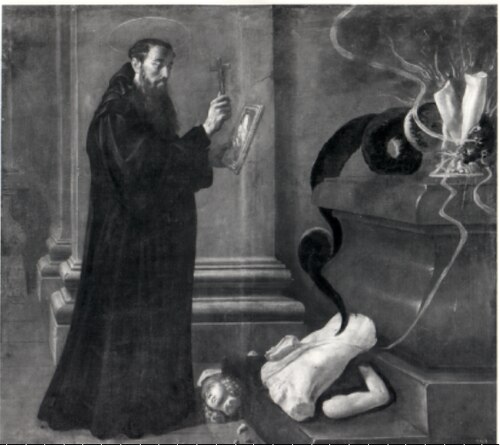
- St. Benedict Destroying Idols (1653) – This canvas depicts the legendary act of Saint Benedict smashing pagan idols, a subject that resonated with the Counter‑Reformation’s emphasis on the triumph of Christianity over idolatry. Rizi situates the saint in a dimly lit interior, using a single torch‑like light to illuminate the saint’s determined expression while the shattered idols lie in stark relief.
- Don Tiburcio de Redín (1635) – A portrait of a lay patron, this work diverges from his usual religious commissions. The sitter is rendered with a dignified pose, a dark background and subtle modelling that suggests the influence of Flemish portraiture. The painting’s inclusion of a modest still‑life—a book and a crucifix—reflects the patron’s piety and social status.
- Saint Benedict blessing the Bread (1655) – Here Rizi captures a quiet, devotional moment in which the saint blesses a loaf of bread. The composition is simple: the saint stands before an altar, his hands raised, while a beam of light falls on the bread, symbolising divine sustenance. The work’s calm atmosphere contrasts with the more theatrical intensity of his earlier martyrdom scenes.
- The Messenger (1640) – This allegorical piece shows a youthful figure delivering a letter, possibly a reference to the transmission of sacred knowledge. Though less overtly religious, the work retains Rizi’s characteristic chiaroscuro and careful rendering of fabric, suggesting that he applied his Baroque vocabulary across varied subjects.
- San Benito’s dinner (1601) – The date attached to this work predates Rizi’s birth, and scholars generally treat it as a later copy or misattribution. When discussed, the painting is noted for its domestic interior, where Saint Benedict shares a modest meal with monks. The scene is rendered with a warm palette and an intimate perspective, reinforcing the monastic ideals of humility and communal life.
Influence and legacy Juan Rizi’s impact on Spanish art history is subtle rather than revolutionary. Operating largely within monastic circles, his work contributed to the visual reinforcement of Counter‑Reformation doctrine in the Iberian Peninsula. His dual role as painter and architect exemplifies the Benedictine tradition of integrating artistic production with spiritual practice. While he did not found a distinct school, later Spanish religious painters inherited his compositional clarity and disciplined use of light.
Beyond his visual output, Rizi authored treatises on theology and geometry, demonstrating the intellectual breadth expected of a Benedictine scholar. Some archival references suggest he was considered for episcopal appointment, indicating that his reputation extended into ecclesiastical administration. Today, his paintings are housed in regional churches and monastic collections, where they continue to be studied for their embodiment of Baroque spirituality and their testament to the often‑overlooked contributions of monastic artists to Spain’s cultural heritage.
Frequently asked questions
Who was Juan Rizi?
Juan Rizi (1600–1681) was a Spanish Benedictine monk who worked as a painter, architect and writer during the Baroque period.
What artistic style or movement is he associated with?
He painted in the Spanish Baroque style, using dramatic light, deep shadows and religious themes typical of Counter‑Reformation art.
What are his most famous works?
His best‑known paintings include *St. Benedict Destroying Idols* (1653), *Saint Benedict blessing the Bread* (1655), the portrait *Don Tiburcio de Redín* (1635) and the allegory *The Messenger* (1640).
Why is Juan Rizi important in art history?
Rizi exemplifies the role of monastic artists in reinforcing Counter‑Reformation ideals, and his combined work in painting, architecture and scholarly writing illustrates the interdisciplinary nature of Benedictine cultural production.
How can I recognise a painting by Juan Rizi?
Look for a restrained earth‑tone palette, strong chiaroscuro from a single light source, careful underdrawings of architectural elements, and a calm, devotional subject matter typical of his religious scenes.