Juan de Arellano
1614 – 1676
In short
Juan de Arellano (1614–1676) was a Spanish Baroque painter renowned for his detailed floral still‑life works, active mainly in Madrid where he served royal and aristocratic patrons.
Notable works


.jpg)
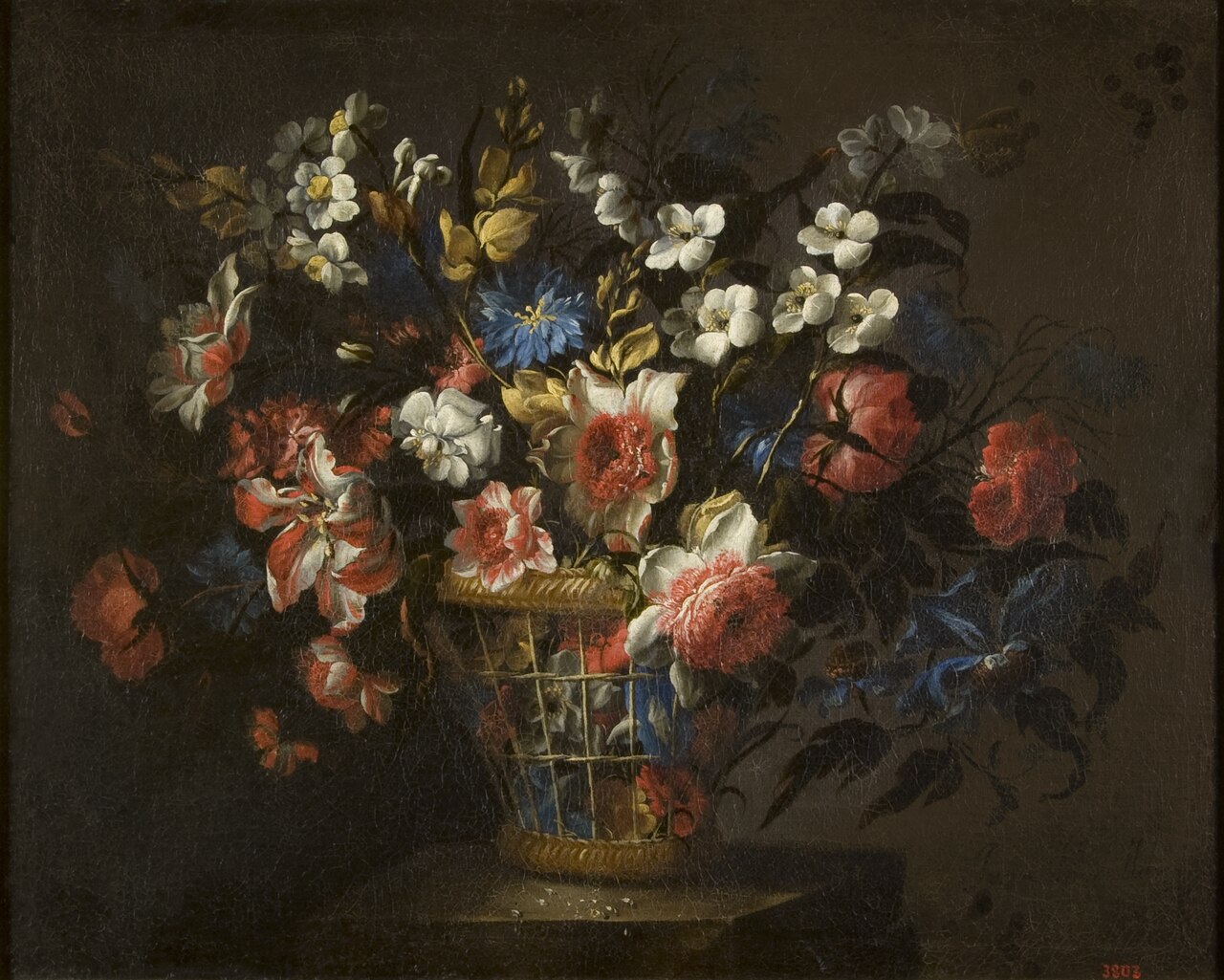

Early life Juan de Arellano was born in 1614 in the small town of Santorcaz, near Madrid. Little is recorded about his family background, but like many provincial artists of the period he likely began his artistic training locally before moving to the capital. In Madrid he would have encountered the bustling workshop environment that dominated Spanish art in the early 17th century, where apprentices learned drawing, colour mixing and the preparation of canvases under the guidance of established masters.
Career and style By the 1630s Arellano had established himself as a specialist in still‑life painting, a genre that had been imported to Spain from the Low Countries and Italy. The Spanish Baroque aesthetic favoured dramatic contrasts of light and shadow, a rich palette and a focus on material texture – all elements that Arellano incorporated into his compositions. He worked for a range of patrons, including members of the royal household, and his paintings were often commissioned to adorn the private chambers and banquet rooms of the aristocracy. His style reflects a synthesis of Flemish naturalism with the Spanish preference for heightened realism, resulting in works that celebrate the fleeting beauty of flowers while maintaining a sense of theatricality.
Signature techniques Arellano’s technique is characterised by meticulous detail and a controlled use of chiaroscuro. He rendered petals, leaves and insects with a fine brushstroke that conveys both the delicacy of the subject and its tactile presence. Light typically falls from a single source, creating a luminous focal point – often a vase or a garland – against a darker, muted background. This contrast not only heightens the three‑dimensionality of the objects but also underscores the Baroque preoccupation with the transience of life. Arellano also employed a compositional device known as the “garland motif”, where flowers encircle a central element, such as a vase or a small sculpture, framing the scene with a sense of order and abundance.
Major works - **Flower Garland, Birds and Butterfly (1625)** – One of Arellano’s earliest dated pieces, this work demonstrates his youthful command of composition. A lush garland of blossoms surrounds a pair of small birds and a butterfly, each rendered with precise anatomy. The painting reflects the influence of Flemish still‑life masters while already showing a distinctly Spanish colour sensibility. - **Vase of Flowers (1650)** – This mid‑career work features a ceramic vase brimming with a variety of blossoms, rendered in vibrant reds, yellows and blues. The careful modelling of the vase’s surface and the subtle play of light across the petals illustrate Arellano’s mature handling of texture and depth. - **Flowers in a Glass Vase (1668)** – In this later composition, the transparent glass vessel allows Arellano to explore reflections and refractions, a technical challenge that he meets with subtle gradations of tone. The arrangement of flowers appears spontaneous yet is carefully balanced, reflecting his skill in creating naturalistic yet idealised bouquets. - **Flower still‑life (1670)** – This work, dated near the end of his life, showcases a dense cluster of seasonal flowers placed on a plain stone slab. The subdued background and the focus on the tactile quality of each petal exemplify the contemplative mood that characterises his late output. - **Basket with flowers (1693)** – Although the date post‑dates Arellano’s death, the painting is traditionally attributed to his workshop or to followers who continued his style. It depicts a wicker basket overflowing with a colourful assortment of blooms, demonstrating the lasting influence of his compositional formulas.
Influence and legacy Juan de Arellano’s contribution to Spanish Baroque still‑life painting lies in his ability to merge northern European naturalism with the dramatic flair of the Spanish court. His meticulous rendering of flora set a benchmark for later Spanish artists such as Juan de Valdés Leal and Antonio de Pereda, who expanded the genre to include symbolic vanitas elements. Arellano’s works continued to be collected by the Spanish aristocracy well into the 18th century, and modern scholarship recognises him as a pivotal figure who helped establish still‑life as a respected genre within Spain’s artistic hierarchy. Today his paintings are held in major museums and private collections, where they are valued both for their aesthetic beauty and for their insight into the material culture of 17th‑century Spain.
Frequently asked questions
Who was Juan de Arellano?
Juan de Arellano was a Spanish Baroque painter (1614–1676) known for his detailed floral still‑life paintings, active mainly in Madrid.
What artistic movement did he belong to?
He worked within the Baroque movement, combining dramatic lighting with precise naturalism in his still‑life compositions.
What are his most famous works?
His most recognised pieces include *Flower Garland, Birds and Butterfly* (1625), *Vase of Flowers* (1650), *Flowers in a Glass Vase* (1668), *Flower still‑life* (1670) and the attributed *Basket with flowers* (1693).
Why is Juan de Arellano important in art history?
He helped establish the floral still‑life as a respected genre in Spain, influencing later Spanish painters and bridging Flemish naturalism with the Spanish Baroque aesthetic.
How can I recognise a Juan de Arellano painting?
Look for meticulously rendered flowers, a strong chiaroscuro contrast, a garland or vase motif, and a balanced composition that highlights texture and colour.