José García y Ramos
1852 – 1912
In short
José García y Ramos (1852–1912) was a Spanish painter and illustrator from Seville, best known for his costumbrista scenes that depict everyday life and bullfighting culture. His works such as Spanish Courting and the bullring series capture the colour and atmosphere of late‑19th‑century Andalusia.
Notable works

Early life José García y Ramos was born in 1852 in the historic city of Seville, a centre of Andalusian culture and artistic activity. Little is recorded about his family background, but it is clear that he grew up amid the vibrant streets, festivals and religious processions that characterised the city. Seville’s rich visual traditions, from its famed Semana Santa processions to the lively atmosphere of its plazas, provided a fertile environment for a young artist eager to observe and record daily life. García y Ramos likely received his initial training in local workshops, where the practice of drawing from life and mastering academic techniques were standard. By the time he reached his twenties, he was already developing a keen eye for the details of popular customs that would later define his oeuvre.
Career and style In the 1870s and 1880s García y Ramos began to establish himself as a professional painter and illustrator. He worked for a variety of periodicals, producing sketches and illustrations that catered to a growing readership interested in scenes of Spanish life. His style aligns with the costumbrista tradition, a movement that sought to document the customs, costumes and social practices of particular regions. While the movement itself was not a formal school, it shared an emphasis on realistic representation, narrative content and a subtle romanticism that celebrated national identity.
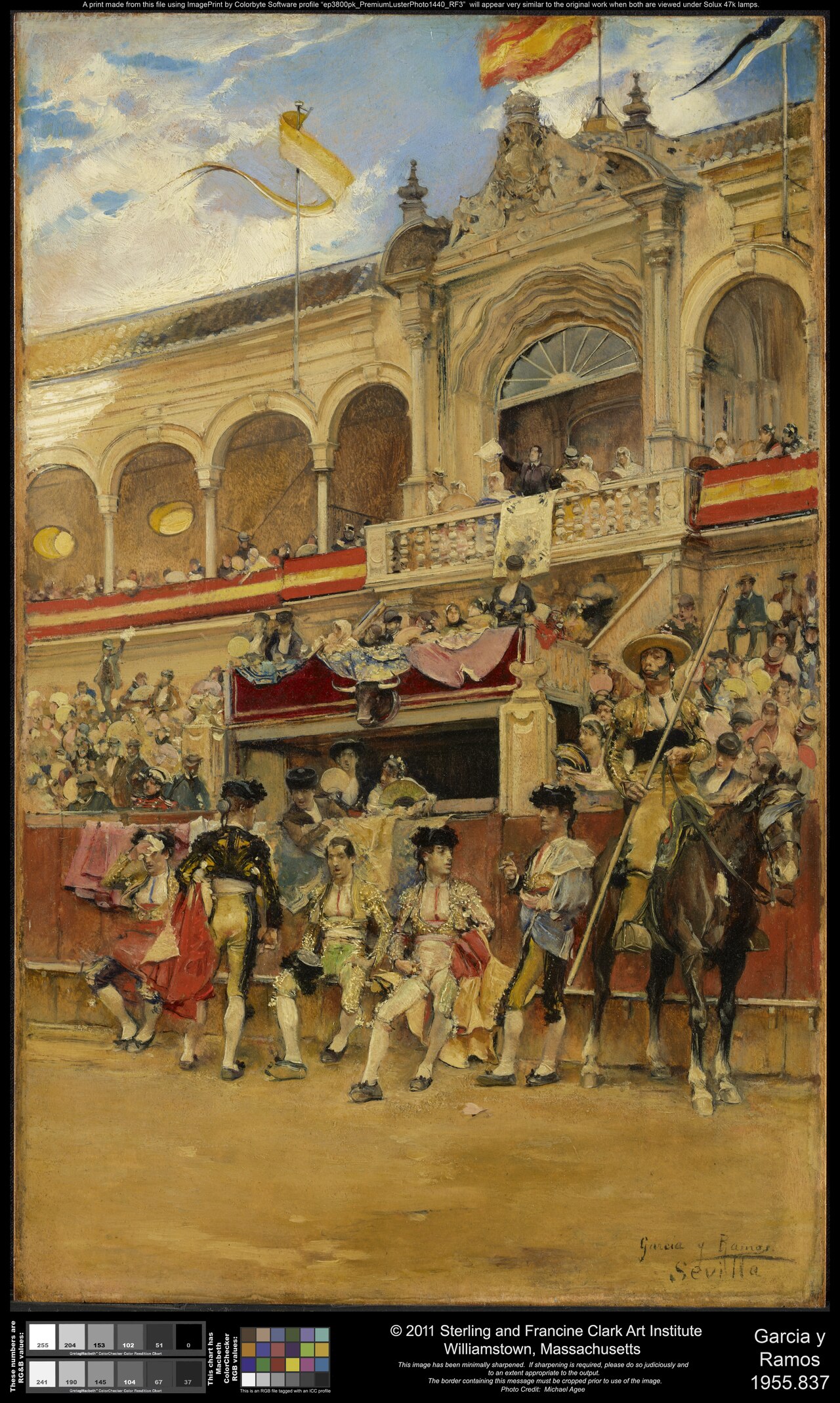
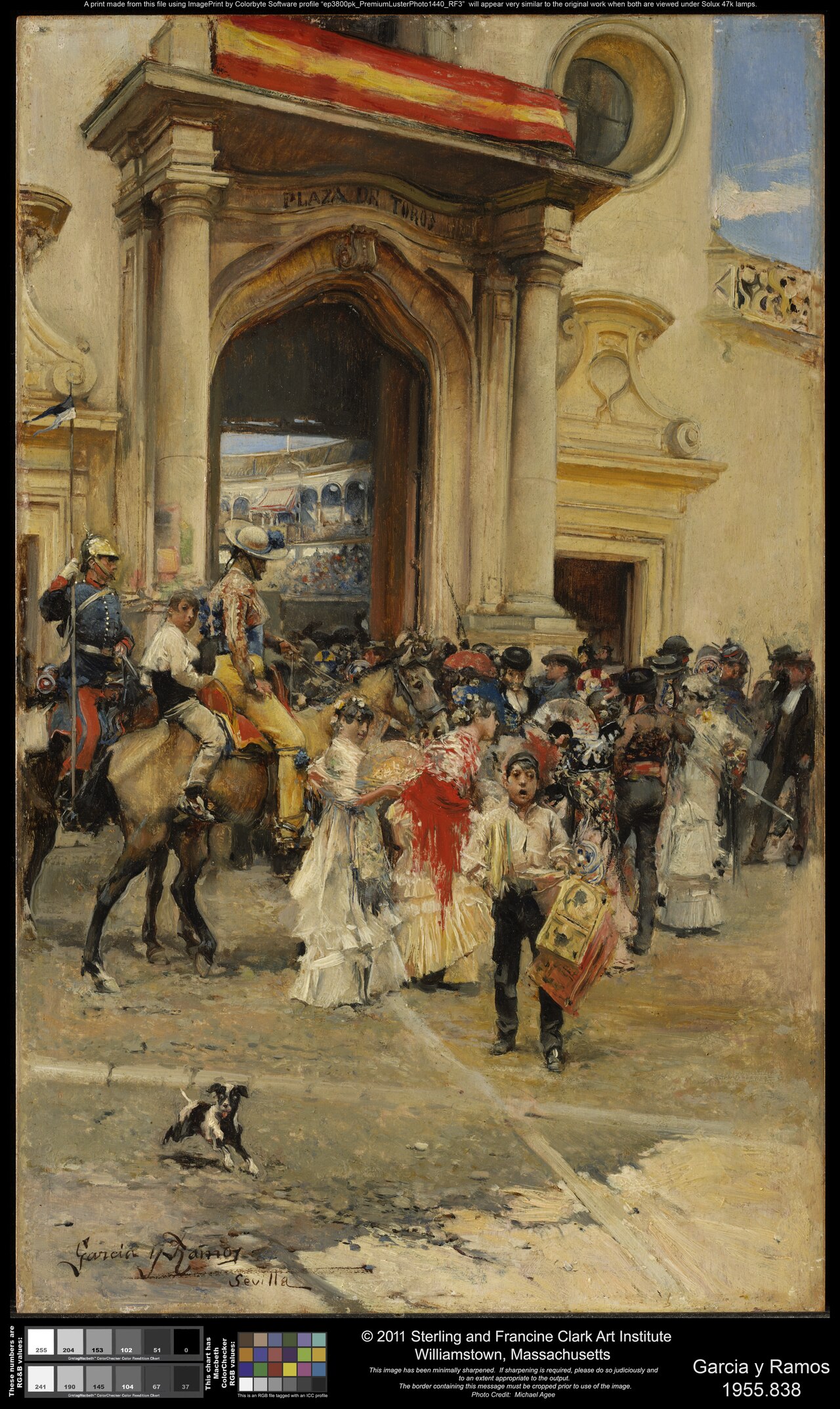
García y Ramos’s paintings are characterised by a balanced composition, careful attention to light, and a palette that reflects the warm hues of Andalusian sunshine. He often placed figures within bustling public spaces, allowing the viewer to sense the rhythm of everyday activity. His work displays a moderate realism, avoiding the excesses of hyper‑detail while still rendering textures—such as the sheen of a silk dress or the dust of a sand‑covered arena—with convincing fidelity. The artist’s subjects range from intimate domestic scenes to public spectacles, each rendered with a narrative clarity that invites the observer to imagine the story behind the moment captured.
Signature techniques A hallmark of García y Ramos’s technique is his use of controlled brushwork that combines fine detail with broader, more expressive strokes. In his interior scenes, he employs a delicate, almost filigree approach to delineate fabrics and facial expressions, while in his larger, outdoor compositions he favours broader washes to convey atmosphere and movement. Light plays a crucial role; he often positions a strong, directional light source—typically the Mediterranean sun—to create striking contrasts that highlight the figures and architectural elements.
His handling of colour is similarly noteworthy. García y Ramos favours earthy ochres, warm terracotta tones and occasional bursts of brighter reds and blues to accentuate clothing or decorative elements. This restrained yet vivid palette reinforces the authenticity of his settings while providing visual interest. The artist also made use of compositional devices such as diagonal lines formed by streets or architectural elements, guiding the eye toward focal points and adding dynamism to otherwise static scenes.
Major works Among García y Ramos’s most recognised paintings are three works that illustrate his preoccupation with Andalusian life. **Spanish Courting (1885)** portrays a tender moment between a young couple within a courtyard, their gestures and attire reflecting the customs of courtship in Seville’s middle‑class society. The composition balances intimacy with a broader sense of place, as the surrounding architecture and decorative tiles frame the lovers.
The two Bullring pieces—Inside the Bullring (1880) and Outside the Bullring (1880)—offer complementary perspectives on one of Spain’s most iconic spectacles. In *Inside the Bullring*, García y Ramos captures the intensity of the arena, with matadors, horses and spectators rendered in a tightly packed composition that conveys the tension and excitement of the event. The use of chiaroscuro heightens the drama, while the crowd’s varied expressions provide a human dimension to the spectacle.
*Outside the Bullring* shifts focus to the surrounding streets, showing vendors, onlookers and the architecture that frames the arena. Here the artist emphasizes the communal atmosphere that extends beyond the arena walls, illustrating how the bullfight permeates everyday life. Together, these works demonstrate García y Ramos’s ability to portray both the spectacle itself and its broader social context.
Influence and legacy Although José García y Ramos never achieved the same international fame as some of his contemporaries, his contributions to Spanish costumbrismo remain significant. By documenting the customs of Seville with both affection and realism, he provided future generations with visual records of a period undergoing rapid change. His illustrations for newspapers and magazines helped popularise regional scenes among a wider audience, reinforcing a sense of national identity rooted in everyday life.
Later Spanish artists, particularly those working in the early twentieth century, drew upon García y Ramos’s narrative approach and his balanced blending of realism with subtle romanticism. His work also offers valuable insight for scholars studying the visual culture of Andalusia, as his paintings capture details of dress, architecture and social interaction that textual sources alone may overlook.
Today, García y Ramos’s paintings are held in several regional collections and occasionally appear in exhibitions focused on costumbrista art. Their continued appreciation underscores the lasting relevance of his depictions of Spanish life, serving both as artistic achievements and as cultural documentation of a vibrant era in Seville’s history.
Frequently asked questions
Who was José García y Ramos?
José García y Ramos (1852–1912) was a Spanish painter and illustrator from Seville, noted for his costumbrista scenes that portray everyday Andalusian life.
What artistic style or movement is he associated with?
He is linked to the costumbrista tradition, which focuses on realistic depictions of regional customs, costumes and social practices.
What are his most famous works?
His best‑known paintings include *Spanish Courting* (1885) and the pair *Inside the Bullring* and *Outside the Bullring* (both 1880).
Why does José García y Ramos matter in art history?
He provides a vivid visual record of late‑19th‑century Seville, influencing later Spanish artists and offering scholars valuable insight into the period’s cultural life.
How can I recognise a painting by García y Ramos?
Look for warm, earthy colour palettes, careful light effects, and scenes of everyday Spanish life—especially bullfighting events—rendered with balanced composition and modest realism.