Joris van Son
1623 – 1667
In short
Joris van Son (1623–1667) was a Flemish painter from Antwerp, renowned for his richly detailed still lifes of fruit, flowers, and banquet scenes, working mainly in the Habsburg Netherlands during the mid‑17th century.
Notable works
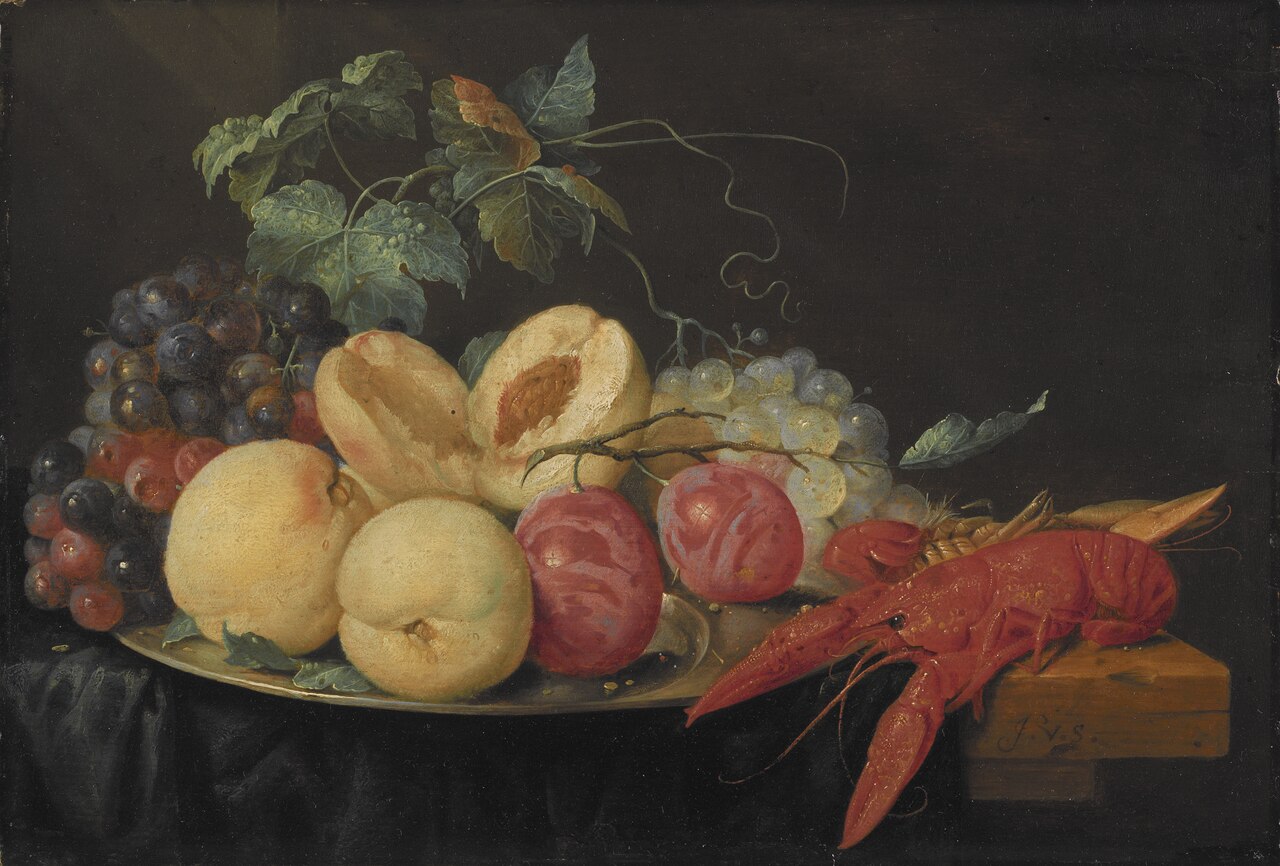


Early life Joris van Son was born in Antwerp in 1623, a city that was a thriving centre of artistic production in the Spanish‑ruled Southern Netherlands. Little is recorded about his family background, but it is likely that he received his initial training in one of the many workshops that catered to the city's vibrant market for decorative and devotional art. Antwerp’s guild system required apprentices to complete a formal apprenticeship, and Van Son would have been exposed to the prevailing Flemish Baroque style, characterised by a strong emphasis on naturalism, chiaroscuro, and a sumptuous visual vocabulary.
Career and style By the 1640s Van Son had established himself as an independent painter, specialising in still‑life subjects that appealed to both private collectors and the commercial market. He worked across several sub‑genres: fruit still lifes, flower bouquets, banquet pieces, vanitas compositions, and the more elaborate pronkstillevens that displayed opulent objects such as luxury foods, silverware and exotic vessels. His oeuvre reflects the broader Flemish tradition of the period, which combined meticulous observation of material texture with symbolic content. While no single movement claims Van Son as a leading figure, his work sits comfortably within the late Baroque still‑life tradition, sharing affinities with contemporaries such as Jan Davidsz. de Heem and Jan van Kessel the Elder.
Signature techniques Van Son’s paintings are distinguished by a finely rendered surface quality. He employed a layered glazing technique that allowed him to achieve luminous colour and depth, particularly in the skins of fruit and the translucent quality of glassware. Light often falls from a single, slightly off‑centre source, creating a dramatic contrast that highlights the curvature of apples, the sheen of grapes, and the delicate translucency of shells. He also used a tight compositional framing, frequently arranging objects in a shallow, table‑top space that draws the viewer’s eye across the surface. In his garland paintings, he collaborated with figure painters, letting the surrounding fruit or floral wreath serve as a visual conduit between the devotional image and the viewer.
Major works - **Still Life with Fruit and Boiled Crayfish (1667)** – One of his final dated works, this composition juxtaposes a sumptuous arrangement of ripe fruit with a boiled crayfish, an emblem of the fleeting nature of earthly pleasures. The meticulous rendering of the crayfish’s shell and the soft flesh demonstrates Van Son’s skill in texture. - **Allegory on Human Life (1659)** – A complex vanitas piece that combines symbols of wealth, transience and moral reflection. Objects such as a cracked mirror, wilting flowers and a half‑eaten fruit convey the impermanence of worldly success. - **Still‑Life with Cheese (1650)** – A study in domestic abundance, this painting presents a wheel of cheese surrounded by grapes, figs and a pewter dish, illustrating the artist’s ability to render both the tactile qualities of foodstuffs and the subtle play of light on metal. - **Niche with Rummer Wine, Surrounded by Flowers and Fruit (1653)** – Here Van Son integrates a carved stone niche that holds a glass rummer, a motif often associated with convivial gatherings. The surrounding bouquet and fruit reinforce the celebratory atmosphere. - **Stone Cartouche with Fruit and Flower Garland (1664)** – A decorative panel that frames a stone cartouche with a lush garland of blossoms and fruit, exemplifying his work on collaborative garland paintings that blend still‑life with religious or allegorical imagery.
Influence and legacy Joris van Son’s meticulous approach to texture and his balanced compositions helped cement the reputation of Flemish still‑life painting as a genre capable of both visual pleasure and moral instruction. His works were widely collected in his own time, and they continued to circulate in the art market well into the 18th century, influencing later Dutch and Flemish painters who sought to emulate his realistic rendering of fruit and his nuanced handling of light. Modern scholarship recognises Van Son as a key figure in the transition from the exuberant pronkstilleven of the early 17th century to the more restrained, symbol‑laden compositions that characterised the later Baroque period. His paintings remain in major European collections, where they are valued for their technical mastery and their insight into the material culture of the Habsburg Netherlands.
Frequently asked questions
Who was Joris van Son?
Joris van Son (1623–1667) was a Flemish painter from Antwerp, best known for his detailed still‑life paintings of fruit, flowers, and banquet scenes.
What artistic style or movement is he associated with?
He worked within the Flemish Baroque still‑life tradition, producing works that blend naturalistic detail with symbolic vanitas elements.
What are his most famous works?
Key works include *Still Life with Fruit and Boiled Crayfish* (1667), *Allegory on Human Life* (1659), *Still‑Life with Cheese* (1650), *Niche with Rummer Wine, Surrounded by Flowers and Fruit* (1653) and *Stone Cartouche with Fruit and Flower Garland* (1664).
Why is Joris van Son important in art history?
He exemplifies the high level of technical skill and symbolic richness of mid‑17th‑century Flemish still‑life painting, influencing later artists and helping to define the genre’s visual language.
How can I recognise a painting by Joris van Son?
Look for a crisp, layered glazing that gives fruit a luminous sheen, a strong yet subtle light source, meticulous texture, and often a decorative garland or niche framing a central devotional or allegorical image.