Johannes Lingelbach
1622 – 1674
Notable works
_-_Campo_Vaccino_te_Rome_(1653)_-_MSK_Brussel_25-02-2011_13-19-27.jpg)


Early life Johannes Lingelbach was born in 1622 in Frankfurt, a city at the crossroads of German and Dutch cultural exchange. Little is recorded about his family background, but his early exposure to the vibrant artistic milieu of the Rhine region likely sparked his interest in painting. By his late teens he had moved to the Dutch Republic, where he began an apprenticeship that introduced him to the techniques of the Dutch genre tradition. The pull of Italy—particularly Rome, the centre of the Bamboccianti—proved decisive for his artistic development, and he travelled south in the early 1640s.
Career and style In Rome Lingelbach joined the second generation of the Bamboccianti, a loosely organised group of Northern European painters who specialised in low‑brow genre scenes of everyday life. The Bamboccianti were known for their unidealised depictions of markets, taverns, and rural labour, rendered with a high degree of naturalism. Lingelbach absorbed this ethos while also encountering the flourishing Italian landscape tradition. His work consequently merged the Dutch attention to detail with the luminous colour and compositional breadth of Italian art. After a decade in Rome, he returned to the Dutch Republic, eventually establishing himself in Amsterdam. There he catered to a growing market for Italianate subjects among Dutch collectors, producing canvases that combined the narrative charm of genre painting with the atmospheric depth of Italian landscape.
Signature techniques Lingelbach’s paintings are distinguished by several recurring technical traits. He employed a warm, golden palette that recalled the Mediterranean light of Rome, yet he retained the fine brushwork and textural precision typical of Dutch masters. Light often falls obliquely across his compositions, creating a chiaroscuro effect that highlights figures and architectural elements alike. He favoured a crowded yet balanced composition, placing groups of figures in foreground activity while allowing distant vistas to open the scene. Small, anecdotal details—such as a stray dog, a overturned basket, or a distant tower—serve both decorative and narrative purposes. Moreover, Lingelbach frequently used a limited colour range for clothing and architecture, allowing the surrounding landscape to dominate the visual impact.
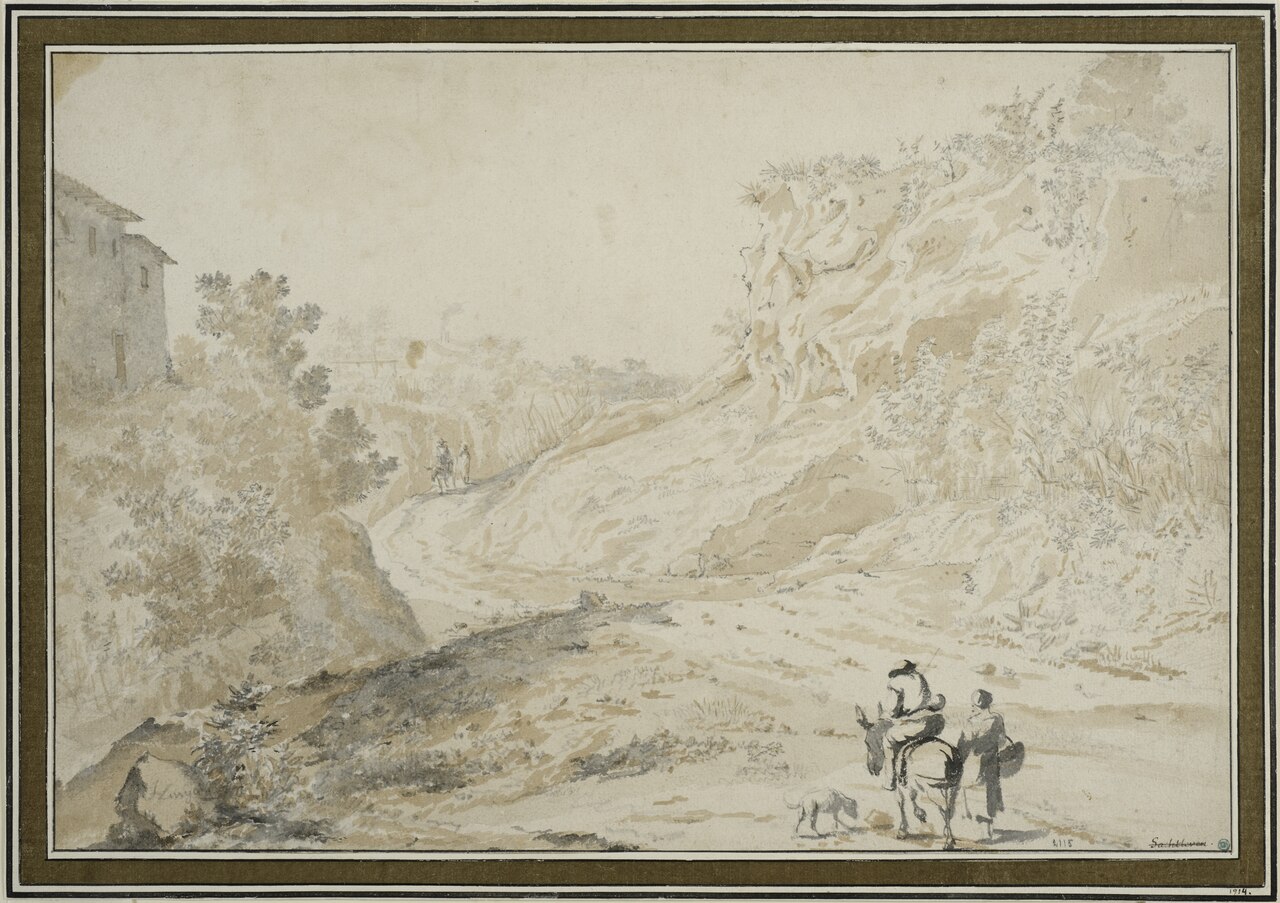
Major works - **Campo Vaccino in Rome (1653)** – This canvas captures the ancient Roman Forum bathed in soft afternoon light. Lingelbach populates the ruins with market stalls, peasants, and travellers, juxtaposing the grandeur of classical architecture with the mundane activities of daily life. The work exemplifies his ability to blend archaeological accuracy with genre storytelling. - **Carnival in Rome (1650)** – A bustling street scene set during the Roman carnival, the painting showcases a mixture of masked revelers, street musicians, and vendors. Lingelbach’s attention to costume detail and the dynamic movement of crowds creates a vivid record of contemporary festivity. - **Shepherd with goats and sheep and a carriage on the right** – In this pastoral composition, a solitary shepherd tends his flock while a carriage passes in the distance. The contrast between the tranquil agrarian foreground and the hint of urban activity on the right demonstrates Lingelbach’s skill at integrating multiple narrative strands within a single frame. - **A Watermill with Peasants Taking Refreshments** – The scene depicts a rustic watermill beside a river, where peasants pause to drink and share food. Lingelbach’s rendering of water’s reflective surface and the mill’s mechanical structure reveals his keen observation of everyday labour. - **Italian Landscape with Travellers** – This work shows a group of travellers navigating a sun‑lit Italian countryside, complete with rolling hills, distant villas, and a winding road. The composition balances the travellers’ narrative presence with an expansive, atmospheric landscape, a hallmark of Lingelbach’s Italianate phase.
Influence and legacy Lingelbach’s synthesis of Dutch genre realism and Italian landscape lyricism positioned him as a key conduit between Northern and Southern artistic traditions in the mid‑17th century. His works were widely collected in the Dutch Republic, influencing contemporaries such as Jan van der Heyden and later painters who sought to evoke Mediterranean ambience. The clarity of his compositions and the integration of narrative detail into expansive settings anticipated the later development of Dutch landscape painting that emphasized both topographical accuracy and anecdotal charm. Modern scholarship regards Lingelbach as an essential figure for understanding the cross‑cultural exchange that enriched Dutch Golden Age art, and his paintings continue to be exhibited in major European museums.
Frequently asked questions
Who was Johannes Lingelbach?
Johannes Lingelbach (1622–1674) was a Dutch Golden Age painter noted for his genre scenes and Italianate landscapes, active in Rome and later in Amsterdam.
What artistic style or movement is Lingelbach associated with?
He is linked to the Bamboccianti, a group of Northern genre painters in Rome, and is known for a synthesis of Dutch realism with Italian landscape painting.
What are his most famous works?
Key works include *Campo Vaccino in Rome* (1653), *Carnival in Rome* (1650), *Shepherd with goats and sheep and a carriage on the right*, *A Watermill with Peasants Taking Refreshments*, and *Italian Landscape with Travellers*.
Why is Lingelbach important in art history?
He bridged Dutch and Italian traditions, influencing the development of genre and landscape painting in the Netherlands and helping to spread the Italianate style among Northern artists.
How can I recognise a Lingelbach painting?
Look for warm, golden lighting, crowded yet balanced compositions, detailed everyday figures, and a blend of rustic or Roman settings with a subtle, atmospheric perspective.