Johann König
1586 – 1642
In short
Johann König (1586–1642) was a German painter from Nuremberg, noted for his small‑scale copper panel works and for following the style of Adam Elsheimer. He produced a series of religious and mythological paintings, including Bathsheba's Bath and The Brazen Serpent.
Notable works
.jpg)


Early life Johann König was born in 1586 in Nuremberg, a city that in the late sixteenth and early seventeenth centuries was a thriving centre of artistic production in the Holy Roman Empire. Little is recorded about his family background, but the city's vibrant workshop environment suggests that he likely began his training in a local painter’s studio. Nuremberg's guild system required apprentices to learn drawing, composition, and the handling of various supports, including the increasingly popular copper plates used for small, highly detailed works.
Career and style König emerged as an independent painter in the first decade of the seventeenth century. His work shows a clear affinity with the style of Adam Elsheimer, a Dutch‑German artist who had settled in Rome and become renowned for his luminous, intimate scenes on copper. Like Elsheimer, König favoured a restrained colour palette, subtle chiaroscuro, and a meticulous attention to naturalistic detail. While the precise nature of their relationship is not documented, contemporary accounts describe König as a “follower” of Elsheimer, implying that he studied Elsheimer’s prints and possibly consulted the older artist during visits to the southern German courts.
König’s oeuvre is dominated by religious and mythological subjects, rendered for private devotion or small chapel commissions. His paintings are typically modest in size, a characteristic of copper panel works that allowed collectors to display them in intimate interiors. The artist’s compositions balance narrative clarity with a quiet, contemplative mood, reflecting the Counter‑Reformation’s emphasis on personal piety.
Signature techniques König’s most distinctive technical hallmark is his use of copper as a painting support. Copper provides a smooth, non‑absorbent surface that enables the application of fine brushwork and luminous glazes. König exploited this by laying down thin, translucent layers of oil paint, building up delicate colour transitions that give his figures a soft, almost metallic glow. His handling of light often centres on a single, naturalistic source—such as a window or a divine radiance—that creates subtle highlights on flesh and fabric.
Another recurring technique is the careful rendering of textures. Whether depicting the sheen of a serpent’s scales in *The Brazen Serpent* or the intricate folds of a draped garment in *Bathsheba's Bath*, König achieved a tactile quality through fine stippling and fine brushstrokes. The artist also employed a restrained, almost monochromatic underpainting, allowing the copper’s reflective quality to contribute to the overall luminosity.
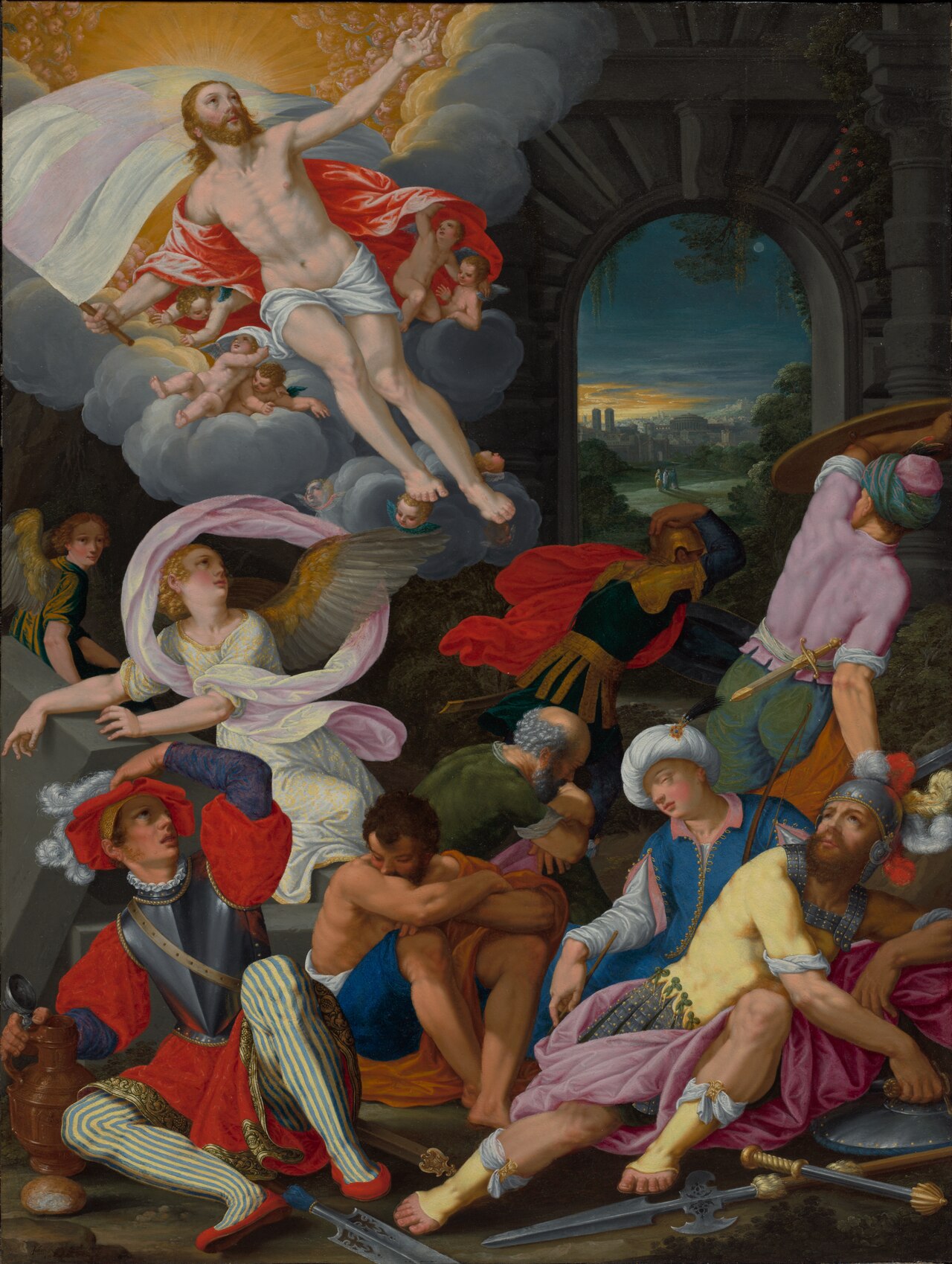
Major works - **Bathsheba's Bath (1610)** – This early work illustrates König’s mastery of copper panel painting. The composition captures Bathsheba at the moment of her bathing, illuminated by a soft, diffused light that highlights her skin against the dark background. The treatment of water and the reflective quality of the copper enhance the sense of intimacy. - **The Brazen Serpent (1621)** – Depicting the Old Testament episode in which the Israelites are healed after looking upon a bronze serpent, König places the serpentine object in the centre of the scene, bathed in a radiant glow. The surrounding figures are rendered with a calm gravity, underscoring the work’s devotional purpose. - **Sacrifice of Noah (1625)** – In this painting, König portrays the post‑flood offering with a striking use of colour contrast: the burnt offering’s orange‑red against a muted sky. The work demonstrates his skill in arranging multiple figures within a compact copper surface while maintaining narrative clarity. - **Adam and Eve in Paradise (1629)** – This later piece shows the first humans amidst a lush, idealised garden. König’s delicate handling of foliage and the subtle play of light on the figures convey a sense of both innocence and impending loss, reflecting contemporary theological concerns. - **The Resurrection of Christ (1622)** – One of König’s most ambitious religious compositions, it presents the risen Christ surrounded by astonished onlookers. The composition is anchored by a strong vertical axis, and the luminous figure of Christ is rendered with the same fine glazes that characterise König’s smaller works.
Each of these paintings exemplifies König’s consistent approach: a restrained palette, precise modelling, and an emphasis on the reflective qualities of copper. While none of the works were large‑scale altarpieces, they were highly prized by private collectors for their technical brilliance and devotional intensity.
Influence and legacy Johann König remained active in Nuremberg until his death in 1642, and his works continued to circulate among collectors in the Germanic lands. Although he never achieved the international fame of some of his contemporaries, his paintings contributed to the diffusion of the Elsheimer aesthetic beyond Italy and the Netherlands. Later German painters of the mid‑seventeenth century, particularly those working in the court of Dresden, adopted König’s copper‑plate technique and his subtle handling of light.
Modern scholarship recognises König as a key figure in the transition from the late Renaissance to the early Baroque in northern Europe. His paintings are valued not only for their technical merit but also as visual documents of the devotional practices of the period. Several of his copper panels are held in museum collections, where they are studied for their material qualities and their role in the broader network of artistic exchange that linked German, Dutch, and Italian painters in the early seventeenth century.
In sum, Johann König’s legacy lies in his meticulous copper panel paintings, his faithful continuation of Elsheimer’s luminous style, and his contribution to the visual culture of the Counter‑Reformation in Germany.
Frequently asked questions
Who was Johann König?
Johann König (1586–1642) was a German painter from Nuremberg, best known for his small copper‑panel works that blend religious and mythological subjects.
What style or movement is he associated with?
He is closely linked to the style of Adam Elsheimer, employing a luminous, naturalistic approach on copper supports that anticipates early Baroque sensibilities.
What are his most famous works?
His most recognised paintings include *Bathsheba's Bath* (1610), *The Brazen Serpent* (1621), *The Resurrection of Christ* (1622), *Sacrifice of Noah* (1625) and *Adam and Eve in Paradise* (1629).
Why does Johann König matter in art history?
König helped disseminate Elsheimer’s luminous copper‑panel technique in northern Europe, influencing later German painters and enriching the visual vocabulary of Counter‑Reformation devotion.
How can I recognise a Johann König painting?
Look for a small copper panel with finely layered oil glazes, a subtle, single light source, meticulous texture work, and a restrained colour palette that creates a soft, reflective glow.