Johann Georg Meyer
1813 – 1886
In short
Johann Georg Meyer (1813–1886) was a German painter from Bremen who specialised in Biblical, peasant and family scenes. He is remembered for works such as Young Woman Looking through a Window, Little Housewife (1854) and The Secret (1885).
Notable works




Early life Johann Georg Meyer was born in 1813 in the Hanseatic city of Bremen, a prosperous trading centre in north‑western Germany. Little is recorded about his family background, but contemporary records indicate that his upbringing took place in a middle‑class environment that valued education and the arts. As a youth he displayed a keen interest in drawing, copying the decorative motifs that adorned Bremen’s merchant houses and the modest interiors of the surrounding countryside. By his late teens he had begun to attend local drawing schools, where he received the foundational training that would later underpin his genre paintings.
In the early 1830s Meyer moved to Berlin, the cultural capital of the German Confederation, to further his artistic education. The precise academy or workshop he entered is not documented, but Berlin’s art institutions at the time offered rigorous instruction in drawing, anatomy and the study of classical models. Immersed in the city’s vibrant artistic circles, Meyer encountered a range of influences, from the Romantic idealism of Caspar David Friedrich to the emerging realist tendencies of the Düsseldorf school. These currents would later inform his own approach to narrative painting.
Career and style Meyer’s professional career unfolded over a period of more than five decades, during which he cultivated a reputation for depicting intimate domestic scenes and morally charged biblical episodes. While he did not affiliate himself with a single, formally recognised movement, his work exhibits a synthesis of Romantic sentiment and realist observation. The emotional tone of his biblical subjects—often rendered with a gentle, almost nostalgic atmosphere—reflects the lingering influence of early‑nineteenth‑century German Romanticism. At the same time, his treatment of peasant life demonstrates a commitment to realistic detail, aligning him with the broader European genre‑painting tradition.
Throughout the 1840s and 1850s Meyer exhibited regularly at Berlin’s academic salons, attracting the interest of both private collectors and public institutions. Critics of the day praised his ability to convey narrative clarity without sacrificing aesthetic refinement. By the 1860s his oeuvre had expanded to include larger historical compositions, yet his core interest in everyday moments—children at play, women engaged in household tasks, quiet contemplations—remained constant. This continuity gave his work a recognisable thematic unity, even as his palette evolved from the muted earth tones of his early period to richer, more saturated colours in his later years.
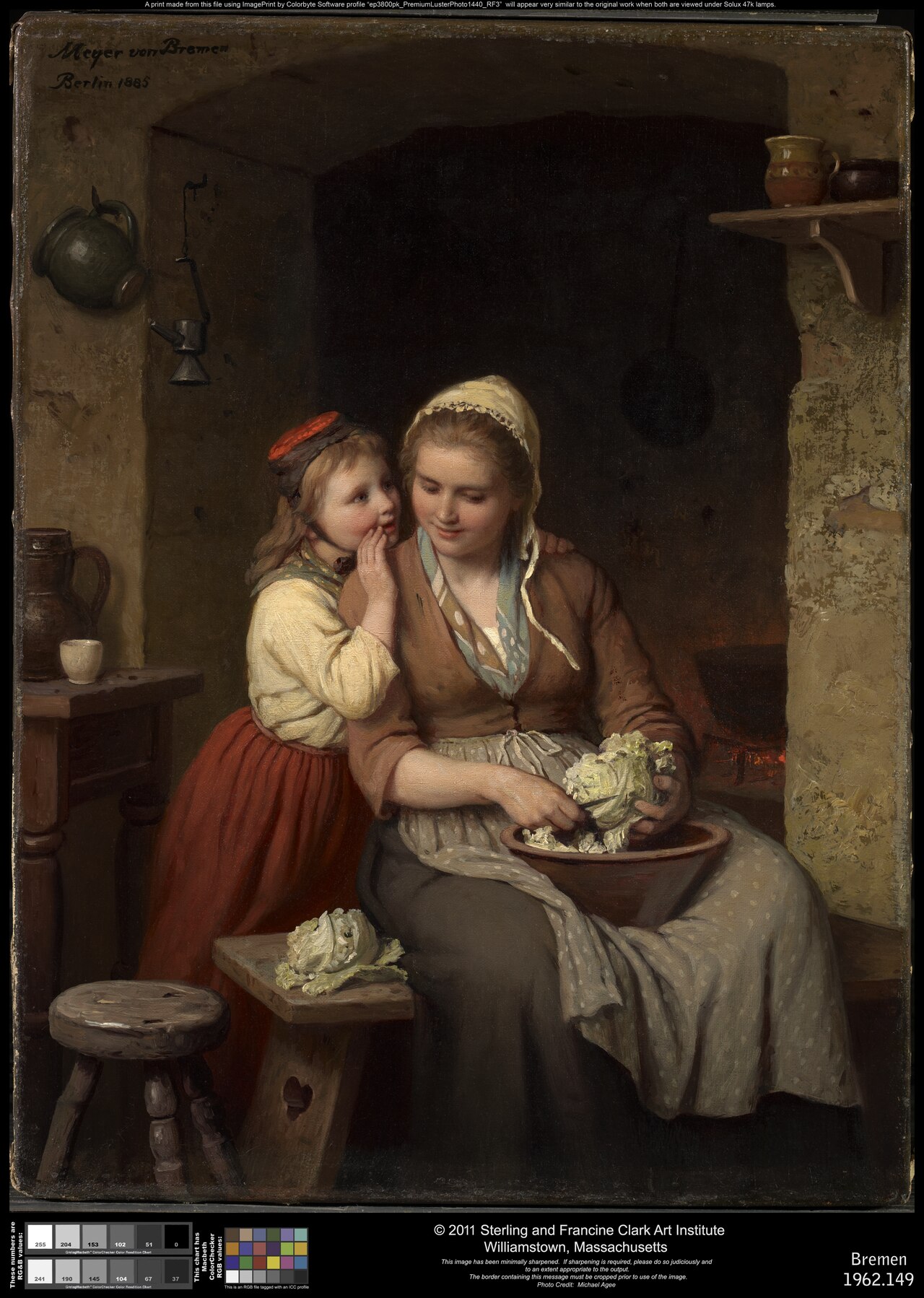
Signature techniques Meyer’s paintings are distinguished by several technical hallmarks. First, his handling of light demonstrates an acute sensitivity to the way illumination shapes interior spaces. He frequently employed a soft, diffused light source that falls across a figure’s face or a domestic object, creating a sense of calm intimacy. Second, his compositional arrangements often place the principal subject off‑centre, inviting the viewer’s eye to wander through secondary details that enrich the narrative. This technique mirrors the storytelling strategies of Dutch genre masters, yet Meyer adapts it within a Germanic sensibility.
Another notable feature is his meticulous rendering of texture. Whether depicting the sheen of polished wood, the coarse weave of a peasant’s apron, or the delicate translucency of a window pane, Meyer captures material qualities with a painterly precision that heightens the realism of his scenes. Finally, his colour palette, while generally restrained, occasionally incorporates vivid accents—such as a crimson dress or a golden lamp—to draw attention to focal points and underscore emotional undercurrents.
Major works **Young Woman Looking through a Window** – This composition presents a solitary figure, poised before a lattice‑framed window, peering outward with a mixture of curiosity and melancholy. The painting exemplifies Meyer’s skill in conveying psychological nuance through simple gestures. The softly illuminated interior contrasts with the bright exterior, underscoring the tension between private contemplation and the world beyond.
Little Housewife (1854) – Executed in the middle of his career, this work portrays a young girl engaged in domestic chores, perhaps sweeping or arranging a modest meal. The painting’s attention to the texture of the girl’s clothing and the rustic setting reflects Meyer’s commitment to realistic detail. Contemporary reviewers lauded the piece for its tender depiction of youthful industriousness, a theme resonant with the moral values of mid‑nineteenth‑century Germany.
The Listener (1867) – In this painting a figure—often interpreted as an elderly woman—listens intently to a storyteller or a piece of music. Meyer captures the rapt attention of the subject through subtle facial expression and the careful use of chiaroscuro, which highlights the listener’s face against a dimly lit interior. The work is frequently cited as an exemplar of Meyer’s ability to merge narrative content with atmospheric depth.
The Secret (1885) – One of Meyer’s later masterpieces, The Secret depicts a group of individuals sharing a concealed piece of information, perhaps a whispered confession. The composition is tightly framed, with the central figures illuminated by a single candle, casting dramatic shadows that amplify the sense of intrigue. Art historians note that the painting’s psychological tension reflects Meyer’s mature exploration of human emotion.
Over The Hills And Far Away – Though undated, this canvas illustrates a pastoral landscape punctuated by distant hills, with figures moving towards an undefined horizon. The title, drawn from a popular 19th‑century song, suggests a yearning for adventure or escape. Meyer’s treatment of atmospheric perspective and his use of muted, harmonious colours contribute to a tranquil yet evocative mood.
Influence and legacy Johann Georg Meyer’s contribution to German art lies in his consistent dedication to genre subjects that bridge biblical narrative and everyday life. While he never achieved the fame of contemporaries such as Adolph Menzel, his works enjoyed steady appreciation among collectors and were regularly displayed in Berlin’s exhibition halls throughout the latter half of the nineteenth century. Several of his paintings entered public collections, including the Berlin National Gallery, where they continue to be referenced in studies of nineteenth‑century German genre painting.
Meyer’s legacy endures primarily through the pedagogical value of his technique. His careful rendering of light, texture and composition offers a model for students of academic painting, and his ability to articulate moral narratives without overt didacticism provides a template for later realist artists. Moreover, his paintings serve as visual documents of mid‑nineteenth‑century German domestic environments, offering scholars insight into the material culture of the period.
In recent decades, renewed scholarly interest in lesser‑known genre painters has led to a modest reassessment of Meyer’s oeuvre. Exhibition catalogues and art‑historical surveys now acknowledge his role in shaping the visual language of intimate, narrative‑driven art in Germany. Though his name may not be as instantly recognisable as that of his more celebrated peers, Johann Georg Meyer remains a significant figure for those exploring the intersection of religious, peasant and family themes in nineteenth‑century European painting.
Frequently asked questions
Who was Johann Georg Meyer?
Johann Georg Meyer (1813–1886) was a German painter from Bremen, best known for his biblical, peasant and family scenes.
What style or movement is he associated with?
Meyer did not belong to a single defined movement; his work blends Romantic sentiment with realist detail, placing him within the broader nineteenth‑century German genre‑painting tradition.
What are his most famous works?
His notable paintings include Young Woman Looking through a Window, Little Housewife (1854), The Listener (1867), The Secret (1885) and Over The Hills And Far Away.
Why does he matter in art history?
Meyer’s paintings provide a valuable illustration of domestic and biblical narratives in mid‑nineteenth‑century Germany, and his technical handling of light and texture influenced later realist artists.
How can I recognise a Johann Georg Meyer painting?
Look for softly diffused interior lighting, meticulous texture work, off‑centre compositions, and a calm, narrative focus on everyday or biblical subjects.