Johann Dominik Bossi
1767 – 1853
In short
Johann Dominik Bossi (1767–1853) was an Austrian painter born in Trieste who specialised in portraiture for European aristocracy. He worked mainly in Munich, producing finely detailed oil portraits that are now held in several museum collections.
Notable works

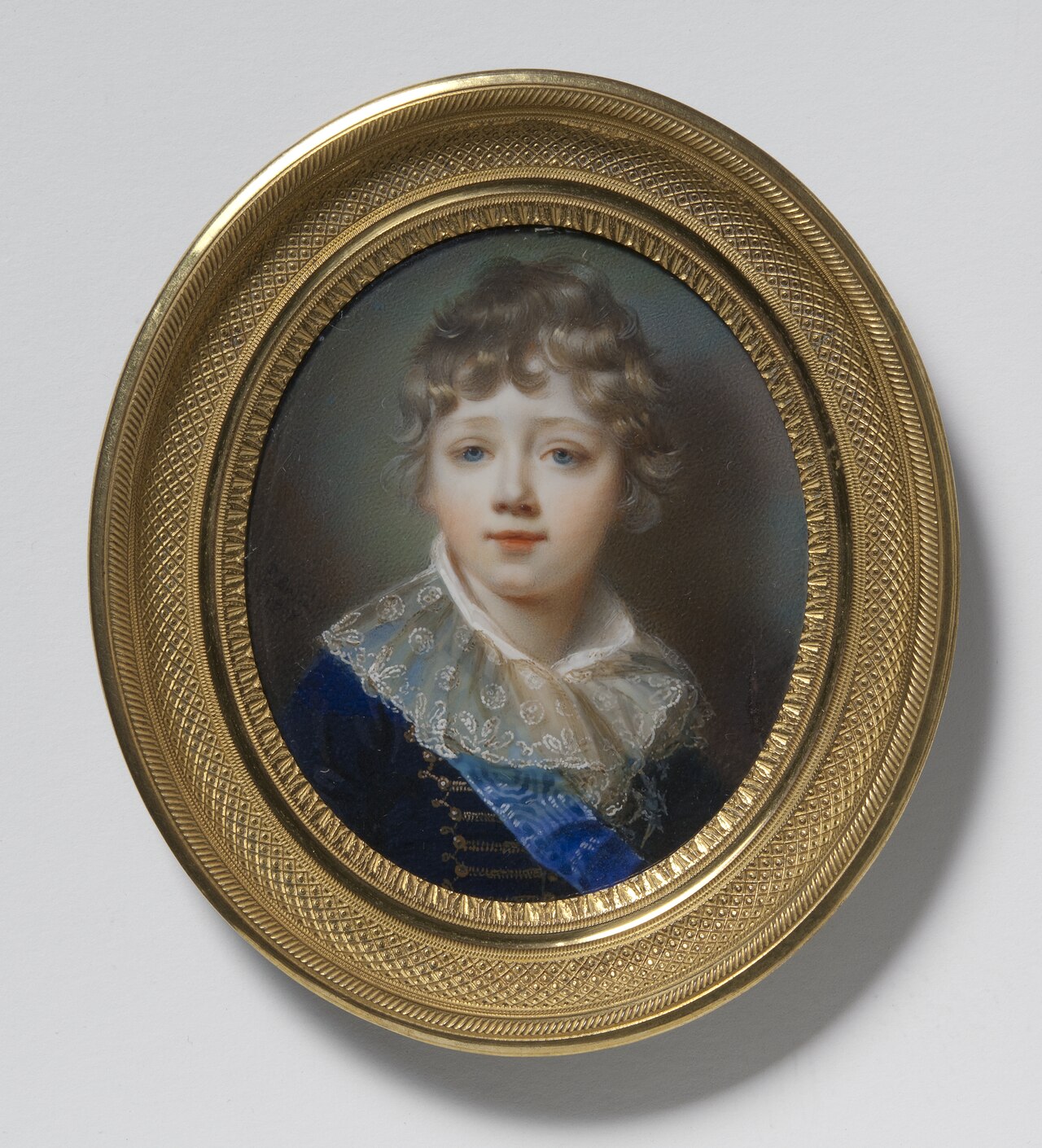
,_keizer_van_Rusland_Rijksmuseum_SK-A-4388.jpeg)

-_Young_Woman_with_Garland_of_Flowers_-_Nuori_seppelep%C3%A4inen_tytt%C3%B6_-_Ung_kvinna_med_blomsterkrans_(28845438853).jpg)
Early life Johann Dominik Bossi was born in 1767 in the port city of Trieste, which at the time was part of the Habsburg Empire. Although the city lay on the Adriatic coast, his family identified with the Austrian cultural sphere. Little is recorded about his formal training, but contemporary practice suggests that a young artist of his background would have apprenticed with a local master before moving to a larger centre such as Vienna to complete his education. The artistic climate of the late‑18th century in the empire was dominated by a strong court tradition, with an emphasis on precise draftsmanship and the rendering of aristocratic dignity—an environment that would shape Bossi’s later work.
Career and style By the early 1790s Bossi had established himself as a portrait painter capable of attracting commissions from the higher echelons of society. He eventually settled in Munich, a city that was emerging as a cultural hub for the German‑speaking world. In Munich he worked for a clientele that included members of the Bavarian court and visiting dignitaries from across Europe. His portraits are characterised by a sober, restrained palette and a focus on the sitter’s facial expression, reflecting the broader neoclassical sensibility of the period without overtly aligning himself with any specific artistic movement. Bossi’s style balances the formal conventions of court portraiture with a subtle psychological depth, a combination that appealed to patrons seeking both representation and status.
Signature techniques Bossi’s technical approach relied heavily on oil on canvas, a medium that allowed him to achieve fine gradations of tone and a luminous skin quality. He employed a layered glazing method, building up thin translucent layers to model the flesh and fabrics. This technique gave his subjects a soft, almost three‑dimensional presence. In addition to his careful handling of light, Bossi paid meticulous attention to the details of clothing, jewellery and insignia, which he rendered with a micro‑precision that served both documentary and aesthetic purposes. His compositions are typically straightforward, with the sitter placed centrally against a muted background, allowing the viewer’s eye to remain focused on the face and hands. Subtle use of chiaroscuro adds depth while preserving the clarity required for official portraiture.
Major works - **Pendant with portrait of Princess Karoline of Baden** – This work, executed as a pair, showcases Bossi’s ability to convey regal poise. The princess is depicted in an elegant dress with delicate embroidery, her gaze directed slightly off‑canvas, suggesting both confidence and introspection. The pendant format emphasizes the symmetrical relationship between the two portraits, a common practice for married or sibling pairs. - **Portrait of Alexander I Romanov (1777‑1825) (1810)** – Commissioned during Alexander’s visit to the German states, the portrait captures the future Tsar in a sober uniform, his expression marked by a contemplative seriousness. Bossi’s rendering of the imperial regalia is exacting, reflecting his skill in portraying the insignia of power. - **Gustav, 1799‑1877, Prince of Sweden and Vasa (1808)** – In this portrait the young prince is shown in a princely uniform, with a faint hint of a landscape visible through a window behind him. The work illustrates Bossi’s capacity to blend personal portraiture with a sense of the sitter’s broader dynastic context. - **Count Alexander Ivanovich Sollogoub (1788–1844) (1810)** – This portrait presents the count in a dark coat, his hands clasped in front of him, a pose that conveys both authority and restraint. Bossi’s treatment of the count’s facial features demonstrates his talent for capturing subtle character traits. - **Young woman with garland of flowers (1797)** – Departing from his strictly portraitic commissions, this composition shows a youthful figure holding a wreath of blossoms. The work is notable for its softer colour scheme and lyrical quality, hinting at a more romantic sensibility while still retaining Bossi’s characteristic precision.
Influence and legacy Although Bossi never founded a distinct school, his portraits contributed to the visual vocabulary of Austrian and German aristocratic representation in the early 19th century. His meticulous handling of detail set a benchmark for later portrait painters who sought to combine documentary accuracy with aesthetic refinement. Works by Bossi are now part of several public collections, including the Munich State Gallery and the Russian Museum, where they are valued both as historical documents and as exemplars of late‑classical portraiture. Scholars regard him as a reliable chronicler of his era’s elite, and his paintings continue to inform exhibitions exploring the intersection of art, politics and identity in pre‑modern Europe.
Frequently asked questions
Who was Johann Dominik Bossi?
Johann Dominik Bossi (1767–1853) was an Austrian painter known for his detailed portraiture of European aristocracy, active mainly in Munich.
What artistic style or movement is he associated with?
Bossi worked within the late‑18th‑century court portrait tradition, employing a restrained neoclassical style without belonging to a specific movement.
What are his most famous works?
Key works include the pendant portrait of Princess Karoline of Baden, his 1810 portrait of Alexander I of Russia, the 1808 portrait of Prince Gustav of Sweden, the 1810 portrait of Count Alexander Sollogoub, and the 1797 genre piece ‘Young woman with garland of flowers.’
Why is Bossi important in art history?
He provided a reliable visual record of early‑19th‑century European elites and set a high standard for technical precision in portrait painting, influencing subsequent generations of Austrian and German portraitists.
How can I recognise a painting by Bossi?
Look for finely layered oil glazes, meticulous rendering of clothing and insignia, a calm, centred composition, and a subtle chiaroscuro that gives the sitter a three‑dimensional presence.