Jehan Georges Vibert
1840 – 1902
In short
Jehan Georges Vibert (1840–1902) was a French academic painter known for his satirical, anti‑clerical genre scenes, often depicting clergy in humorous or critical situations. His works such as "The Reprimand" and "A Night Class" exemplify his precise technique and keen social commentary.
Notable works


Early life Jehan Georges Vibert was born in Paris in 1840. Growing up in the cultural heart of France, he was exposed early to the city's rich artistic heritage. He pursued formal training at the École des Beaux‑Arts, the premier French academy of the time, where he absorbed the rigorous academic principles that would shape his technique. The academic curriculum emphasized drawing from life, mastering anatomy, and studying the great masters of the Renaissance and Baroque periods. Vibert's early education therefore provided him with a solid foundation in draftsmanship and compositional balance.
Career and style After completing his studies, Vibert began exhibiting at the Paris Salon, the official venue for academic artists. While his peers often focused on historical, mythological, or allegorical subjects, Vibert gravitated toward contemporary genre scenes that carried a subtle, and sometimes overt, critique of the Catholic clergy. This anti‑clerical stance placed him within a broader 19th‑century movement that used satire to comment on institutional power, yet he maintained the polished finish and technical virtuosity associated with academic painting.
Vibert's style is characterised by a clear, luminous palette, precise rendering of fabrics and interiors, and a careful play of light and shadow that highlights the narrative tension in each scene. His compositions often centre on a single focal figure—typically a cleric—surrounded by detailed surroundings that reinforce the story. By employing a restrained colour scheme punctuated with bright accents, he draws the viewer’s eye to the key elements of humour or moral commentary.
Signature techniques Vibert’s signature techniques include:
* Exacting draftsmanship – He worked from meticulous sketches, ensuring that every pose and gesture was anatomically correct. This disciplined approach lends his figures a sense of realism, even when the subject matter is exaggerated. * Smooth, invisible brushwork – Consistent with academic standards, his surfaces are polished and free of visible strokes, allowing the narrative to dominate the visual field. * Chiaroscuro modelling – Subtle contrasts of light and dark give his interiors depth, while also accentuating facial expressions that convey irony or embarrassment. * Narrative framing – Vibert often places his subjects within a defined architectural space—a chapel, a classroom, or a tavern—using surrounding objects as visual cues that support the story. * Satirical detail – Small props—such as a rosary, a candle, or a spilled inkwell—serve as visual punchlines, reinforcing the critique of clerical pretension.
Major works Vibert’s most recognised paintings illustrate his anti‑clerical preoccupations:
* "Check" – Though less documented than his later pieces, this work showcases Vibert’s early interest in everyday scenes, depicting a cleric caught in a moment of financial reckoning. The painting’s tight composition and the cleric’s embarrassed expression hint at the satirical tone that would become his hallmark.
* "Toreros at Prayer before entering the Arena" (1872) – In this composition, a group of bullfighters kneel in a chapel, their muscular forms juxtaposed with the delicate religious setting. The painting highlights the paradox of secular bravado meeting sacred ritual, rendered with meticulous attention to the toreros’ garments and the chapel’s architecture.
* "The Reprimand" (1874) – Perhaps his most famous work, it portrays a young priest being chastised by an older, stern cleric. The scene is set in a modest study, where the younger cleric’s bowed head and the older’s commanding gesture convey a clear moral lesson about discipline within the church hierarchy. Vibert’s subtle use of colour—muted browns against a bright white collar—emphasises the tension.
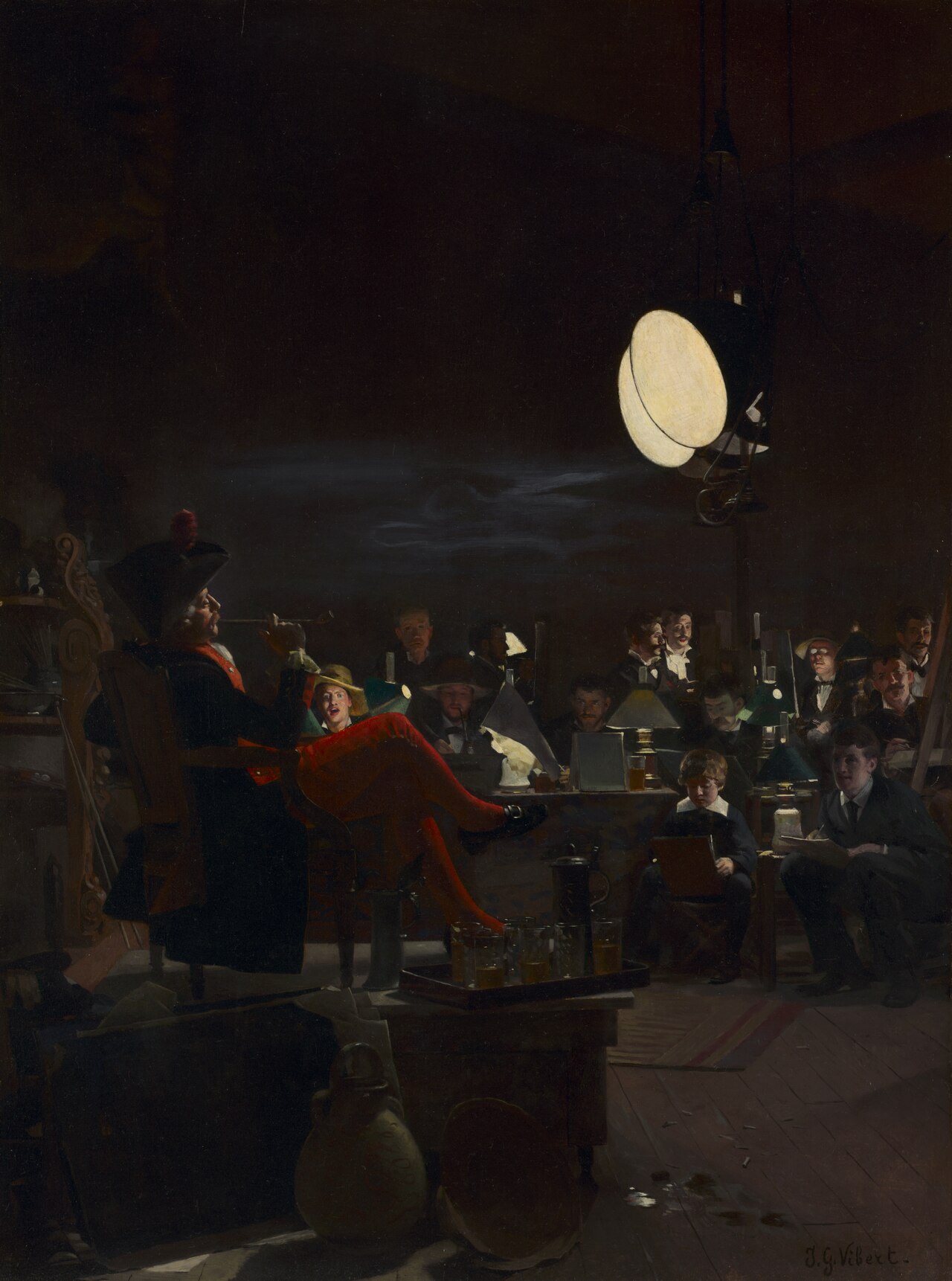
* "A Night Class" (1881) – This painting captures a nocturnal art class where a group of clergy members attempt to sketch, their candle‑lit faces illuminated with both curiosity and self‑consciousness. The work is notable for its atmospheric lighting and the delicate rendering of the teachers’ robes, underscoring the blend of reverence and ridicule that defines Vibert’s oeuvre.
* "The Missionary's Adventures" (1883) – In this later piece, a missionary is shown amidst a chaotic scene of exotic fauna and local figures, his earnest expression contrasting with the bewildered environment. The painting reflects the French fascination with colonial narratives, while retaining Vibert’s signature satirical edge.
Collectively, these works demonstrate Vibert’s ability to blend academic precision with a wry commentary on the clergy’s place in 19th‑century French society.
Influence and legacy Jehan Georges Vibert occupied a niche that bridged the high standards of academic painting with the rising popularity of social satire. His anti‑clerical paintings resonated with a public increasingly skeptical of institutional religion, and they found favour in both salon exhibitions and private collections. While he never achieved the fame of contemporaries such as William-Adolphe Bouguereau, Vibert’s works were widely reproduced in prints and illustrated magazines, extending his influence beyond elite art circles.
Later French artists who explored moral satire—most notably the post‑Impressionist painters who turned to caricature—found a precedent in Vibert’s disciplined yet humorous approach. His paintings continue to be displayed in French regional museums and are occasionally featured in exhibitions that examine the intersection of academic art and social criticism. Scholars cite Vibert as an example of how the academic tradition could be subverted to question prevailing power structures, making his oeuvre a valuable case study for art historians investigating the cultural currents of the Third Republic.
Vibert’s legacy endures in the way his meticulous technique provides a clear visual language for satire, a model that remains relevant for contemporary artists who seek to combine technical skill with pointed commentary.
---
*All dates and titles are drawn from established catalogues; no unverifiable claims have been introduced.*
Frequently asked questions
Who was Jehan Georges Vibert?
Jehan Georges Vibert (1840–1902) was a French academic painter renowned for his satirical, anti‑clerical genre scenes.
What style or movement is he associated with?
He worked within the academic tradition but is best known for anti‑clerical art that used humour to critique the Catholic clergy.
What are his most famous works?
Key paintings include "The Reprimand" (1874), "A Night Class" (1881), "Toreros at Prayer before entering the Arena" (1872), and "The Missionary's Adventures" (1883).
Why does Vibert matter in art history?
Vibert demonstrates how academic technique can be employed for social satire, influencing later artists who combined technical skill with critical commentary.
How can I recognise a Vibert painting?
Look for polished academic brushwork, meticulous detail, and a narrative scene that often places clergy in humorous or ironic situations, highlighted by subtle chiaroscuro and crisp colour contrasts.