Jean Victor Schnetz
1787 – 1870
In short
Jean‑Victor Schnetz (1787–1870) was a French academic painter renowned for his historical and genre scenes. Working mainly in the early‑to‑mid‑19th century, he produced large‑scale narrative works that reflected the academic standards of his time.
Notable works



Early life Jean‑Victor Schnetz was born in 1787 in Versailles, a city closely linked to the French court. Little is recorded about his family background, but his upbringing in a culturally rich environment would have given him early exposure to the visual arts. He entered the Parisian art world during the Napoleonic era, a period when the French Academy dictated artistic standards and provided formal training for aspiring painters. Schnetz likely attended the École des Beaux‑Arts, where he would have studied drawing, composition, and the classical canon under the guidance of established masters.
Career and style Schnetz built his reputation as an academic painter, a label that denotes adherence to the hierarchy of genres promoted by the Académie des Beaux‑Arts. His work predominantly occupied the historical and genre categories, with an emphasis on narrative clarity, idealised figuration, and polished technique. The early 19th century in France saw a resurgence of interest in national history, and Schnetz’s subjects often celebrated French heroism and moral exempla. While the precise stylistic influences on his oeuvre are not exhaustively documented, his paintings display the balanced composition, careful modelling of flesh, and controlled colour palette typical of academic classicism. He participated in the Salon exhibitions, the principal venue for public display, where his works were evaluated by juries steeped in academic tradition.
Signature techniques Schnetz’s paintings are characterised by several recurring technical approaches. First, he employed a clear, linear drawing style that underpinned the overall structure of his compositions; this ensured that narrative elements were legible even at a distance. Second, his handling of light was subtle, using chiaroscuro to model forms without dramatic contrast, thereby maintaining a harmonious visual tone. Third, he often placed his figures in carefully staged settings, using architectural elements or period costumes to anchor the scene historically. Finally, his colour choices tended toward muted earth tones punctuated by brighter accents on focal points, a strategy that guided the viewer’s eye toward the central action.
Major works Among Schnetz’s most noted paintings are several large‑scale historical canvases. **"Combat devant l'Hôtel de Ville le 28 juillet 1830" (1833)** depicts the violent clashes of the July Revolution, capturing the fervour of the Parisian crowd and the chaos of street combat. The work demonstrates Schnetz’s capacity to render collective drama while preserving individual expressions. **"Count Eudes defends Paris" (1835)** continues this patriotic theme, presenting a noble figure protecting the city, a composition that resonates with the contemporary valorisation of French national heroes.
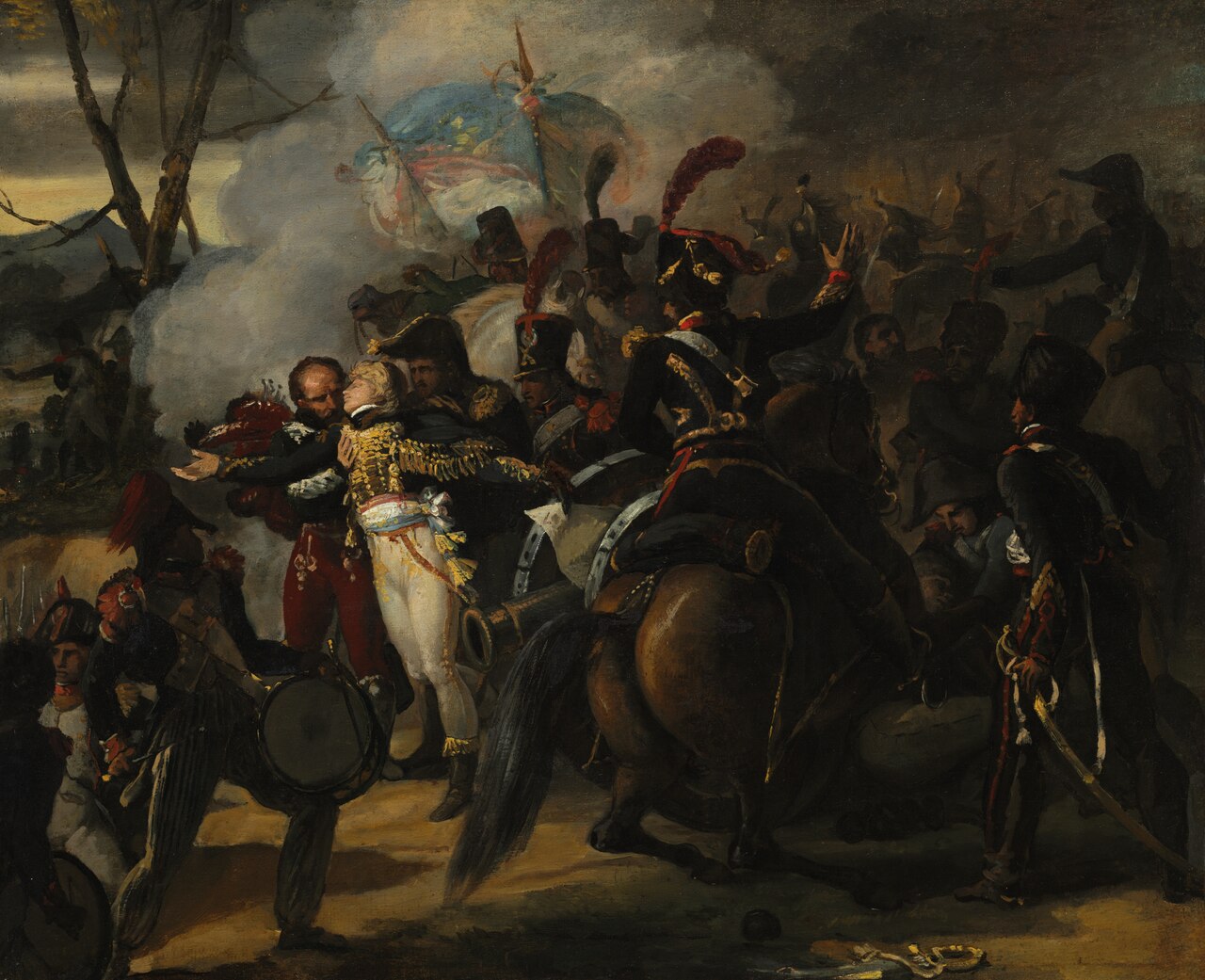
In the realm of religious and genre subjects, "Christ and the children" (1830) offers a tender scene drawn from biblical narrative, displaying the artist’s softer side and his skill in rendering intimate human interaction. "The Death of General Colbert" (1809), an early work, portrays the demise of a military figure, likely employing the solemnity and gravitas expected of a historical tableau. Although the title suggests a specific historical event, the painting aligns with the period’s penchant for dramatising the fate of notable individuals.
A work listed under Schnetz’s oeuvre, "The Old Italian Woman" (1900), bears a date that post‑dates his death by three decades. This discrepancy indicates either a misattribution or a later reproduction of an earlier sketch; consequently, the painting cannot be confidently presented as an original work by Schnetz.
Influence and legacy Jean‑Victor Schnetz occupies a respectable place within the academic tradition of 19th‑century French painting. While he never achieved the fame of contemporaries such as Ingres or Delacroix, his contributions exemplify the disciplined approach of the Academy and the period’s interest in historical narrative. His works were part of the visual culture that reinforced national identity during a time of political upheaval, and they provided a visual reference for later generations of history painters. Schnetz’s paintings continue to appear in museum collections and academic discussions as examples of the intersection between state‑endorsed art and the evolving tastes of the French public. Though the academic style eventually gave way to more avant‑garde movements, Schnetz’s oeuvre remains a valuable resource for scholars examining the conventions and techniques of the French Academy in the early nineteenth century.
Frequently asked questions
Who was Jean‑Victor Schnetz?
Jean‑Victor Schnetz (1787–1870) was a French academic painter known for his historical and genre paintings that adhered to the standards of the French Academy.
What artistic style or movement is Schnetz associated with?
He worked within the academic classicism of the early‑to‑mid‑19th century, following the hierarchy of genres prescribed by the Académie des Beaux‑Arts.
What are Schnetz’s most famous works?
His best‑known paintings include "Combat devant l'Hôtel de Ville le 28 juillet 1830" (1833), "Count Eudes defends Paris" (1835), "Christ and the children" (1830), and "The Death of General Colbert" (1809).
Why is Schnetz important in art history?
He exemplifies the disciplined, narrative‑driven approach of the French academic tradition, contributing to the visual articulation of national history during a period of political change.
How can I recognise a Schnetz painting?
Look for clear, linear drawing, balanced composition, subdued colour palettes with strategic highlights, and subject matter that centres on historical or moral narratives rendered with polished, academic technique.