Jean-Louis de Marne
1752 – 1829
In short
Jean-Louis de Marne (1752–1829) was a French painter born near Brussels who worked in Paris during the late 18th and early 19th centuries, best remembered for pastoral and genre scenes such as Italian Landscape with Shepherds and Animals at a Fountain.
Notable works



Early life Jean-Louis de Marne was born in 1752 in the metropolitan area of Brussels, a region that at the time was part of the Austrian Netherlands but culturally intertwined with French artistic circles. Little is recorded about his family background, but the proximity of Brussels to major artistic centres such as Antwerp and Paris meant that he was exposed to a wide range of visual influences from an early age. He likely received his initial training in the local workshops that catered to both Flemish and French tastes, a hybrid environment that would later inform his eclectic compositional choices.
In his early twenties, de Marne moved to Paris, the heart of the French art world. The city was undergoing a period of intense political and cultural transformation as the Ancien Régime gave way to revolutionary ideals. For a young painter, Paris offered access to the Académie royale de peinture et de sculpture, the Salon exhibitions, and a thriving market for both aristocratic commissions and the emerging bourgeois clientele. While there is no definitive record of his formal admission to the Académie, his later participation in Salon shows suggests that he was at least informally integrated into the Parisian artistic community.
Career and style De Marne’s career unfolded against the backdrop of the French Revolution, the Napoleonic era, and the Restoration. Throughout these turbulent decades, he maintained a focus on genre scenes, landscapes, and modest narrative subjects rather than overtly political or historical themes. This choice positioned him within a tradition of painters who catered to the taste for bucolic and sentimental imagery, an aesthetic that resonated with both aristocratic nostalgia and the rising middle class.
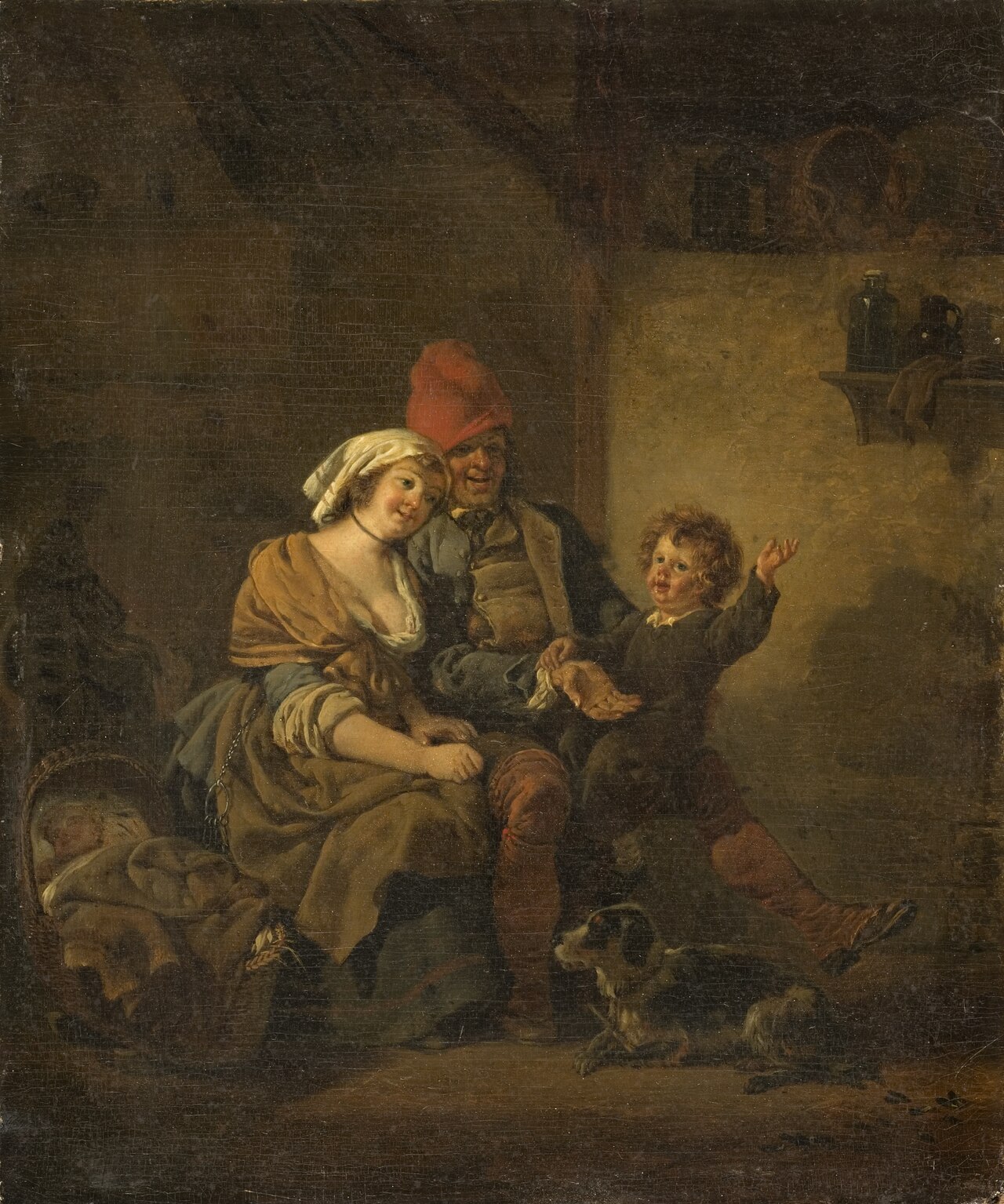
Stylistically, his work displays a synthesis of French classicism and the more naturalistic tendencies emerging from the Dutch and Flemish schools. The compositions are generally balanced, with a gentle chiaroscuro that models forms without dramatic contrast. Colour palettes tend toward muted earth tones punctuated by brighter accents—such as the blue of a sky or the red of a garment—used to draw the viewer’s eye to focal points. Though the precise movement with which he is associated remains uncertain, his paintings share affinities with the late Rococo’s pastoral charm and the early Romantic fascination with nature’s quiet drama.
Signature techniques De Marne’s technique is characterised by a careful handling of brushwork that conveys texture while preserving a smooth overall surface. In figures, he employs modest, almost invisible strokes to render flesh, favouring a softness that enhances the intimate atmosphere of his scenes. For landscapes, he often builds up foliage and ground using layered, stippled applications of paint, allowing the underlying tones to emerge through the layers and create depth.
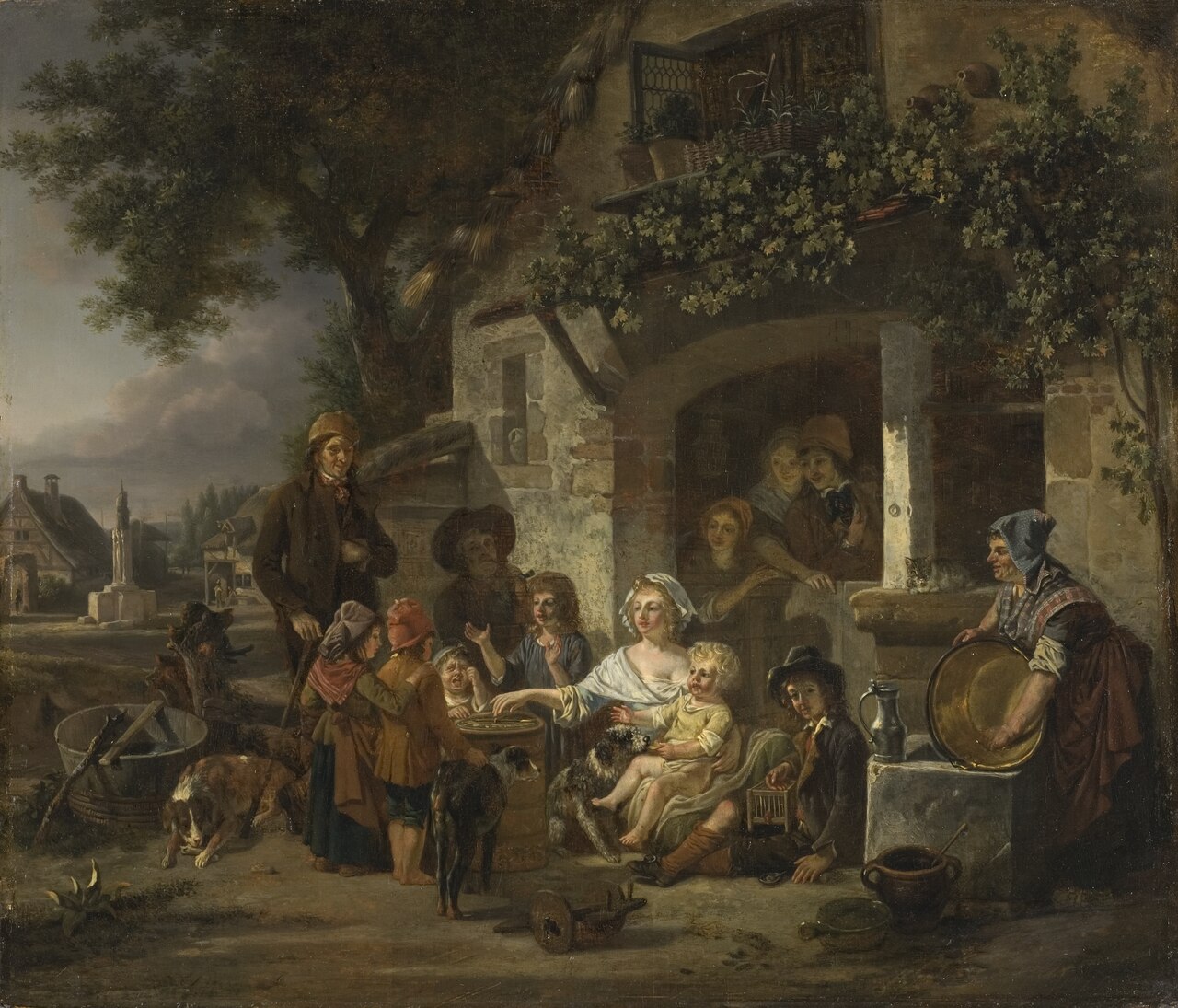
A notable feature of his paintings is the treatment of light. Rather than the stark, theatrical illumination favoured by some contemporaries, de Marne prefers a diffused, natural light that seems to emanate from an overcast sky or a distant sun. This approach lends his works a timeless quality, as the lighting conditions are never tied to a specific historical moment. Additionally, he frequently incorporates reflective surfaces—such as water in wells or fountains—to introduce subtle highlights that enliven the composition without overwhelming the main subjects.
Major works Among de Marne’s surviving oeuvre, several pieces stand out for their representation of his thematic interests and technical skill.
- Italian Landscape with Shepherds and Animals at a Fountain (1795) – This early work illustrates his capacity to blend landscape with narrative. Set in an imagined Italian countryside, shepherds pause beside a stone fountain while livestock graze nearby. The composition balances human and animal figures within a harmonious natural setting, demonstrating his adeptness at integrating multiple elements into a cohesive whole.
- The Happy Family – In this genre scene, a domestic interior is populated by a multigenerational family engaged in everyday activities. The painter’s attention to detail—such as the texture of textiles and the play of light across a wooden table—creates a warm, inviting atmosphere that reflects the period’s fascination with family life as a moral exemplar.
- The Top – This piece captures a moment of leisure, depicting children playing with a spinning top on a courtyard floor. The work is notable for its dynamic composition; the circular motion of the toy is echoed by the surrounding architectural lines, and the subtle use of shadow conveys a sense of time passing.
- A Donkey by a Water Well – Here, a solitary donkey rests beside a stone well, its head lowered to drink. The simplicity of the subject allows de Marne to explore texture— from the donkey’s coarse hide to the cool, reflective surface of the well— and to experiment with atmospheric perspective that recedes into a hazy background.
- Two Cows and a Woman Lying Down – This pastoral tableau presents a woman reclining in a meadow while two cows graze nearby. The painting’s tranquil mood is reinforced by the gentle slope of the land and the soft, muted colours that dominate the palette, highlighting de Marne’s skill at rendering both human and animal forms with equal empathy.
These works collectively reveal a consistent preoccupation with rural life, domestic tranquility, and the subtle interplay between humans, animals, and their environments.
Influence and legacy Although Jean-Louis de Marne never achieved the renown of contemporaries such as Jacques-Louis David or Jean‑Baptiste-Camille Corot, his paintings contributed to the broader appreciation of everyday subjects in French art. By focusing on modest, pastoral scenes, he helped sustain a market for genre works that appealed to collectors seeking sentimentality over grand historical narratives.
His influence can be traced in the later 19th‑century French painters who embraced similar themes, particularly those associated with the Barbizon School, which also celebrated the natural world and rural labour. While there is no direct documentary link, the aesthetic affinities suggest that de Marne’s oeuvre formed part of the visual vocabulary that informed these later developments.
Today, his works are held in several European collections, where they are valued for their quiet lyricism and technical proficiency. Scholars regard him as a representative figure of a transitional period in French painting—bridging the decorative elegance of the late Rococo with the emerging naturalism that would dominate the Romantic era. His paintings continue to be cited in discussions of early genre painting, offering insight into the tastes and social values of his time.
In summary, Jean-Louis de Marne remains an interesting study for art historians interested in the evolution of French genre painting, the cross‑cultural influences between the Low Countries and France, and the subtle ways in which everyday subjects were elevated to fine‑art status during a period of profound societal change.
Frequently asked questions
Who was Jean-Louis de Marne?
Jean-Louis de Marne (1752–1829) was a French painter born near Brussels who worked in Paris, known for his tranquil pastoral and genre scenes.
What style or movement is he associated with?
His style blends late Rococo charm with early Romantic naturalism, drawing on French classicism and Flemish‑Dutch realism, though no specific movement formally claims him.
What are his most famous works?
Key works include *Italian Landscape with Shepherds and Animals at a Fountain* (1795), *The Happy Family*, *The Top*, *A Donkey by a Water Well*, and *Two Cows and a Woman Lying Down*.
Why does he matter in art history?
De Marne exemplifies the shift toward everyday subjects in French art, influencing later genre painters and contributing to the development of naturalistic landscape traditions.
How can I recognise a painting by Jean-Louis de Marne?
Look for balanced compositions, muted earth tones with soft highlights, gentle diffused lighting, and a focus on quiet rural or domestic scenes featuring both people and animals.