Jean-Joseph-Xavier Bidauld
1758 – 1846
In short
Jean-Joseph‑Xavier Bidaud (1758–1846) was a French painter born in Carpentras who specialised in landscape scenes, often depicting Italian and Neapolitan vistas. He worked throughout the late 18th and early 19th centuries, producing works such as View of the Isle of Sora and The Bridge at La Cava.
Notable works



Early life Jean‑Joseph‑Xavier Bidaud was born in 1758 in the Provençal town of Carpentras, a region known for its light‑filled countryside and rich artistic traditions. Little is recorded about his family background, but the cultural milieu of southern France, with its proximity to the Rhône valley and the artistic centres of Avignon, would have provided early exposure to the visual arts. Bidaud likely received his initial training in a local workshop, where the emphasis was on drawing from nature—an approach that would become a hallmark of his later landscape practice. By his early twenties, he had moved to Paris, the epicentre of French artistic life, to further his studies and to seek patronage.
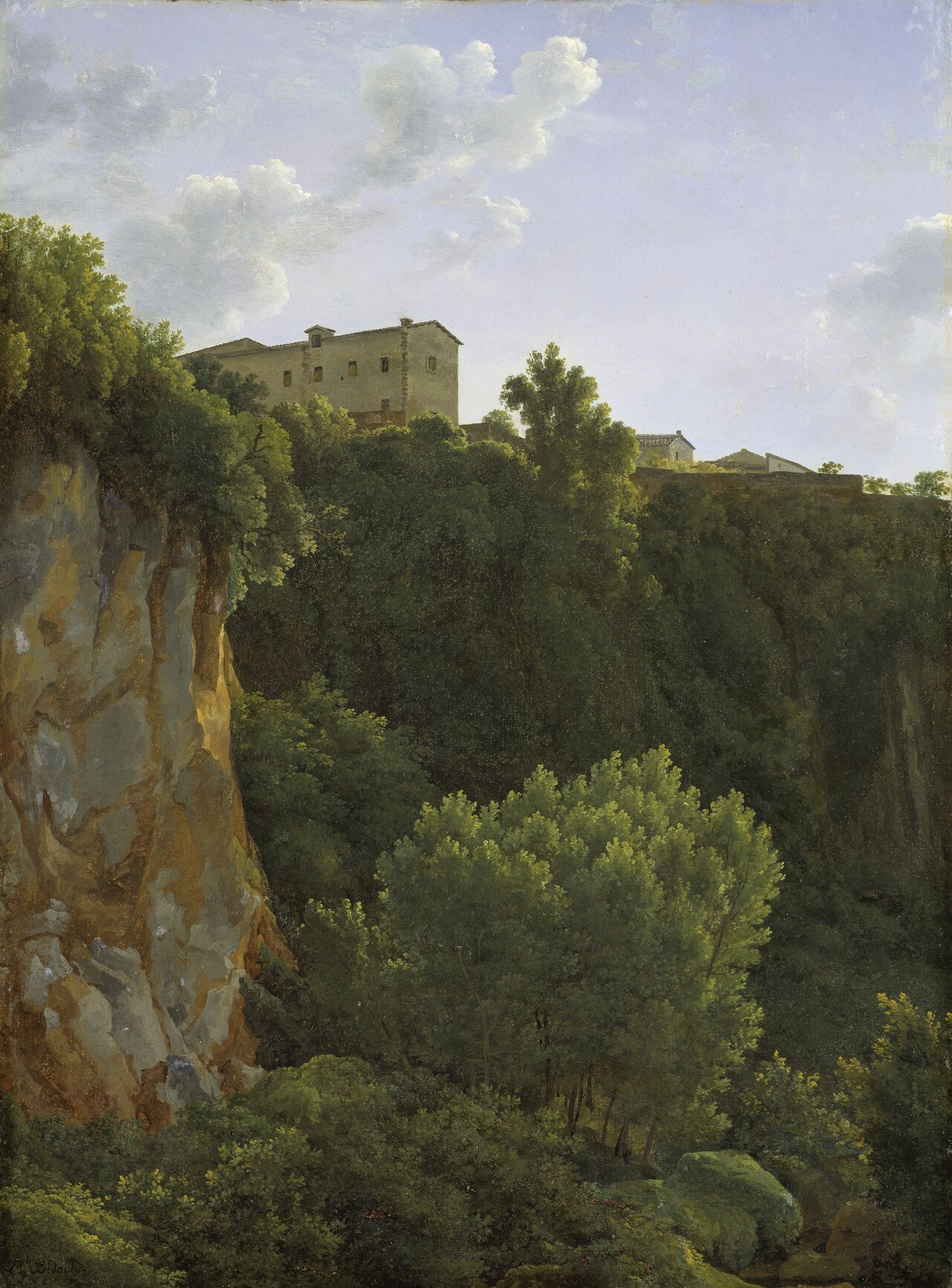
Career and style In Paris, Bidaud entered the circles of the Académie Royale and was influenced by the burgeoning interest in naturalistic landscape painting that characterised the late Ancien Régime. Though he never aligned himself with a specific movement, his work reflects the transition from the idealised pastoral scenes of the 18th century to the more empirical, topographical depictions that foreshadowed the Barbizon School. Bidaud’s style is characterised by a balanced composition, careful observation of light, and a muted palette that captures the atmospheric qualities of his subjects. He favoured a measured, almost scientific rendering of terrain, yet retained a lyrical quality that appealed to contemporary tastes for the picturesque.
His career spanned the turbulent years of the French Revolution, the Napoleonic era, and the Restoration. Throughout these periods, Bidaud maintained a steady output of landscapes, often commissioned by aristocratic patrons who sought visual records of their estates or of exotic locales they had visited on the Grand Tour. His ability to meld precise topographical detail with an aesthetic sensibility made his works popular among both private collectors and the emerging public exhibitions of the Salon.
Signature techniques Bidaud employed a range of techniques to convey depth and atmosphere. He typically began with a finely drawn under‑drawing, using charcoal or ink to map the major topographical features. Over this foundation, he layered thin washes of gouache or watercolour, allowing the underlying line work to remain visible. This method produced a subtle interplay between line and colour, giving his landscapes a sense of immediacy. In oil paintings, he favoured a limited palette of earth tones—ochre, umber, and sienna—combined with cooler blues and greens to render distant mountains and water surfaces. His handling of light often involved a soft, diffused illumination, suggesting early morning or late afternoon conditions, which enhanced the mood of tranquillity.
Bidaud also paid particular attention to atmospheric perspective, reducing colour saturation and contrast as elements receded into the background. This technique, coupled with careful rendering of foliage and rock formations, contributed to the realistic yet poetic quality of his scenes. In several of his works, he incorporated modest figures—travelers, shepherds, or fishermen—to provide a sense of scale and narrative without detracting from the landscape itself.
Major works Among Bidaud’s most notable paintings are a series of Italianate landscapes produced during his journeys to the Italian peninsula. **View of the Isle of Sora (1793)** captures the tranquil atmosphere of a small island in the Tiber River, with the gentle curve of the shoreline rendered in delicate washes of green and gold. The composition balances the island’s rocky outcrop against a sky streaked with soft clouds, exemplifying Bidaud’s skill in portraying water and light.
Gorge at Cività Castellana (1787) offers a dramatic depiction of a deep, shadowed gorge near the Roman suburb of Cività Castellana. Here, Bidaud’s use of chiaroscuro accentuates the rugged rock faces, while the limited colour palette of muted greys and earthy reds conveys the geological austerity of the landscape.
In Running Stream at San Cosimato (1788), the artist focuses on the dynamic movement of water, employing fine, sinuous strokes to suggest the stream’s flow through a verdant valley. The work demonstrates his capacity to render both stillness and motion within a single frame.
Lake Fucino and the Abruzzi Mountains (1789) presents a panoramic view of the former Lake Fucino, now drained, juxtaposed against the towering Abruzzi peaks. Bidaud’s composition foregrounds the flat basin of the former lake, with distant mountains rendered in pale blue, creating a sense of vastness and depth.
Later in his career, The Bridge at La Cava, Kingdom of Naples (1812) reflects his continued interest in southern Italian scenery. The painting depicts a stone bridge spanning a narrow gorge, framed by rugged cliffs and a bright Mediterranean sky. The work’s crisp architectural lines and warm colour temperature illustrate Bidaud’s mature style, where precise detail coexists with an atmospheric sense of place.
These works collectively demonstrate Bidaud’s commitment to documenting specific locales while maintaining a poetic sensibility that resonated with both his contemporaries and later audiences.
Influence and legacy Jean‑Joseph‑Xavier Bidaud’s legacy lies in his contribution to the development of French landscape painting at a time when the genre was gaining prominence. By integrating topographical accuracy with an aesthetic appreciation of nature, he helped bridge the gap between scientific illustration and artistic expression. His attention to atmospheric effects and his methodical approach to composition influenced younger artists who sought to portray the natural world with both fidelity and feeling.
Although Bidaud never achieved the fame of contemporaries such as Camille Corot or later Barbizon painters, his works remain valuable records of late‑18th‑ and early‑19th‑century European landscapes. They are held in several regional museums in France and Italy, where they are studied for their documentary value as well as their artistic merit. Scholars regard his paintings as early examples of the plein‑air sensibility that would later dominate French landscape art, making him a noteworthy, if understated, figure in the evolution of the genre.
Bidaud died in 1846 in Montmorency, a suburb of Paris, leaving behind a modest but respected body of work that continues to be referenced in discussions of early French landscape painting. His paintings are occasionally featured in exhibitions exploring the Grand Tour’s visual legacy, underscoring his role as a visual chronicler of the European countryside during a period of profound social and political change.
Frequently asked questions
Who was Jean‑Joseph‑Xavier Bidaud?
Jean‑Joseph‑Xavier Bidaud (1758–1846) was a French landscape painter from Carpentras who worked mainly in the late 18th and early 19th centuries, known for his topographically detailed scenes of Italy and southern France.
What artistic style or movement is Bidaud associated with?
Bidaud is not linked to a specific movement, but his work sits between the idealised pastoral tradition of the 18th century and the more naturalistic, observational landscape style that preceded the Barbizon School.
What are his most famous works?
His most recognised paintings include View of the Isle of Sora (1793), Gorge at Cività Castellana (1787), Running Stream at San Cosimato (1788), Lake Fucino and the Abruzzi Mountains (1789) and The Bridge at La Cava, Kingdom of Naples (1812).
Why is Bidaud significant in art history?
He contributed to the early development of French landscape painting by combining accurate topographical detail with atmospheric rendering, influencing later artists who pursued a more realistic depiction of nature.
How can I recognise a Bidaud painting?
Look for carefully drawn outlines, a muted earth‑tone palette, subtle atmospheric perspective, and a focus on specific geographic features such as rivers, gorges or bridges rendered with both precision and poetic light.