Jean Dubuffet
1901 – 1985
In short
Jean Dubuffet (1901–1985) was a French painter and sculptor who founded the Art Brut (outsider art) movement, rejecting academic standards in favour of raw, untrained expression. He is known for works such as Jardin d'émail (1974) and Monument au Fantôme (1983).
Notable works



Early life Jean Dubuffet was born on 31 July 1901 in the port city of Le Havre, France. He was the son of a middle‑class family; his father worked as a merchant. After completing secondary education, Dubuffet studied law in Paris and qualified as a solicitor, but his interest in drawing and painting persisted. In the early 1920s he began to attend ateliers and exhibitions, absorbing the vibrant atmosphere of the École de Paris while working as a tax collector to support himself.
Career and style Dubuffet’s first public exhibitions appeared in the late 1920s, but it was the post‑World War II period that defined his artistic direction. Disillusioned with the prevailing modernist ideals of beauty, he turned toward what he termed "low art" – the spontaneous, unmediated creations of children, psychiatric patients, and self‑taught makers. This stance led him to coin the term *art brut* (raw art) in 1945, positioning his work outside the conventional art market and academic discourse. Throughout the 1950s and 1960s Dubuffet cultivated a distinctive visual language characterised by thick impasto, earthy pigments, and an almost sculptural treatment of the canvas surface. He deliberately avoided polished finishes, preferring the tactile, the gritty, and the imperfect.
Signature techniques Dubuffet’s technique often involved layering coarse materials such as sand, gravel, and tar onto the support before applying pigment. He employed a method called *pierre collée*, in which fragments of stone or glass were adhered to the surface, creating a relief that blurs the line between painting and sculpture. His palette favoured muted ochres, umbers and whites, occasionally punctuated by vivid primary colours. Brushwork was typically gestural and uneven, producing a sense of immediacy that echoed the naïve drawings he admired. In sculpture, Dubuffet used welded steel, plaster and plaster of Paris, allowing him to render abstract, organic forms that echoed the textures of his paintings.
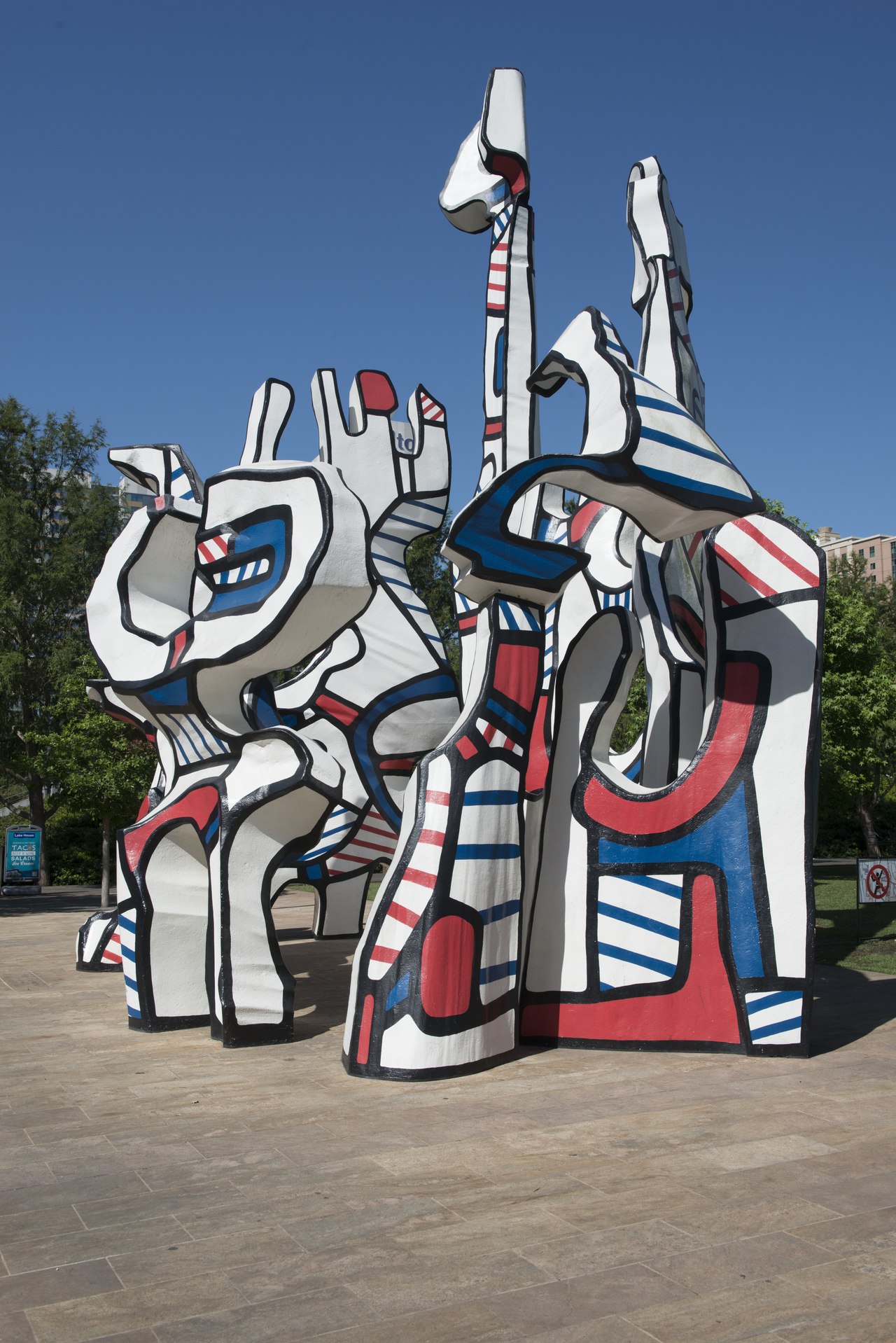
Major works - **Arbre biplan (1969)** – A large-scale sculpture made from welded steel and plaster, *Arbre biplan* exemplifies Dubuffet’s interest in the intersection of two‑dimensional drawing and three‑dimensional form. The piece resembles a tree rendered in abstract planes, its jagged edges and rough surfaces reflecting his rejection of smooth, classical sculpture. - **Jardin d’émail (1974)** – This public installation, situated in the Parc de la Villette, consists of a series of ceramic tiles and concrete forms that together create a whimsical garden space. The work’s enamel‑like surfaces, bright yet weathered colours, and irregular shapes embody Dubuffet’s fascination with everyday materials transformed into art. - **Monument au Fantôme (1983)** – Installed in the Musée d’Art Moderne de la Ville de Paris, the monument is a massive concrete structure with a cracked, matte finish. Its towering silhouette and ambiguous silhouette invite viewers to contemplate the invisible presence suggested by the title, a recurring theme in Dubuffet’s late work. - **Tour aux figures (1985)** – Completed shortly before his death, this tower‑like sculpture combines steel, plaster and painted surfaces. Its vertical thrust and repetitive abstract figures convey a sense of rhythmic movement, encapsulating Dubuffet’s lifelong exploration of the human figure in a non‑representational manner.
Influence and legacy Dubuffet’s advocacy for *art brut* reshaped the parameters of what could be considered art, paving the way for later outsider‑art collectors, curators and artists. His personal collection, the *Collection de l’art brut*, now housed in Lausanne, Switzerland, remains a seminal repository of works by self‑taught creators. Contemporary artists such as Anselm Kiefer, Jean-Michel Basquiat and the members of the Neo‑Expressionist movement have cited Dubuffet’s raw aesthetic as a key inspiration. In France, numerous public spaces and museums feature his sculptures, ensuring his presence in the urban landscape. Academic scholarship continues to examine his writings on aesthetics, and his legacy endures as a counter‑point to the polished modernist canon, reminding viewers of the value inherent in untrained, instinctive creativity.
Frequently asked questions
Who was Jean Dubuffet?
Jean Dubuffet (1901–1985) was a French painter and sculptor best known for founding the Art Brut, or outsider‑art, movement.
What style or movement is he associated with?
Dubuffet is associated with Art Brut, a style that celebrates raw, untrained expression and rejects conventional standards of beauty.
What are his most famous works?
Among his most recognised pieces are *Arbre biplan* (1969), *Jardin d’émail* (1974), *Monument au Fantôme* (1983) and *Tour aux figures* (1985).
Why does Dubuffet matter in art history?
He challenged the academic art system, legitimised the work of self‑taught creators, and influenced later avant‑garde and Neo‑Expressionist artists.
How can I recognise a Dubuffet artwork?
Look for thick, textured surfaces, earthy palettes, irregular forms and a deliberate roughness that blur the line between painting and sculpture.