Jean-Damascène Sallusti
1727 – 1781
In short
Jean‑Damascène Sallusti (1727–1781) was an Italian missionary‑artist who served as a court painter for the Qianlong Emperor in Qing‑era China, producing a series of battle and surrender scenes that blend European techniques with Chinese court aesthetics.
Notable works
.jpg)

.jpg)

Early life Jean‑Damascène Sallusti, also recorded in some missionary archives as Giovanni Damasceno, was born in Rome in 1727. Little is known about his family background, but he received a conventional artistic education in Italy, acquiring the fundamentals of drawing, composition, and the use of oil and tempera media that were standard in European workshops of the early eighteenth century. His early training would later prove essential when he travelled to China, where the visual language of the imperial court differed markedly from that of his native Europe.
In his early twenties, Sallusti entered the Society of Jesus, a Catholic order that maintained a network of missionaries across Asia. The Jesuits of the period were notable for their cultural accommodation policies, encouraging members to master local languages, customs, and artistic conventions. Sallusti’s mission assignment took him eastward, and after a period of preparation in Rome, he embarked for the Qing Empire, arriving in Beijing in the mid‑1750s.
Career and style Upon his arrival in the Chinese capital, Sallusti was quickly recognised by the imperial court for his artistic skill. The Qianlong Emperor (r. 1735‑1796) maintained a prolific workshop of court painters, many of whom were Chinese, but the emperor also valued the contributions of foreign artists who could bring novel techniques and perspectives. Sallusti secured a position within this atelier, where he was tasked with documenting military campaigns, diplomatic encounters, and ceremonial events.
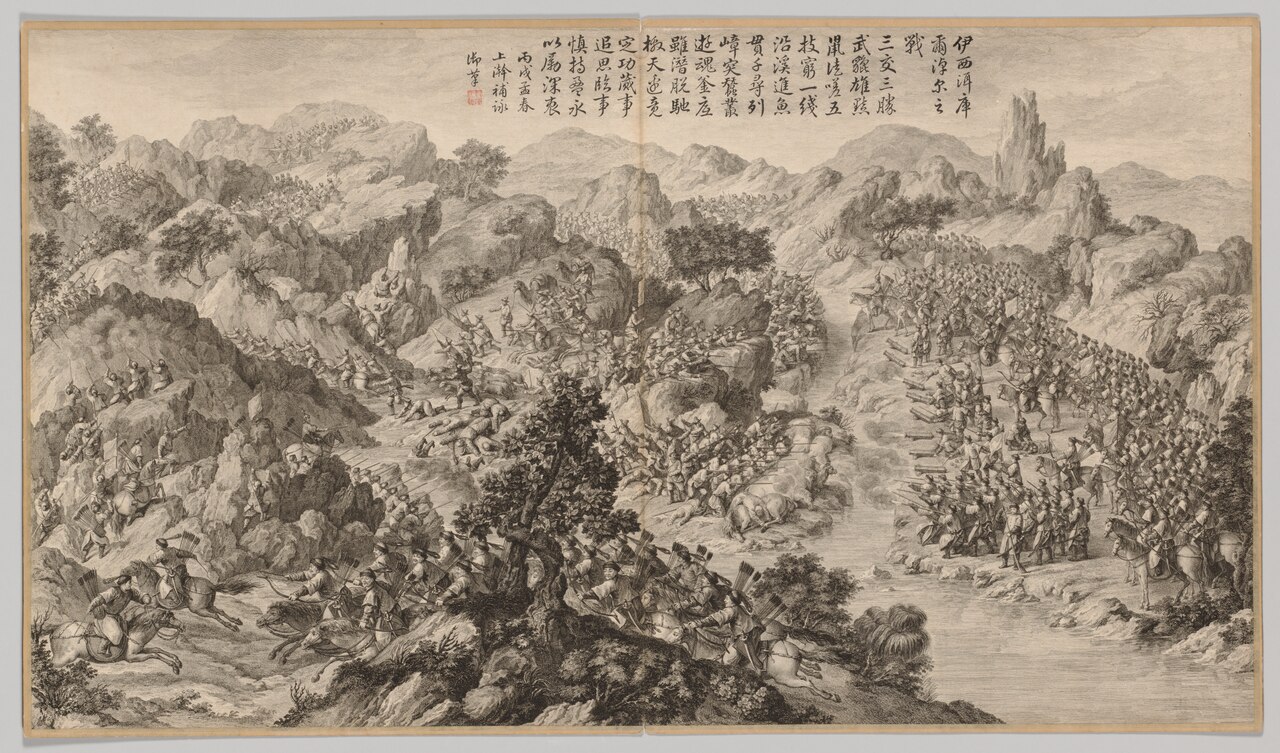
Sallusti’s style can be described as a hybrid of European realism and Chinese narrative composition. He employed a disciplined approach to perspective and anatomical accuracy derived from his European training, while integrating the fluid brushwork, ornamental detail, and compositional balance prized by Chinese court painters. This synthesis resulted in works that were both technically precise and aesthetically attuned to the tastes of the Qing court.
Signature techniques Sallusti’s paintings are characterised by several recurring technical choices:
* Linear perspective – Unlike many native Chinese works of the period, Sallusti often used a vanishing point to give depth to battlefield scenes, allowing viewers to discern the spatial relationships between troops, horses, and terrain. * Layered glazing – Borrowing from oil painting methods, he applied thin, translucent layers of pigment to achieve subtle modelling of light and shadow, particularly in the rendering of armour and fabric. * Ink‑wash outlines – To harmonise with Chinese conventions, Sallusti frequently employed ink washes to define the contours of figures, a technique that softened the rigidity of his European draftsmanship. * Narrative sequencing – Several of his works incorporate multiple vignettes within a single scroll, guiding the observer through a chronological sequence of events, a practice common in Chinese historical painting.
These techniques together created a distinctive visual language that was recognisable to both European and Chinese audiences.
Major works Sallusti’s surviving oeuvre is relatively limited, but the works that have been documented provide insight into his role as a chronicler of Qing military activity.
1. The Battle of Khurungui – This painting captures a decisive clash on the empire’s western frontier. Sallusti renders the combatants with disciplined formations, employing perspective to convey the chaos of the battlefield while preserving the emperor’s narrative authority. 2. The Chief of Us‑Turfan Surrendering his City – In this work, the chief is depicted kneeling before a Qing official, a scene that emphasizes the imperial power of benevolent conquest. Sallusti’s careful rendering of clothing and facial expression conveys both resignation and respect. 3. The Battle of Qurman (1770) – Dated to 1770, this canvas records a lesser‑known engagement. The composition is notable for its use of atmospheric clouds and a pronounced foreground that brings the viewer into immediate proximity with the combatants. 4. The Battle of Yesil‑kol‑nor (1772) – Completed two years later, the painting demonstrates an evolution in Sallusti’s handling of light, with a cooler palette that reflects the high‑altitude setting of the battle. 5. The Surrender of the Khan of Badakhsan (1772) – This work portrays the moment a regional Khan yields to Qing authority. Sallusti juxtaposes the Khan’s elaborate regalia with the understated robes of the Qing envoy, underscoring the cultural and political hierarchy.
Each of these pieces exemplifies Sallusti’s ability to balance documentary precision with the ornamental sensibilities of the imperial court, providing a visual record that served both historical and propagandistic purposes.
Influence and legacy Although Sallusti’s name is not as widely recognised as that of some contemporaneous Chinese painters, his contributions had a lasting impact on the visual culture of the Qing court. By introducing European techniques of perspective and glazing, he helped broaden the stylistic repertoire available to imperial workshops. Later court painters, both Chinese and foreign, incorporated elements of his approach, particularly in the rendering of military subjects.
Beyond the court, Sallusti’s works have become valuable primary sources for historians studying Qing expansion in Central Asia. The specificity of his battle scenes offers insight into the composition of armies, the appearance of weaponry, and the geography of contested regions during the mid‑eighteenth century.
In modern scholarship, his paintings are examined as examples of cultural exchange, illustrating how missionary artists negotiated their dual identities as religious emissaries and courtly creators. While the precise details of his later life remain obscure, records indicate that he remained in Beijing until his death in 1781, where he was interred according to Jesuit customs.
Today, reproductions of Sallusti’s paintings are housed in Chinese imperial collections and occasionally appear in exhibitions of Sino‑European artistic interaction. Their enduring appeal lies in their capacity to convey a moment of cross‑cultural dialogue, encapsulating both the grandeur of the Qianlong court and the technical virtuosity of an Italian artist far from his homeland.
Frequently asked questions
Who was Jean‑Damascène Sallusti?
Jean‑Damascène Sallusti (1727–1781) was an Italian Jesuit missionary who became a court painter for the Qianlong Emperor in Qing‑era China, producing works that combined European realism with Chinese court aesthetics.
What artistic style or movement is Sallusti associated with?
Sallusti worked in a hybrid style that fused European techniques such as linear perspective and layered glazing with traditional Chinese brushwork and narrative composition, rather than belonging to a specific European movement.
What are his most famous works?
His most noted paintings include *The Battle of Khurungui*, *The Chief of Us‑Turfan Surrendering his City*, *The Battle of Qurman* (1770), *The Battle of Yesil‑kol‑nor* (1772) and *The Surrender of the Khan of Badakhsan* (1772).
Why is Sallusti important in art history?
He introduced European perspective and glazing to the Qing imperial workshop, providing a visual record of mid‑eighteenth‑century military campaigns and exemplifying the cultural exchange between Europe and China.
How can I recognise a painting by Sallusti?
Look for battle scenes that combine accurate anatomical detail and perspective with Chinese ink‑wash outlines, a subtle glazing of colours, and a narrative layout that guides the viewer through multiple vignettes.