Jean Bérain the Elder
1640 – 1711
In short
Jean Bérain the Elder (1640–1711) was a French draughtsman, designer, painter and engraver whose ornamental designs defined the visual language of the French court in the Baroque era. He directed the royal Menus‑Plaisirs, creating elaborate stage sets, ceremonial décor and decorative motifs that prefigured the Rococo style.
Notable works


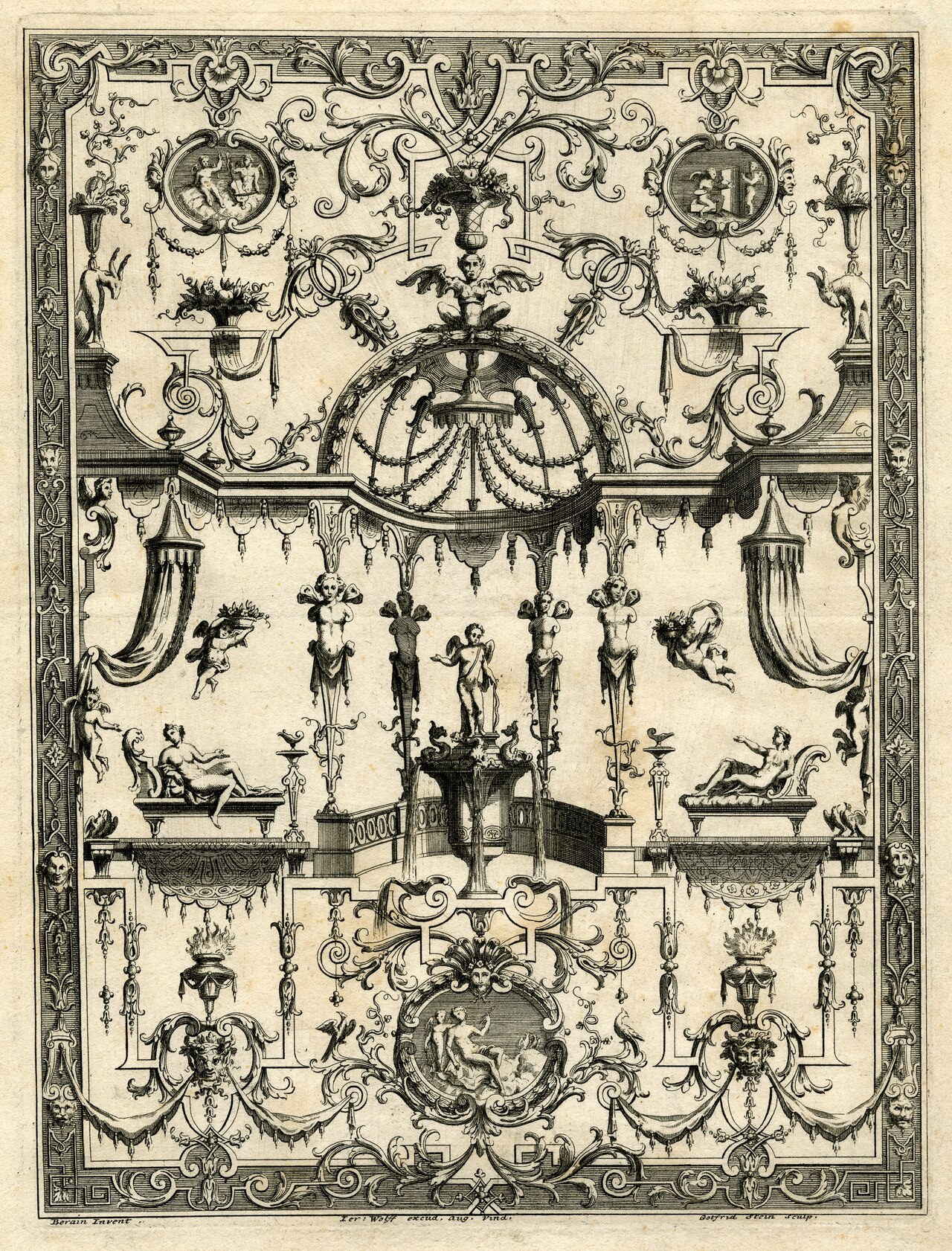

Early life Jean Bérain the Elder was born in 1640 in the town of Saint‑Mihiel, in the Lorraine region of France. Little is recorded about his family background, but he entered the artistic world of Paris as a young man, attracted by the vibrant court culture that was flourishing under Louis XIV. Bérain received training as a draughtsman and engraver, mastering the fine line work and ornamental vocabulary that would become his hallmark.
Career and style By the late 1660s Bérain had secured a position within the royal administrative body known as the Menus‑Plaisirs du Roi. This office was responsible for the visual aspects of court spectacles—festivals, funerals, theatrical productions, and temporary architectural installations. Unlike the Bâtiments du Roi, which handled permanent royal building projects, the Menus‑Plaisirs focused on transient décor, and Bérain became its chief designer.
Bérain’s style is characterised by a lightness of arabesque, intricate grotesques, and a playful synthesis of classical motifs with fanciful ornament. His designs blended the disciplined classicism of the French Baroque with a lyrical, almost whimsical sensibility that would later inform the Régence style and, ultimately, the Rocaille and European Rococo movements. The term “Bérainesque” came to denote this distinctive ornamental language, marked by flowing foliage, interlaced scrolls, and stylised figures that seem to float on the surface of a design.
Signature techniques Bérain worked primarily as a draughtsman, producing detailed pen‑and‑ink drawings that could be transferred onto a variety of media. His engravings were executed with fine hatching, allowing subtle gradations of tone that enhanced the delicacy of his patterns. He frequently employed a modular approach, creating repeatable motifs that could be re‑arranged to fill large decorative panels, ceilings, or stage sets. The precision of his line work made his designs ideal for translation into tapestry, furniture carving, and interior decoration.
Another hallmark of Bérain’s technique was his use of perspective to suggest architectural depth in flat surfaces. In ceiling designs, for example, he would draw trellised frameworks that appear to recede into space, populated by seated figures or mythological beings that add narrative interest. This combination of ornamental flourish with illusionistic perspective became a defining feature of French court décor in the late seventeenth century.
Major works - **Orgue, basilique Saint‑Quentin** – Bérain supplied the ornamental programme for the organ case in the Saint‑Quentin basilica. His design integrated carved arabesques with painted figures, creating a harmonious blend of music, architecture, and decorative art that exemplifies his ability to adapt his style to ecclesiastical settings. - **1/48th‑scale model of “Ambitieux”, unbuilt project (2003)** – Although the original design dates from Bérain’s lifetime, a miniature model was produced in 2003 to illustrate his unexecuted architectural concepts. The model demonstrates Bérain’s visionary approach to monumental design, showing how his ornamental vocabulary could be applied to grand civic schemes. - **An Elaborate Ceiling with Trellises and Seated Figures (1700)** – Executed for a royal residence, this ceiling showcases Bérain’s mastery of spatial illusion. The trellised framework creates a lattice of depth, while the seated figures, rendered in a graceful, almost theatrical pose, add narrative movement to the overall composition. - **Ornament designs (1800)** – Published posthumously, these engraved sheets collected Bérain’s ornamental motifs. They served as reference material for craftsmen throughout the eighteenth century, influencing decorative programmes in furniture, metalwork, and interior design. - **“Chinoise”. Costume sketch** – Reflecting the growing fascination with exotic cultures, Bérain produced a sketch of a Chinese costume. The drawing combines his characteristic arabesque detailing with an imaginative interpretation of foreign dress, illustrating his versatility and the court’s appetite for theatrical spectacle.
Influence and legacy Jean Bérain the Elder’s impact on French decorative arts extended far beyond his lifetime. His ornamental language shaped the visual identity of the French court during the final decades of Louis XIV’s reign and set the stage for the more exuberant Rococo that flourished under Louis XV. The “Bérainesque” style was disseminated through engravings, pattern books, and the work of his son, Jean Bérain the Younger, who continued the family workshop.
Through the Menus‑Plaisirs, Bérain’s designs reached a wide audience, influencing not only architects and painters but also furniture makers, tapestry weavers, and stage designers across Europe. The light arabesques and playful grotesques that he popularised became a common visual shorthand for elegance and refinement in aristocratic interiors. Moreover, his systematic approach to ornamental design—creating modular, repeatable motifs—anticipated the industrial design practices that would emerge in later centuries.
Today, Bérain is recognised as a pivotal figure in the transition from the austere classicism of the early Baroque to the decorative exuberance of the Rococo. His surviving drawings and engravings are held in major museum collections, and his influence continues to be studied by scholars of Baroque and decorative arts. By bridging the worlds of theatrical spectacle and permanent decoration, Jean Bérain the Elder helped define the aesthetic of an entire era, leaving a legacy that endures in the ornamental vocabulary of Western art.
Frequently asked questions
Who was Jean Bérain the Elder?
Jean Bérain the Elder (1640–1711) was a French draughtsman, designer, painter and engraver who led the decorative design work for the royal Menus‑Plaisirs du Roi.
What artistic movement or style is he associated with?
He worked in the Baroque period and created a distinctive ornamental style that foreshadowed the Régence and Rococo movements.
What are his most famous works?
Key works include the organ case at Saint‑Quentin, an elaborate ceiling with trellises and seated figures (1700), his published ornament designs, a miniature model of the unbuilt ‘Ambitieux’ project, and a Chinese costume sketch.
Why is Jean Bérain the Elder important in art history?
His ornamental designs defined the visual language of the French court, influencing decorative arts across Europe and paving the way for the Rococo style.
How can I recognise a Bérain design?
Look for light, interlaced arabesques, playful grotesques, finely hatched line work, and a modular pattern that often incorporates trellised frameworks and elegant seated figures.