Jean Baptiste Madou
1796 – 1877
In short
Jean‑Baptiste Madou (1796–1877) was a Belgian painter and lithographer known for his detailed genre scenes and illustrations, produced mainly in the mid‑19th century. He worked in Brussels, creating works such as A Draughtsman in a Tavern (1842) and De voorlezer (1862), and left a lasting imprint on Belgian visual culture.
Notable works


_(fr.t._demande_et_mariage)_-_SA_11_-_Amsterdam_Museum.jpg)
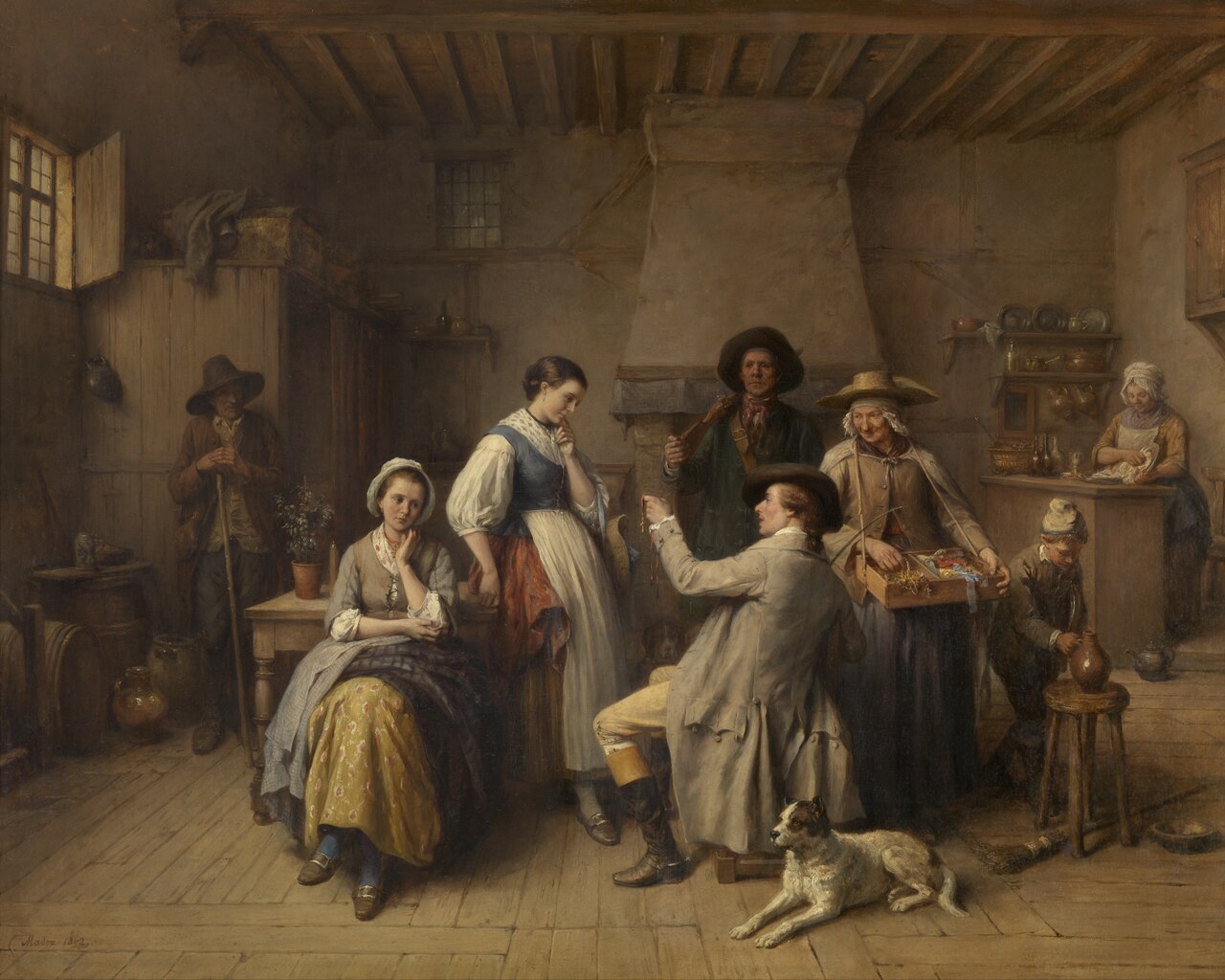
Early life Jean‑Baptiste Madou was born in 1796 in the Brussels metropolitan area, at a time when the region was undergoing political and cultural transformation following the French Revolutionary Wars. Little is recorded about his family background, but he grew up in a city that was becoming a centre for artistic training and publishing. Early exposure to the bustling streets, markets, and taverns of Brussels would later inform the everyday subjects that dominate his oeuvre.
Career and style Madou began his professional life as a draughtsman and illustrator, a common entry point for artists seeking commissions in the expanding print market of the 1820s and 1830s. He quickly developed a reputation for precise, lively renderings of contemporary life, often infused with a subtle narrative quality. While he is not formally linked to a specific avant‑garde movement, his work aligns with the broader European tradition of genre painting, which celebrated ordinary people and domestic scenes. Throughout the 1840s and 1850s Madou produced a series of lithographs that were widely circulated, allowing his images to reach an audience beyond the walls of galleries.
In the 1860s he turned increasingly toward watercolour and oil, yet his graphic sensibility remained evident. The consistency of his visual language—careful composition, clear line, and an eye for anecdotal detail—created a recognizable brand that appealed to both bourgeois patrons and the emerging middle‑class market for affordable art.
Signature techniques Madou’s technical hallmark was his mastery of lithography, a print‑making process that enabled fine tonal gradations and crisp outlines. He often employed a delicate hatching technique to suggest texture, especially in fabrics and wooden surfaces. In his drawings, he favoured a restrained palette, allowing the subject matter to convey narrative weight without the distraction of vivid colour. When working in watercolour, he layered washes to achieve depth, a method that echoed the tonal subtleties of his earlier prints. Across media, his compositions are characterised by a balanced placement of figures within interior or landscape settings, creating a sense of intimacy and immediacy.
Major works - **A Draughtsman in a Tavern (1842)** – This lithograph captures a cramped, dimly lit tavern where a solitary artist sketches the surrounding patrons. The work exemplifies Madou’s interest in the creative process itself, as well as his skill in rendering atmospheric light. - **Een stroper, door eenen boschwachter en eenige boeren aangehouden (1840)** – Translating to “A poacher, apprehended by a forest guard and some peasants,” the piece presents a dramatic moment of rural law enforcement. Madou’s careful attention to clothing and gestures provides a vivid snapshot of 19th‑century Flemish countryside life. - **De voorlezer (1862)** – Meaning “The Reader,” this composition depicts a woman absorbed in a book, surrounded by domestic objects. The work reflects Madou’s later focus on quiet, introspective moments and showcases his refined watercolour technique. - **Vrijage (1850)** – A marriage scene rendered in lithography, where the bride and groom are surrounded by well‑dressed guests. The piece is notable for its elegant figures and the subtle commentary on social ceremony. - **Courtesy (1862)** – This work illustrates a gentleman offering his arm to a lady, a gesture of polite conduct. Madou’s precise line work captures the refined manners of the period, reinforcing his reputation as a chronicler of contemporary etiquette.
These works collectively illustrate Madou’s range—from bustling public interiors to private domestic moments—while maintaining a consistent visual vocabulary.
Influence and legacy Jean‑Baptiste Madou’s legacy rests on his contribution to the visual documentation of Belgian society in the first half of the 19th century. By marrying narrative content with technical proficiency, he provided later Belgian artists with a model for integrating everyday subjects into fine art. His lithographs, in particular, helped popularise the genre scene beyond elite circles, influencing the burgeoning market for illustrated books and periodicals. While his name is less prominent in contemporary museum narratives, his works are preserved in national collections and continue to be cited in studies of Belgian print culture. Madou’s ability to capture the nuances of social interaction—whether in a tavern, a courtroom, or a domestic parlour—offers historians a valuable visual record of a transformative era.
Today, scholars appreciate Madou for his documentary clarity and his role in bridging the gap between academic painting and the emerging commercial art of the industrial age. His works remain a touchstone for those exploring the visual language of 19th‑century Belgium, and his prints continue to be exhibited and reproduced for both academic and public audiences.
Frequently asked questions
Who was Jean‑Baptiste Madou?
Jean‑Baptiste Madou (1796–1877) was a Belgian painter and lithographer known for detailed genre scenes that depict everyday life in 19th‑century Belgium.
What style or movement is Madou associated with?
Madou is not tied to a single avant‑garde movement; his work belongs to the broader tradition of genre painting and printmaking, emphasizing realistic, narrative depictions of ordinary people.
What are his most famous works?
Key works include A Draughtsman in a Tavern (1842), Een stroper, door eenen boschwachter en eenige boeren aangehouden (1840), De voorlezer (1862), Vrijage (1850) and Courtesy (1862).
Why does Madou matter in art history?
He documented Belgian social life with technical skill, influencing later artists and expanding the market for illustrated prints, thereby bridging academic art and commercial publishing.
How can I recognise a Madou piece?
Look for crisp lithographic lines, balanced compositions of interior or rural scenes, subtle tonal washes, and a focus on narrative moments that reveal everyday customs.