Jean-Augustin Franquelin
1798 – 1839
In short
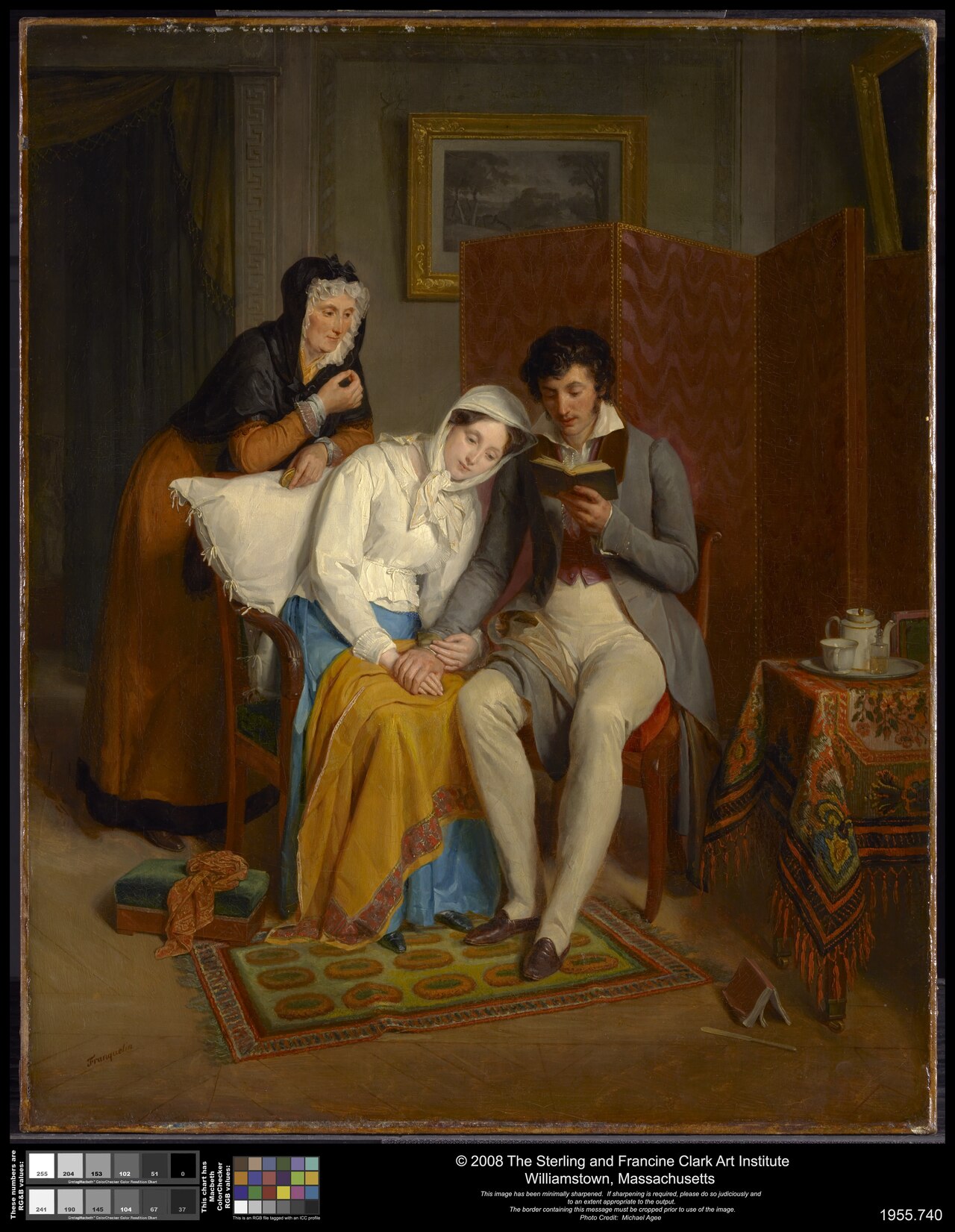
Jean-Augustin Franquelin (1798–1839) was a French painter born and died in Paris, taught by Jean‑Baptiste Regnault, whose oeuvre includes domestic and public scenes such as Reading to the Convalescent (1827) and The Attendant (1839). Though his precise movement is unclear, his work was widely copied and his pieces are held in institutions like Versailles.
Notable works


Early life Jean‑Augustin Franquelin was born in Paris in 1798, a period when the French capital was still recovering from the Revolutionary upheavals and the Napoleonic wars. Little is recorded about his family background, but the city’s vibrant artistic milieu provided ample opportunity for a young talent to find mentorship. Franquelin entered the atelier of the established painter Jean‑Baptiste Regnault, a leading figure of the Neoclassical tradition. Under Regnault’s guidance, Franquelin received rigorous training in drawing, composition, and the disciplined handling of colour that were hallmarks of academic art in the early nineteenth century.
Career and style Franquelin began exhibiting his work in the 1820s, a decade marked by the rise of Romanticism and a renewed interest in genre painting that captured everyday life. While he never aligned himself formally with a specific movement, his paintings demonstrate a synthesis of academic technique and the softer, narrative focus characteristic of genre scenes. The artist favoured subjects drawn from public and domestic settings—intimate conversations, moments of care, and quiet contemplation. This approach resonated with contemporary audiences who sought relatable, emotive images after the turbulence of the previous era.
His style is marked by careful draftsmanship inherited from his Regnault training, combined with a warm palette that softens the often stark realism of earlier academic works. Franquelin’s compositions are balanced, often employing a modest number of figures placed within a clearly defined space, allowing the narrative to unfold without unnecessary ornamentation. Though the precise critical reception of his work during his lifetime is sparsely documented, the fact that his paintings were frequently copied suggests a degree of popularity and accessibility.
Signature techniques Several technical hallmarks distinguish Franquelin’s paintings:
1. Controlled chiaroscuro – He uses subtle contrasts of light and shadow to model forms, giving his figures a three‑dimensional presence while maintaining a gentle overall tone. 2. Delicate brushwork – In areas such as foliage, textiles, and skin, Franquelin applies thin, almost translucent layers of paint that lend a sense of immediacy and texture. 3. Narrative framing – Many of his works are framed by architectural or natural elements that guide the viewer’s eye toward the central interaction, a technique that heightens the storytelling aspect of the piece. 4. Colour harmony – Rather than relying on dramatic colour juxtapositions, he favours muted earth tones punctuated by occasional accents—such as a red ribbon or a blue garment—to draw attention to focal points.
Major works Franquelin’s catalogue, though not extensive, includes several paintings that exemplify his thematic interests and technical skill.
- Self‑Portrait (1820) – Executed when the artist was in his early twenties, this work reveals his confidence in handling the human form. The portrait presents Franquelin in a modest studio setting, his gaze directed toward the viewer, conveying both introspection and professional poise. - Evirchoma (1824) – Though the title’s meaning is obscure, the painting portrays a tranquil interior scene, possibly a domestic interior, where a figure is engaged in a quiet activity. The composition showcases Franquelin’s ability to render light filtering through a window, creating a serene atmosphere. - Reading to the Convalescent (1827) – This work captures a tender moment of care, with a young woman reading aloud to a bedridden patient. The delicate rendering of the figures’ expressions and the soft lighting underscore the compassionate narrative, making it one of his most frequently reproduced pieces. - The Leafs of Willow (1834) – In this landscape‑type composition, Franquelin turns his attention to nature, depicting willow branches swaying over a water surface. The painting demonstrates his skill in portraying foliage with a sense of movement, while maintaining the subtle colour palette that defines his oeuvre. - The Attendant (1839) – Completed the year of his death, this painting revisits the theme of service and care. An attendant is shown preparing a room, perhaps in a hospital or a domestic household, highlighting Franquelin’s continued interest in everyday labour and its quiet dignity.
Beyond these works, the Occupation of Brissac, housed in the Palace of Versailles, further illustrates his capacity to handle historical subjects. While less is known about this piece, its presence in a royal collection indicates official recognition of his talent.
Influence and legacy Jean‑Augustin Franquelin’s career was relatively brief, ending with his death in Paris in 1839, yet his paintings left a modest imprint on French genre painting. By bridging the disciplined approach of Neoclassicism with the emergent desire for relatable, narrative scenes, he contributed to a transitional aesthetic that would later be embraced by Realist painters. His works were copied by contemporaries and students, suggesting that his visual language provided a useful model for artists seeking to depict intimate, domestic moments with technical assurance.
Although he did not found a school or movement, Franquelin’s paintings remain of interest to scholars tracing the evolution of genre painting in early nineteenth‑century France. The presence of his works in public collections, including Versailles, ensures that his contributions are accessible for study and appreciation. Contemporary exhibitions on French art of the period occasionally feature his pieces to illustrate the breadth of artistic practice beyond the more celebrated Romantic masters.
In sum, Franquelin’s legacy lies in his skillful synthesis of academic technique and narrative warmth, offering a window into the everyday lives of his contemporaries while maintaining the compositional rigour of his training.
Frequently asked questions
Who was Jean‑Augustin Franquelin?
Jean‑Augustin Franquelin (1798–1839) was a French painter from Paris, trained by Jean‑Baptiste Regnault, known for genre scenes that depict everyday domestic and public moments.
What artistic style or movement is Franquelin associated with?
Franquelin did not belong to a defined movement; his work blends Neoclassical technique with the narrative focus of early‑nineteenth‑century French genre painting.
What are his most famous works?
His best‑known paintings include Reading to the Convalescent (1827), The Attendant (1839), The Leafs of Willow (1834), Evirchoma (1824), and his Self‑Portrait (1820).
Why is Franquelin important in art history?
He exemplifies the transition from strict academic art to more intimate, story‑driven genre painting, influencing later Realist artists and providing a valuable record of early‑19th‑century French daily life.
How can I recognise a Franquelin painting?
Look for balanced compositions, gentle chiaroscuro, a muted colour palette with occasional colour accents, and subjects that centre on quiet, domestic scenes or modest public interactions.