Jan Stobbaerts
1838 – 1914
In short
Jan Stobbaerts (1838–1914) was a Belgian painter and printmaker noted for his realistic depictions of rural life, animals and everyday subjects. Working in a dark‑brown palette and a forceful style, he helped pioneer Realism and an indigenous form of Impressionism in Belgium.
Notable works
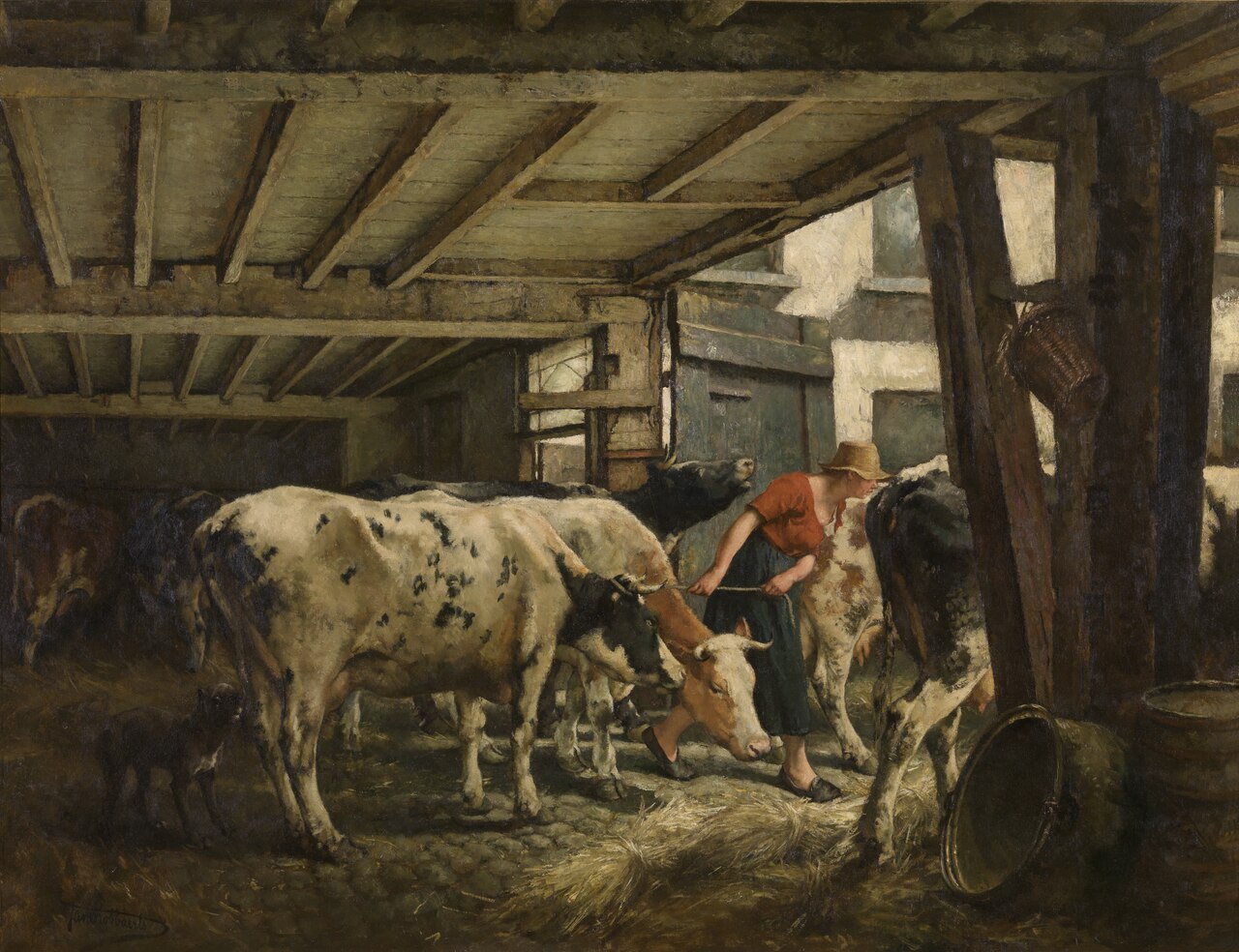


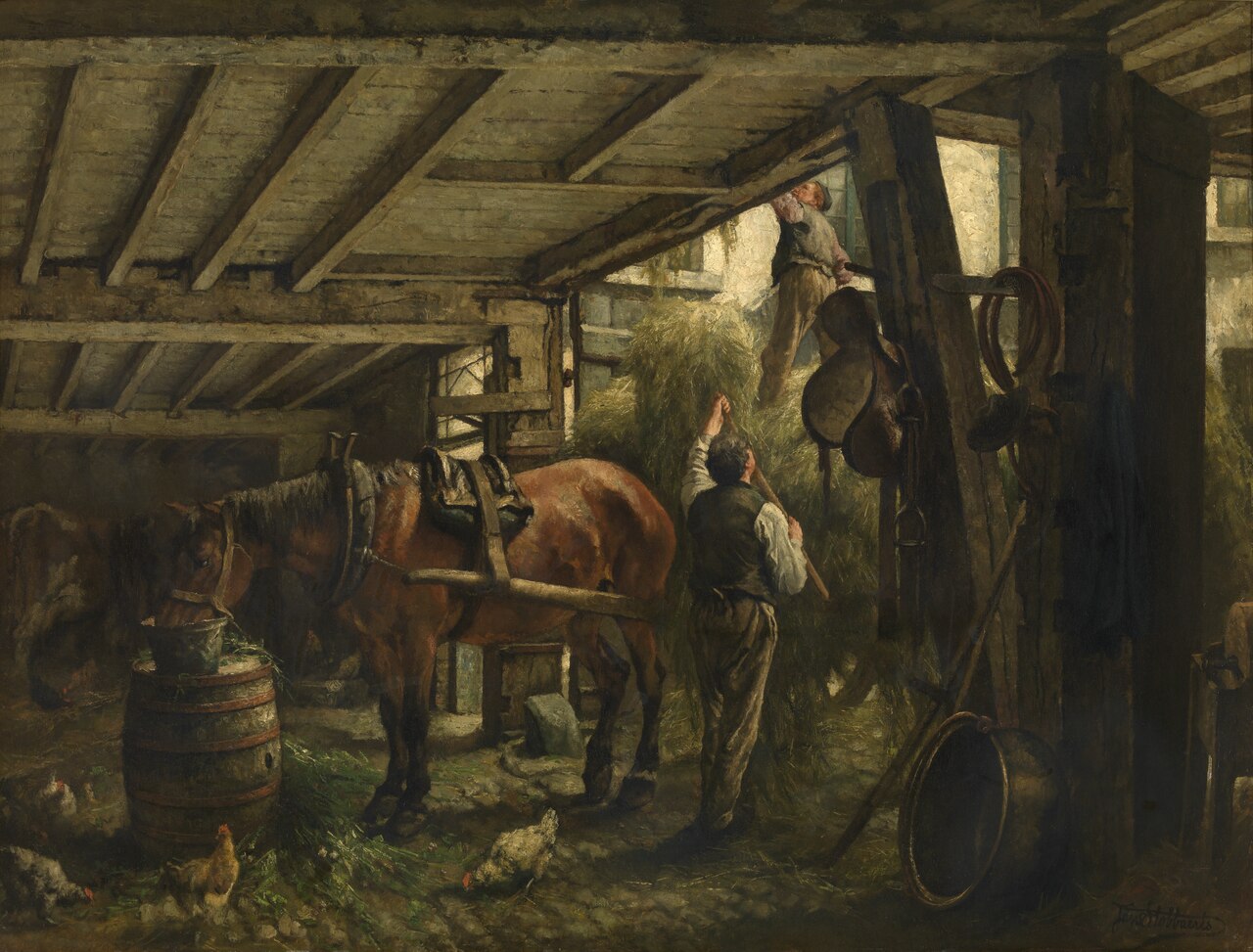

Early life Jan‑Baptist Stobbaerts was born in 1838 in Antwerp, a city with a long tradition of artistic training. His family was modest, and he was drawn to drawing from an early age, often sketching the bustling markets and livestock that surrounded his neighbourhood. He enrolled at the Royal Academy of Fine Arts in Antwerp, where he received formal instruction in drawing and composition. The academy’s emphasis on academic drawing provided him with a solid technical foundation, while the vibrant commercial life of the city exposed him to the everyday scenes that would later dominate his oeuvre.
Career and style After completing his studies, Stobbaerts set up a modest studio in Antwerp and began to exhibit at local salons. His early works show the influence of the Belgian Romantic tradition, but he quickly turned toward a more sober realism, focusing on the unvarnished truth of rural labour, animal behaviour and domestic interiors. By the 1860s he was experimenting with a limited, earth‑toned palette dominated by dark browns and muted greens, a choice that heightened the tactile quality of his canvases.
Stobbaerts’ style is characterised by a direct, almost confrontational handling of subject matter. He rejected idealised compositions in favour of scenes that ordinary viewers might encounter on a farm or in a workshop. This approach placed him at the forefront of a Belgian Realist movement that sought to portray the nation’s own landscapes and people without romantic exaggeration. At the same time, his handling of light and colour anticipated the autochthonous Impressionism that would emerge in Belgium in the 1880s, making him a bridge between two major artistic currents.
Signature techniques Stobbaerts employed several technical strategies that set his work apart. He favoured a thick impasto, applying paint in dense layers that gave his surfaces a palpable texture, especially in depictions of fur and foliage. His use of chiaroscuro was restrained but purposeful: strong contrasts between illuminated and shadowed areas enhanced the three‑dimensionality of his figures while preserving the overall muted tonal scheme.
In printmaking, he worked mainly with etching, translating his painterly concern for line and tone onto paper. His prints often retained the same earthy palette as his paintings, achieved through careful inking and selective wiping. The combination of painterly brushwork and graphic precision made his prints valuable complements to his canvases.
Major works - **Leaving the Barn (1886)** – This canvas captures a moment of agricultural labour as workers exit a dimly lit barn. The composition is anchored by a massive wooden door, through which a shaft of light falls on a group of figures and a horse‑drawn cart. Stobbaerts’ dark‑brown tones emphasize the gritty reality of the scene, while his handling of the horse’s musculature demonstrates his skill in animal anatomy.
- Dogs (1886) – A study of two dogs at rest, this work showcases Stobbaerts’ ability to render fur with tactile precision. The animals are positioned against a muted backdrop, allowing the viewer to focus on the subtle variations of colour and texture that suggest both the heat of the day and the weight of their coats.
- The Sculptor Robert Fabri (1885) – In this portrait, Stobbaerts depicts his contemporary, the sculptor Robert Fabri, at work in a modest studio. The painting is notable for its restrained colour scheme and the way the artist’s tools are rendered with the same dignity as the figure himself, reinforcing the theme of honouring the everyday labour of creation.
- Haycart – Though less documented, the Haycart composition follows the same realist approach, presenting a simple wooden cart loaded with hay against a rural backdrop. The emphasis on the weathered wood and the play of shadow underscores Stobbaerts’ preoccupation with texture and the passage of time.
- Bath of Roses (1886) – This still‑life diverges from his usual genre scenes, focusing instead on a vase of roses bathed in soft light. Even here, his palette remains subdued, allowing the delicate pinks of the flowers to emerge without overwhelming the composition. The work illustrates his capacity to balance colour and form while maintaining his characteristic tonal restraint.
Influence and legacy Jan Stobbaerts’ dedication to realistic subject matter and his restrained, earth‑toned palette left a lasting imprint on Belgian art. By treating humble rural scenes with the same seriousness afforded to historical or mythological subjects, he broadened the scope of acceptable artistic content in the late 19th‑century Belgian academies. His willingness to experiment with texture and light paved the way for younger artists who would fully embrace Impressionist techniques, particularly those working in Brussels and Antwerp.
His paintings and prints entered the collections of several national museums, most notably the Royal Museum of Fine Arts Antwerp, where they continue to be displayed as exemplars of Belgian Realism. Art historians credit Stobbaerts with helping to define a distinctly Belgian approach to Impressionism—one that maintained a strong link to local colour, light and everyday life rather than adopting a purely French model.
In contemporary scholarship, Stobbaerts is recognised not only for his technical skill but also for his role as a cultural documentarian. His works provide valuable visual records of rural Belgian life in the late 19th century, preserving details of clothing, architecture and agricultural practices that might otherwise have been lost. As a result, his oeuvre is studied both for its artistic merit and for its contribution to social history.
Overall, Jan Stobbaerts stands as a pivotal figure who straddled the line between Realism and the emerging Impressionist sensibility, leaving a legacy that continues to inform the study of Belgian art and its development within the broader European context.
Frequently asked questions
Who was Jan Stobbaerts?
Jan Stobbaerts (1838–1914) was a Belgian painter and printmaker known for realistic depictions of animals, rural labour and everyday scenes.
What artistic style or movement is he associated with?
He is linked to Realism and an indigenous Belgian Impressionism, combining dark‑brown tonalities with a forceful, truthful representation of ordinary subjects.
What are his most famous works?
Key works include *Leaving the Barn* (1886), *Dogs* (1886), *The Sculptor Robert Fabri* (1885), the *Haycart* composition, and the still‑life *Bath of Roses* (1886).
Why is Jan Stobbaerts important in art history?
He helped expand the accepted subject matter of Belgian art, pioneering a realistic approach that influenced later Impressionists and providing valuable visual documentation of 19th‑century Belgian life.
How can I recognise a painting by Jan Stobbaerts?
Look for a muted, earth‑toned palette, thick impasto texture, careful rendering of animal fur or rustic material, and a focus on everyday, often agricultural, scenes.